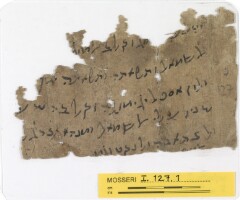
Collection of liturgical poems: (a) ahava, beginning: רבתי שמחי כמ[...] זמניי with an alphabetical acrostic ר-ת (recto); (b) a zulat headed by אמת זלות probably for the intermediate Šabbat of Passover or Sukkot. Arabic jottings in margin on recto.
Recto: prescription mentioning medicinal substances and their measures. Verso, written transversely in relation to recto, contains an Arabic document and, inverted in relation to the Arabic, the continuation of the prescription from recto.
Recto: abridged piyyuṭim, separated by horizontal lines, and with acrostics: 4 spelling Judah, 2 Isaac and 1 Abraham. Verso: a medical prescription in Arabic, with a Hebrew liturgical text in the margin.
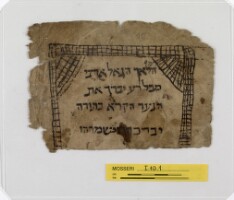
Recto: benediction המלאך הגאל for a boy reading the Torah. Verso: the Arabic word عنز, ‘goat’, written repeatedly to form a circle of text and a few Hebrew letters.
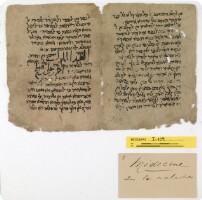
Pages of a medical work, dealing with different kinds of illnesses and their causes, including fever. On f. 2r there is some Arabic written in larger letters: al-ʿAbd al-Mamlūk Aḥmad b. ʿAlī b. Ṣaliḵ.
Letter from Ḥayy Gaʾon to Sahlān b. Abraham, dated 1349 of the Seleucid era (= 1037 CE). The continuation is inverted on verso, with an address in Hebrew and Arabic script. Edited by Gil (1997: II 123-7).
Letter addressing Abū Sahl, and his family, and Abū Manṣūr, and referring, among others to an elder, Barakāt and his son, Abū Faḍl (in Arabic script), and Abū Ḥajjāj Joseph.