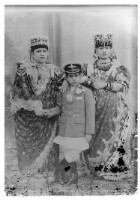
A boy siting at the garden in Singha Mahal. Singha Mahal at Thapathali, the former residence of General Singha Shamsher, son of Prime Minister Chandra Shamsher, was built in 1919. Today it belongs to the Nepal Rastra Bank.
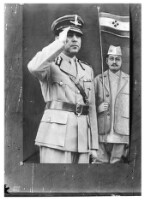
King Tribhuvan with the Nepali Congress flag in the background. King Tribhuvan became King at the age of 5 on 2 February 1911. He was king until 1955. He is known as the "father of democracy" who ended the 104 year Rana rule and introduced multi-party system.
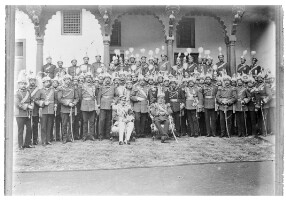
King Tribhuvan (center) with his sons Mahendra, Himalaya and Basundhara and Prime Minister Juddha Shamsher (right) with high court officials. First row: General Singha Shumsher General Kaiser Shumsher, Unidentified, Unidentified, Prime Basundhara, Prince Himalaya, King Tribhuvan, King Mahendra, ...
King Tribhuvan (left) with Prime Minister Bhim Shamsher (ruled 1929-1932) with high court officials. King Tribhuvan does not wear a crown, whereas, PM Bhim Shamsher wears one signifying the power of the Ranas in the courts of Nepal.
Prime Minister Mohan Shamsher with his sons-in-law from India and his family on the occasion of his 'Rajya Abhishake' (Coronation) in 1948 at Singha Durbar. (Standing from left): Yuvaraj of Patan, Rao Raja of Samode, Yuvraj Samode, Maharaja of Patan, Yuvaraja Rudi of Basi, Maharaja Mohan Shumshe...
King Tribhuvan (third from left) with his mother and sisters (in front) and brother-in-law, General Kaiser Shamsher (second left), and General Singha Shamsher (left).
Born in 1877, Raja Jai Prithvi Bahadur Singh (center), was the 55th king of Bajhang, far western Nepal. He graduate from Calcutta University, and started the publication of 'Gorkhapatra' (the first newspaper in Nepal) in 1899, established the first Nepali language school, and brought many books ...