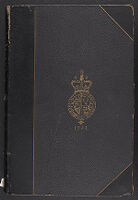
Contents: This manuscript consists of eight originally independent units or booklets, each containing from one to four quires. See Hathaway, Fouke le Fitz Waryn (1975), p. xliv-xlvii on how this manuscript was compiled.
The contents include:
ff. 1r-v, Office in honour of Thomas, Earl of Lancaster, beheaded in 1322; verses on the corruption of the law courts;
ff. 2r-3v, Charters of Edward I and Henry III;
ff. 4r-6v, Hymns, prayers, verses and proverbs in Latin and French;
f. 7r-v, Macaronic satirical verses in Latin, French and English; medical notes in Latin and French;
ff. 8r-10v, Arithmetical and other puzzles in Latin;
ff. 11r-13r, Recipes in Anglo-Norman French;
ff.13r-16v, Prophecies in Latin, including an account of a false prophet in the East and Merlin Silvester (f. 15v);
ff. 17r-32v, Speculum Ecclesie of Edmund Rich, Archbishop of Canterbury (reigned: 1234-1240); a tract on the Mass in French;
ff. 33r-60v, Romance of Fulk le Fitz-Warin, in French (the only known manuscript of this text);
ff. 62r-68v, Brut Chronicle up to 1312, in English;
ff. 69r-76r, Amys et Amylion in French;
ff. 76v-94r, Treatises, including medical notes and prognostications, in French and Latin;
ff. 94r-105v, French scientific and astrological verses, including tracts on fortune-telling;
ff. 105v-107v, Medical and chiromantic texts and diagrams;
ff. 108r-123v, Liber experimentarius of astrological verses translated from Arabic.
Decoration:
Two chiromantic ink diagrams of the palms in red and brown (ff. 106v, 107r). One inhabited initial in colours (f. 17r). Initials and paraphs in red.
H. L. D. Ward and J. A. Herbert, Catalogue of Romances in the Department of Manuscripts in the British Museum, 3 vols (London: British Museum, 1883-1910), I (1883), pp. 316-17.
George F. Warner and Julius P. Gilson, Catalogue of Western Manuscripts in the Old Royal and King’s Collections, 4 vols (London: British Museum, 1921), II, pp. 26-29.
I.S.T. Aspin, Anglo-Norman Political Songs, Anglo-Norman Text Society, 11 (Oxford: Blackwell, 1953), pp. 157-68 [an edition of f. 7].
The Lumley Library: The Catalogue of 1609, ed. by Sears Jayne and Francis R. Johnson (London: British Museum, 1956), p. 232.
Facsimile of British Museum MS Harley 2253, Early English Text Society, 255, ed. by Neil R. Ker (London: British Museum, 1965), pp. xviii-xx.
Fouke le Fitz Waryn, ed. by E. J. Hathaway, P. T. Ricketts, C. A Robson and A. D. Wilshere, Anglo-Norman Text Society, 26-28 (Oxford: Blackwell, 1975) [an edition of ff. 33-61].
Pamela R. Robinson, 'A Self-Contained Unit in Composite Manuscripts' in Codicologica 3: Essais typologiques, ed. by A. Gruys and J.P. Gumbert (Leiden: Brill, 1980), pp. 46-69 [on the typology of this manuscript].
Carter Revard, ‘Scribe and Provenance’ in Studies in the Harley Manuscript: The Scribes, Contents, and Social Contexts of British Library MS Harley 2253, ed. by Susanna Fein, TEAMS (Kalamazoo: Medieval Institute Publications, 2000), pp. 21-109 (p. 72).
Constance B. Hieatt and Robin F. Jones, 'Two Anglo-Norman Culinary Collections Edited from British Library Manuscripts Additional 32085 and Royal 12.C.xii', Speculum, 61/4 (1984), 859-82 [an edition of ff. 11-13].
Stephanie Wolf, 'Lexikologisches in den kulinarischen Rezepten aus de Handschrift BL Royal 12 C xii', Zeitschrift fur romansche Philologie, 110 (1994), 37-63.
Ruth Dean and Maureen Bolton, Anglo-Norman Literature, A Guide to Texts and Manuscripts (London: Anglo-Norman Text Society, 1999), nos. 156, 157, 224, 225, 238, 278, 366, 372, 379, 387, 398, 439, 629, 720, 738.
J. O’Rourke, ‘British Library, MS Royal 12 C.xii and the Problems of Patronage’, Journal of the Early Book Society, 3 (2002), 216-26.
Una O‘Farrell-Tate, The Abridged English Metrical Brut edited from London, British Library MS Royal 12 C. XII (Heidelberg: Carl Winter, 2002), pp. 46-50.
Catherine Daniel, Les prophéties de Merlin et la culture politique (XIIE-XVIe siècle) (Turnhout: Brepols, 2006), [on the text, ff. 13-16v].
Early English Cookbooks [http://culinaryhistory.org/english.html] [accessed 11.09.2013].
Alberto Alonso Gualdo, 'Los Prenostica Pitagorice Consideracionis: un libro de suertes medieval. Estudio introductorio', Studi Medievali, 47.3 (2006), II, 839-53 (pp. 850-55) [on ff. 94v-105r].
Anglo-Norman Amys e Amilioun: The Text of Karlsruhe, Badische Landesbibliothek, MS. 345 (olim Codex Durlac 38) in parallel with London, British Library, MS Royal 12 C. XII, ed. by John Ford (Oxford: The Society for the Study of Medieval Languages and Literature, 2011) [an edition of ff. 69-76].
John Spence, Reimagining History in Anglo-Norman Prose Chronicles (Woodbridge: Boydell, 2013), pp. 134-35, 153-55, 157-58.
Margarita Egan, Medieval French Lunaries: https://lunarybooks.com/ [Accessed 28/07/2023]
From the printed Catalogue of the Old Royal and King’s Collections (1921):
'MISCELLANEOUS COLLECTIONS in prose and verse, in Latin, French, and English. Some of the contents are noticed by M. Paul Meyer in Bulletin de la Soc. des Anciens Textes Français, 1893, pp. 38-56.
1. Office in honour of Thomas, Earl of Lancaster beheaded in 1322. Printed from this MS. by T.Wright, Political Songs, Camden Soc., 1839, p. 268, and in Yorkshire Archaeol. Journal, 1882, p. 358. Beg. 'Gaude, Thoma, ducum decus, Lucerna Lancastrie'. f. 1. At the foot of f. 1 is a couplet 'Heu, proles queritur quod rara fides reperitur. Lex iuris moritur, fraus viuit, amor sepelitur'.
2. Rhyming verses on the corruption of the law-courts. Printed, with additional verses, from Harley MS. 913, f. 59, by Wright, op. cit. pp. 224, 382. Beg. 'Beati qui esuriunt et faciunt iusticiam et oderunt et fugiunt iniurie nequiciam'. f. 1 b.
3. Copy of inspeximus by Edward II of an inspeximus by Edward I, dated 8 June, 1280, of two charters of Henry III, dated 20, 23 june, 1253, granting franchises to the Hospitallers of S. John of Jerusalem. Dat. Chertsey, 22 Sept. ao 2 [1308]. Printed in the Irish Record Commission's Chartae, Privelegia, &c., 1171- 1395, p. 42 (wrongly dated), cf. Delaville le Roulx, Cartulaire, iv, no. 4822. f. 2.
4. Hymns and prayers, viz.:-(a) 'Sanctus Edmundus composuit et contulit dicenti triginta dies venie': Latin hymn to the Virgin (13 x 4 lines) by Edmund Rich (cf. art. 18, Chevalier, Rep. Hymn. no. 2267). Followed by a prayer. Beg. 'Aue, uirgo virginum, fons et maris stella'. f. 4;-(b) Hymn to the same (five stanzas), in French. Printed by Meyer, loc. cit., p. 40. Beg. 'Le angle a Marie entra en la chambre celee'. f. 4;-(c) 'Simplex meditatio de sacramento altaris, quicumque eam deuote dixerit dum secretum misse agitur a fratre Iohanne de Peccham quondam (1279-1292) archiepiscopo Cantuariensi, qui eam composuit, xl. dies venie possidebit': a hymn (15 x 4 lines, Chev. Rep. Hymn. no. 2278) sometimes wrongly assigned to S. Bonaventura or (Arundel MS. 301, f. 80) S. Thomas Aquinas. Other copies are in 2 A. II, art. 12, Harley MS. 913, f. 57 b, and Arundel MS. 374, f. 77. Beg. 'Aue, viuens hostia, veritas et vita', f. 4 b.
5. Proverbial verses and miscellaneous notes, including :-(a) One line on the virtues of caraway (cf. 12 B. III, f. 150). f. 4 b;-(b) Rules for sortes to interpret dreams, Lat. ff. 4 b, 5;-(c) Twenty lines, chiefly proverbial, beg. 'Clericus es fronte si vertice laycus es tu'. f. 5;- (d) Three lines on troubles in Henry II's time, beg. 'Per menses ter sex vexatus ab hostibus est rex'. f. 5b; -(e) Ten lines on phlebotomy; the first two are ll. 2762, 2763 of Renzi's Schola Salernitana (Coll. Sal. v). Beg. 'Estas, ver dextras, autumpnus yempsque sinistras'. f. 5b;-(f) Recipes for dyeing linen, in French prose. Beg. 'Si vus volez linge toylle auer iaune'. f. 5 b;-(g) Virtues of celandine, Latin prose. f. 6;-(h) Prophecy for 1325 (corrected to 1326), 'Anno mille c. ter x. bis quinto (sexto) dabit ether vina bladum fructus, flet pro principe luctus, vna columpna cadet populo quia c[r]ismata tradet'. f. 6;-(i) Charms against mice in a granary. Beg. 'Accipe quatuor lapides crete'. f. 6;- (k) Brief questions on the sacraments. Beg. 'Quid facit baptismus ? Mundat ab originali peccato'. f. 6.
6. Chronological, prophetical, and other verses, including:-(a) Couplet on Adam's stay in hell;-(b) Couplet giving the date of the foundation of the Cistercian order.-(c) Couplet on the length of time between the Creation and Incarnation;-(d) Five lines on Thomas Becket's murder (cf. Add. MS. 35091, f. 113, Higden's Polychronicon, Rolls Ser., viii, p. 44). Beg. 'Quis moritur ? presul ; cur ? pro grege ; qualiter ? ense'. Erased by a 16th cent. hand with note 'vacat. falsum fuit';- (e) Verses supposed to be addressed by the Emperor Frederic II to the Pope [Gregory IX ?] and the Pope's reply (here each in four lines only), cf. Harley MS. 3724, f. 49b. Cf. also the prophecy attributed to Michael Scot in Salimbene's chronicle, Monum. Hist. ad Provincias Parmensem el Placenlinam peritentia, Parma, 1857, p. 177. Beg. 'Fata monent stelleque docent auiumque volatus'-(f) Prophecy for 1293, as in Cotton MS. Titus D. vii, f. 30, and printed in the Worcester chronicle (Rolls Ser.), p. 515. Versions adapted to later years are in Lansd. MS. 762, f. 48, and Sloane MS. 429, f. 24 b, and one is printed in Wolfgang Lazius' Fragmenium Vaticinii, &c., Vienna, 1547. Beg. 'Gallorum leuitas Germanos iustificabit'. f. 6b.
7. Maccaronic satirical verses (36 rhyming hexameters), partly alliterative, in Latin, French, and English. Printed from this MS. in T. Wright's Political Songs, p. 251. Beg. 'Quant homne deit parler, videat que verba loquatur'. f. 7.
8. Medical commonplaces, in Latin and French. Beg. 'Auycenna dicit quod mors naturalis est infra lxx. annos'. At the end three lines on phlebotomy, beg. 'Festa Valentini nos docent flegbotomari'. f. 7 b.
9. 'Hastucie algorismi': eighteen arithmetical and other puzzles, sometimes called cautelae algorismi, most of which occur in one of the similar collections in 12 F. XIX, f. 184, Add. MS. 30380, f. 183 b, and Sloane MS. 3281, f. 54. A few come from the Propositiones ad acuendos iuvenes, a collection probably taken from the Greek and attributed to Bede or Alcuin (Migne, Patr. Lat. xc. 667, c. 1143). One of these is the familiar ferry-boat problem (see W. W. R. Ball, Math. Recreations, 1896, p. 61), but the answer to it is here in verse, as also to two others. Beg. 'Destinet aliquis super denarium'. f. 8.
10. Cookery recipes, in French. The dishes are not unlike those in Add. MS. 32085, f. 117 b, but the directions are less full. Printed by Meyer, l. c. p. 48. He notices an English version in a Phillipps MS., no. 8336, in Romania, xiii, p. 506. Beg. 'Blanc desirree. Let de alemaundes, flur de rys', f. II.
11. Fictitious letter of some Christian in the East to a Christian [monarch ?] in the West, describing a supposed warlike invasion of a false prophet calling himself Christus Nazarenus, who drives in a gold chariot carrying a book entitled 'Liber executionis noui testamenti'. Beg. 'Ad flagellum humani generis'; ends 'primo patefacta sunt hec in estate anno dom. milesimo trescentesimo tricesimo quinto'. f. 13.
12. Prophecy for four years, apparently of the early part of Edward III's reign, described as 'mandata quedam que missa fuerunt regi Castelle et magistris Toletanis'. Preceded by an explanation of the symbolism. This and the next five articles are noticed by Ward, Cat. of Romances, i, p. 316. Imperfect copies are in Cotton MSS. Titus D. VII, f. 30, Claud. E. VIII, f. 1 b. Explanation beg. 'Quia antiqui mistice loqui cupientes'; prophecy, 'Quoniam superbis resistit deus'. f. 14.
13. Prophecy attributed to S. Methodius, Bishop of Patara: a brief passage not taken from his De principio saeculi (cf. 5 F. XVIII, art. 2). Beg. 'Methodius dicit, Sub gallo Hispano corruet Francia'. f. 15.
14. 'Isti versus inuenti sunt scripti in quadam rupe excelsa in monte sancti Michaelis in Cornubia in quadam vetustissima cedula': prophecy in ten leonine hexameters, beg. 'Ni pax formetur, draco candidus egredietur'. f. 15.
15. 'Extractum de libro Merlini Siluestris qui Wallice est conscriptus et in Cambria prophetauit sic'; as in Cotton MS. Faust. A. VIII, f. 116, and elsewhere (see Cat. of Rom., l. c.). Beg. 'Catulus lintheus in lupum rapidum'. f. 15 b.
16. Prophecy concerning the Lily, the Lion, &c. (cf. 13 E. IX, f. 27, Cat. of Rom., l. c.). Beg. 'Hermerus deus sapientum: anno a creatione mundi vim. vc. xxxvii [A. D. 1338?] lilium regnans in nobiliori'. f. 16.
17. Vision of consecration-oil, &c., seen at Sens by S. Thomas Becket, as in Cotton MS. Titus D. VII, f. 28, 13 E. IX, f. 27 b, and elsewhere (Cat. of Rom., l. c.). Beg. 'Quando ego Thomas Beket Cantuariensis archiepiscopus exul ab Anglia'. Imperf. by loss of leaves after f. 16. At the foot of the page is a couplet, 'Cum facis ingressum, studeas sic esse modestus, ut post discessum tibi sit regressus honestus'. f. 16 b.
18. 'Le liuere ke seint Edmund de Punteneye fist. e si est apele Speculum amicicie' (so colophon): the summa (more commonly called Speculum Ecclesiae) of Edmund Rich, Archbishop of Canterbury (1234-1240, canonized 1248), in French. Other copies are in Arundel MS. 288, f. 103, Harley MS. 1121, f. 141 (cf. P. Meyer in Romania, xxix, p. 53, xxx, p. 74). For the Latin see 5 A. VI, art. 4, and 7 A. I, art. 3, La Bigne, Max. Bibliotheca, 1677, xxv, p. 316. Beg., after table of tituli, 'Videte euocationem uestram, &c. [I Cor. i. 26]: Cest mot del apostoille'. At the end, after the words 'Amen par sa doce pite', is the couplet 'Amie, pur vus ai fet cest escrit, e cher le tenez e ne mie en despit', followed by a Latin prayer and second colophon 'Ici finist le liuere' (&c. as above). f. 17.
19. Tract on the Mass, in French, giving subjects for contemplation during the celebration. Beg. 'Nostre seygnur Iesu Crist quaunt il uolet partir de cest secle'; ends 'poez vus partyr a dieu'. f. 30 b.
20. Romance of Fulk Fitz-Warin, in French prose (adapted presumably from a verse original). The only known MS., see Cat. of Romances, i, p. 501. Printed with Ralph de Coggeshall's Chronicon (Rolls Ser.), 1875. Beg. 'En le temps de Aueryl e May'. f. 33.
21. 'In festo solennitatis corporis Christi ad completorium ympnus': hymn (5 x 4 lines) beg. 'Iesu nostra refeccio panis potus fidelium'. Printed in Neale's Hymni, &c., Chevalier, Rep. Hymn. no. 9589. f. 61.
22. Chronicle of the Brute, in English verse (1036 lines) to A. D. 1312. Printed from this MS. by Ritson, Metrical Romances, 1802, ii, p. 270. A slightly longer copy is in the Auchinleck MS., Edinburgh Advocates' Library. Beg. 'Herkneþ hideward lordynges 3e þat wolleþ here of kynges ant 3e mowen heren anon hou Engelonde furst bigon'; ends 'þer his heued wes of smyte'. f. 62.
23. Romance of Arays and Amylion, in French verse, differing considerably from the version printed by Conrad Hofmann (Amis et Amiles, 1852). For description see Cat. of Romances, i, p. 674. Beg. 'Qi voet oyr chaunzon damur de leaute e de graunt doucour'. f. 69.
24. Two hymns, viz.:-(a) 4 x 4 lines, beg. 'Aue virgo uirginum, mater Iesu Christi';-(b) 3 x 12 lines, beg. 'O mira Christi pietas, o quanta miseratio'. f. 76 b.
25. Lunationes et Somnia, a pair of treatises on prognostication which appear together in a variety of shapes, both in Latin and in other languages. Early forms of this and part of the following article occur in Cotton MS. Tib. A. III, f. 27 b (Latin and Anglo-Saxon), cf. also 12 E. XVI, artt. 1, 9 (English), and 13 D. 1, art. 14 (Dreams only, in Latin). For printed Latin texts see Hain's Repertorium, 5923 sqq. In the present MS. the days of the month are treated of in French verse, but the dreams in Latin prose, viz.:-(a) Lunationes, imperf. by loss of leaves at beg. The first complete day beg. 'La disme lune est profitable'. f. 77;-(b) 'Incipit visio ac exposicio Danielis prophete': a dictionary of dreams in alphabetical order. Beg. 'Arbores cum fructibus qui viderit'. f. 81 b.
26. 'Incipiunt signa ostensa Osdree (sic) prophete': further tables of prognostication, in Latin, viz.:-(a) From thunder, beg. 'Si mense Ianuario tonitruum sonuerit'. Besides the months in which thunder occurs (as in Egerton MS. 2852, f. 107), there is also a section on the part of the sky in which it takes place. It is entirely different from the early table of prognostications in 2 B. v, art. 8 (f). f. 86;-(b) From the day of the week on which the first of January falls, nearly as in Cotton MS. Tib. A. III, f. 36. Beg. 'Si kalende Ianuarii fuerint die dominica yemps bona suauis et calida'. f. 86 b (c) From the sky, four verses beg. 'Aurea ventos, pallida nimbos, alba serenum'. f.87;-(d) From birthdays, beg. 'Beda dixit quod tres sunt dies'. f. 87;-(e) From the week-day of Christmas, not identical with (b), beg. 'Si natiuitas domini die dominica euenerit, yemps bona et ventosa'. Other copies are in Harley MS. 1811, f. 36 b, Egerton MS. 2852, f. 108 b. It is to these prognostications from Christmas or New Year that the name of Esdras is commonly attached. Various versions occur in Sloane MSS. 122, f. 125, 282, f. 86, 475, f. 217, 1609, f. 47 (Engl.), 3469, f. 37, &c. (cf. 12 E. XVI, art. 2). f. 87.
27. Another prognostication from the first of January, attributed to the prophet Hezekiah, in French verse. Eight stanzas, beg. 'En terre de labour e de promissioun'. An imperfect copy is in Sloane MS. 3469 (f. 37b). f. 88.
28. Medical collections, in French and Latin, viz.:- (a) Diet for the several months, in Fr. verse, beg. 'En le mois de Jeyuer vyn blanc jun beuez'. f. 89 b;- (b) Times for bleeding, in Fr. prose beg. 'Fetes vous seigner chescun an'. f. 90;-(c) Parlous days, in Fr. prose, beg. 'Les mestres qe cest ait'. f. 90 b;-(d) On bleeding, five Lat. verses, including ll. 2680, 2681, 2762, 2763 of Renzi's ed. of Schola Salernitana. Beg. 'In sene vel iuuene si vene sanguine plene'. f. 91;- (e) Parlous days, twelve Lat. lines, beg. 'Prima die nona nocet hora, septima quinta'. f. 91;-(f) On bleeding, Fr. prose note, beg. 'Qy se fra seigner voie quant le sang est cler'. f. 91. 29. 'Le tretitz Aristotle entitlee segree des segretz' (so colophon): the second section (Physiognomy) of the Pseudo-Aristotelian Secreta Secretorum (cf. 12 D. III, art. I). A French translation. Beg. 'Entre autre choses est cele qe besoignast'. f. 91 b.
30. A book of sortes, in French, preceded by a translator's preface in verse, beg. 'Sire, de tous bienz paralosee cest come vus ay aparchenee qe en Romaunz ay translatee de fort Latin e entrikee'. To thirty-six questions are assigned twelve answers each, every group bearing the name of a bird. The first is entitled 'Faucoun' and begins 'Enceynte est e le ne puet celer'. Four lines at the end explain the mode of using the sortes. f. 94.
31. Another similar collection, in verse, consisting of twenty stanzas of twenty lines each, answering similar questions and bearing various titles, including the sun, moon, and signs of the zodiac. The first is 'Solayl' and beg. 'Le planete vus dit qe votre desir trouerez'. Five lines at the end explain the use. f. 98b.
32. Medical notes on (a) Bleeding, in Latin. ff. 105 by 106;-(b) Medicine for the car, in French. f. 106. 33. A short note on chiromancy, in Latin. Beg. 'Nota quod lynee naturales in palma sunt tres'. f. 106. 34. Two chiromantic diagrams, with explanation in Latin. f. 106 b.
35. 'Optima medicina pro 3elwold': a charm in English. Beg. 'Haske furste þe nome of þe seke body'. An insertion. f. 107 b.
36. 'Hic infallibilis liber incipit; an tibi peius an ferat instabilis melius sors ars docet eius': the Liber Experimentarius or book of astrological sortes translated from the Arabic, according to some MSS., by Bernard Silvester [of Chartres], see Black's Catal. of Ashmole MSS. no. 304. The work consists of 28 sets of 28 verses, each set bearing an Arabic title. The first title is Almazena, the last Algagamenar. They are preceded by a table which begins 'De uita quid erit quere a sedente super orientalem faciem turris Saturni'. The translation here is in leonine hexameters having a nearer approach to quantitative scansion than that in 12 E. IV, below. Beg. 'Almazena primus. Hoc ornamentum decus est et fama parentum'. f. 108.
Vellum ; ff. 123. 91/4 in. x 6 in. Circ. 1320-1340. Gatherings, artt. 1-17, i7, ii9 ; artt. 18, 19, i12, ii4; artt. 20, 21, i12, ii9, iii8; art. 22, i7,; artt. 23-35, i-iv8, v7; art. 36, i, ii8. In various hands, and in single and double columns. For one of the hands of art. 20 see pl. 69. Sec. fol. 'Edwardus dei gratia'. Art. 18 has an illuminated initial. Belonged (f. 1) to [John, Lord] Lumley. Lumley cat. f. 334 ; cat of 1666, f. 11; not in CMA.'