Hard-coded id of currently selected item: . JSON version of its record is available from Blacklight on e.g. ??
Metadata associated with selected item should appear here...
Add MS 74236
- Record Id:
- 032-001968352
- Hierarchy Root Ancestor Record Id:
- 032-001968352
- MDARK:
- ark:/81055/vdc_100000000055.0x000363
- LARK:
- ark:/81055/vdc_100104060212.0x000001
- SLARK:
- Format:
- ISAD(G)
- Reference (shelfmark):
- Add MS 74236
- Title:
- Missal ('The Sherborne Missal')
- Scope & Content:
-
The Sherborne Missal is the largest, most lavishly decorated late medieval English service book to have survived the Reformation intact. The manuscript was made for the Benedictine abbey of St Mary’s in Sherborne, Dorset. It was probably produced between 1399-1407, since it contains portraits of Robert Bruyning, abbot of Sherborne (incumbent 1385-1415), portraits and arms of Richard Mitford, bishop of Salisbury (incumbent 1396-1407), and the coat of arms of Henry V as Prince of Wales (title held 1399-1413).
The key patron of the manuscript was probably Robert Bruyning, abbot of Sherborne, who is depicted in the illumination over a hundred times (e.g., pp. 36, 218, 260, 276, 279, 376, 387, 388), often with his motto, ‘laus sit trinitati’ (praise be to the Trinity). The lead scribe was John Whas, monk of Sherborne, who is named in the colophons (pp. 215, 358, 377, 661) and is portrayed in the illumination (e.g., pp. 27, 216, 276). The lead illuminator was John Siferwas, a Dominican friar, who also provided portraits of himself in the decoration (e.g. pp. 47, 81, 216, 276).
Contents:
(N.B.: The manuscript is paginated, not foliated. Each side of a leaf has a unique page number, rather than following the traditional recto/verso convention.)
pp. 1-12: Calendar, with feast days graded by colour.
pp. 13-358: Temporale.
pp. 359-378: Ordinary of the Mass.
pp. 381-393: Canon of the Mass.
pp. 395-611: Sanctorale.
pp. 613-662: Common of Saints.
pp. 662-694: Votive Masses.
Decoration:
The manuscript contains an ambitious and extremely extensive decorative programme. Nearly every page is decorated with elaborate borders and historiated initials in colours and gold. It has stylistic ties to contemporary manuscripts such as the Wyndham-Payne Crucifixion (Add MS 58078) by Herman Scheere and panel paintings such as the Wilton Diptych. The lead artist was John Siferwas, a Dominican friar, who also illuminated the Lovel Lectionary (Harley MS 7026) for presentation by John, Lord Lovel, to Salisbury Cathedral. At least four other artists may have worked on the manuscript (see Scott, Later Gothic Manuscripts (1996), II, pp. 53-58).
1 full-page miniature in colours of the Crucifixion (p. 380). Numerous full historiated borders in colours and gold throughout. Numerous large, medium and small historiated and foliate initials in colours and gold throughout. Figures of the Prophets and Apostles, signs of the Zodiac and Labours of the Months in colours and gold found throughout the calendar (pp. 1-12). Marginal depictions of British birds in colours and gold, most of them identified by an inscription in Middle English (see Yapp, 'Birds of the Sherborne Missal' (1982)) and bas-de-page busts of kings and clerics holding cartouches inscribed with passages relating to Church history and particularly Sherborne’s history throughout the Ordinary and Canon of the Mass (pp. 359-393). Partial and full borders with marginal and bas-de-page scenes in colours and gold throughout. Zoomorphic line fillers in colours and gold throughout. Initials accented by red pen-flourishing and diaperwork throughout. Rubrics and punctuation in red. Ruling in purple.
The subjects of the miniatures, decorated openings for major feasts and historiated borders are as follows:
p. 1: Calendar, January: Jeremiah and St Peter; a man by the fireside; Aquarius.
p. 2: Calendar, February: David and St Andrew; digging; Pisces.
p. 3: Calendar, March: Isaiah and St James the Greater; pruning; Aries.
p. 4: Calendar. April: Daniel and St John; sowing; Taurus.
p. 5: Calendar, May: Hosea and St Thomas; hawking; Gemini.
p. 6: Calendar, June: Amos and St James the Lesser; cutting grass; Cancer.
p. 7: Calendar, July: Sofonias and St Philip; a man with a scythe; Leo.
p. 8: Calendar, August: Joel and St Bartholomew; harvesting; Virgo.
p. 9: Calendar, September: Micheas and St Matthew; flailing; Libra.
p. 10: Calendar, October: Malachi and St Simon; pig pannage; Scorpio.
p. 11: Calendar, November: Zechariah and St Jude; slaughtering pigs; Sagittarius.
p. 12: Calendar, December: Ezechiel and St Matthias; feasting; Capricorn.
p. 13: Temporale, First Sunday in Advent: initial ‘A’ with the Annunciation; Creation and Genesis scenes.
p. 16: Temporale, Second Sunday in Advent: ‘P’, Noah’s Ark; Genesis scenes.
p. 19: Temporale, Third Sunday in Advent: ‘G’, Trinity and Abraham; angel and hermit.
p. 27: Temporale, Fourth Sunday in Advent: ‘M’, Moses and Aaron before Pharoah; scenes featuring Moses; depiction of the scribe, John Whas.
p. 30: Temporale, Vigil of the Nativity: ‘H’, Joseph’s dream; ‘D’ with a crib before a synagogue.
p. 31: Temporale, Missa in Gallicantu: inter-columnar Edict of Caesar Augustus; the Virgin and Child.
p. 33: Temporale, In Primo Mane: ‘L’, Annunciation to the Shepherds; the Virgin and Child.
p. 36: Temporale, Mass of the Nativity: ‘P’, the Nativity; the Virgin and Child; Mitford and Bruyning with arms.
p. 38: Temporale, Feast of St Stephen: ‘E’, the stoning of St Stephen.
p. 40: Temporale, Feast day: ‘I’, St John on Patmos; inter-columnar St John with the poisoned cup.
p. 42: Temporale, Holy Innocents: ‘E’, Annunciation to Joseph; bas-de-page Massacre of Innocents and Flight into Egypt.
p. 44: Temporale, Feast of St Thomas (erased): ‘G’, the martyrdom of Becket (defaced and restored); bas-de-page landscape with a city and praying figure.
p. 47: Temporale, Circumcision: ‘P’, the Presentation and Circumcision; St John the Evangelist; angel; bas-de-page of an angel presenting Abbot Bruyning, accompanied by dogs and a Benedictine.
p. 48: Temporale, First Sunday: ‘D’, the Presentation.
p. 49: Temporale, Vigil of Epiphany: ‘L’, the Baptism of Christ.
p. 51: Temporale, Epiphany: ‘E’, the Adoration of Magi; bishop; bas-de-page scenes of Magi’s journey; Antitypes.
p. 55: Temporale, First Sunday after Epiphany: ‘I’, Christ teaching in Temple; Virgin Mary and Joseph; angel; an abbot.
p. 56: Temporale, Octave of Epiphany: ‘E’, Christ blessing St John the Baptist.
p. 58: Temporale, Second Sunday after Epiphany: ‘O’, marriage feast at Cana; inter-columnar angel.
p. 62: Temporale, Third Sunday after Epiphany: ‘A’, Christ and centurion and son; Christ heals a leper.
p. 64: Temporale, Fourth Sunday after Epiphany: ‘A’, the calling of the Apostles in a boat; an abbot.
p. 66: Temporale, Fifth Sunday after Epiphany: ‘A’, Christ preaching; abbot before Christ as Sower of the Word; bas-de-page, man sowing and conversing with devil whilst others sleep.
p. 68: Temporale, Septuagesima Sunday: ‘C’, woman amidst chapels; bas-de-page of labourer and vineyard.
p. 71: Temporale, Sexagesima Sunday: ‘E’, Christ with orb addresses Samaritans; angel sowing; bas-de-page parable of the sower.
p. 76: Temporale, Quinquagesima Sunday: ‘E’, mocking of Christ; Flagellation; Resurrection; bas-de-page of Christ healing blind man (a hermit).
p. 78: Temporale, Feria Quarta: ‘M’, the blessing and distribution of ashes; Benedictine monks.
p. 85: Temporale, Quadragesima Sunday: ‘I’, The Third Temptation of Christ; bas-de-page of Christ’s other Temptations.
p. 102: Temporale, Second Sunday: ‘R’, woman before Christ; Apostles, women and Christ.
p. 117: Temporale, Third Sunday: ‘O’, enthroned God the Father; an abbot.
p. 135: Temporale, Fourth Sunday: ‘L’, the Feeding of the Five Thousand; an abbot.
p. 153: Temporale, Passion Sunday: ‘I’, Christ conversing with Jews; a Benedictine.
p. 167: Temporale, Sunday before Palm Sunday: ‘D’, abbot blessing fronds.
p. 169: Temporale, Palm Sunday: ‘D’, entry into Jerusalem; bas-de-page landscape with ass and foal.
p. 181: Temporale, Third feast after Easter, Lectio: ‘I’, Flagellation.
p. 190: Temporale, Fourth feast, Lectio: Mocking of Christ.
p. 196: Temporale, Feria V in Cena Domini: ‘D’, Christ washing the Apostles’ feet.
p. 199: Temporale, Good Friday: ‘I’, priest reading at lectern.
p. 200: Temporale, Good Friday: The Man of Sorrows supported by angels; angel and cross.
p. 205: Temporale, Good Friday: ‘O’, church.
p. 209: Temporale, Easter Sunday, Vigil: ‘I’, God with compasses creates the Heavens and the Earth.
p. 214: Temporale, Prayer, ‘Deus qui hanc sacratissimam noctem’: ‘D’, Vernicle cloth.
p. 216: Temporale, Easter Sunday: Resurrection; Mitford and Bruyning presented by Sts Peter and Paul; Christ with orb displaying his wounds; ‘Noli me tangere’; scribe John Whas and artist John Siferwas; antitypes; bas-de-page battle scene with wildmen and knights tilting at a windmill.
p. 217: Temporale, Easter Sunday: ‘I’, St Mark seated at lectern.
p. 218: Temporale, Feria Secunda: ‘I’, Christ shows two Apostles the land of milk and honey; Abbot Bruyning looks on.
p. 220: Temporale, Feria Tercia: ‘A’, the risen Christ appears to the Apostles; abbot.
p. 223: Temporale, Feria Quarta: ‘V’, the calling of fishermen, Sts Andrew and Simon; abbot.
p. 225: Temporale, Feria Quinta: ‘V’, ‘Noli me tangere’; abbot; angel; Siferwas in a rose border.
p. 227: Temporale, Feria Sexta: ‘E’, Christ on a mountain with the Apostles; abbot.
p. 229: Temporale, Sabbato in albis: ‘E’, Sts Peter and John at the empty tomb; kneeling abbot.
p. 231: Temporale, Domenica in albis, or Quasimodo: ‘Q’, doubting Thomas; an angel with instruments of Passion.
p. 234: Temporale, Second Sunday after Easter: ‘M’, Christ appears to the Apostles.
p. 236: Temporale, Third (not the Second as in the manuscript) Sunday after Easter: ‘I’, Christ appears to the Apostles; abbot.
p. 239: Temporale, Fourth (not the Third as in the manuscript) Sunday after Easter: ‘C’, Apostles, Christ appears from cave.
p. 242: Temporale, Fifth (not the Fourth as in the manuscript) Sunday after Easter: ‘V’, Christ with the Apostles (Ascension?).
p. 249: Temporale, Ascension Day: the Ascension; abbot; antitypes.
p. 250: Temporale, Ascension, Sequence: ‘I’, St Mark.
p. 251: Temporale, Sunday in Octave of Ascension: ‘E’, nimbed figure with raised arms.
p. 253: Temporale, Vigil of Pentecost: scenes of Abraham and Isaac.
p. 260: Temporale, Pentecost or Whit Sunday: ‘S’, Pentecost; ‘D’, St John with the Seven Churches; ‘I’, St Paul with sword; St John of Revelation, prostrate before Apocalyptic Son of Man with swords coming from his mouth; God the Father with orb; lighted candlesticks; Mitford and Bruyning; scenes from Apocalypse and Gifts of Holy Spirit.
p. 261: Temporale, Pentecost, Sequence: ‘I’, St John writing.
p. 262: Temporale, Whit Monday: ‘C’, Agnus Dei; Lion of Judah; Bruyning; Sherborne arms; scenes of Gifts of Joy and the Second Petition of the Pater Noster.
p. 264: Temporale, Whit Tuesday: ‘A’, angels of the Seven Churches of Asia; an abbot; scenes of the Gifts of Holy Spirit and Third Petition of the Pater Noster.
p. 266: Temporale, Whit Wednesday: ‘D’, angel filling censer; hand of God; abbot; Sherborne arms; scenes of the Gifts of Holy Spirit and Petitions of the Pater Noster.
p. 268: Temporale, Feria quinta: ‘S’, trumpeting angel (Gifts of Holy Spirit); bas-de-page of a camel and porcupine (bestiary symbols of fidelity and endurance).
p. 270: Temporale, Feria sexta: ‘R’, an angel in red gesturing towards angels in white over waters; abbot; scenes of the Gifts of the Holy Spirit and Petition of the Pater Noster.
p. 271: Temporale, Saturday after Pentecost: ‘C’, God the Father blessing; abbot.
p. 276: Temporale, Trinity Sunday: ‘B’, God the Father, angels, Agnus Dei, Evangelists; ‘O’, an angel with arms of Trinity; an altar with the Eucharist and a dove; Christ displays his wounds; Evangelists in niches; Mitford, Bruyning, Whas and Siferwas; an architectural border inhabited by Orders of Angels; Evangelists in roundels; Orders of Angels with musical instruments.
p. 279: Temporale, Corpus Christi: ‘C’, Trinity, with a dove descending upon a man receiving the Eucharist; ‘D’, St Veronica with the Vernicle Cloth; abbot; antitypes.
p. 281: Temporale, First Sunday after Pentecost: Dives and Lazarus (feasting whilst dogs lick Lazarus’s sores).
p. 284: Temporale, Second Sunday after Pentecost: ‘F’, man who held a feast with apologetic guests; bas-de-page of guests proferring excuses.
p. 286: Temporale, Third Sunday after Pentecost: ‘R’, Christ with an orb relates parables to the Pharisees; a woman with a lamp seeking a lost coin; a man with a lost sheep.
p. 289: Temporale, Fourth Sunday after Pentecost: ‘D’, Christ with an orb converses with men; the blind leading the blind (with guide-dog).
p. 292: Temporale, Fifth Sunday after Pentecost: ‘E’, Apostles leaving the boat to follow Christ; Christ points at a loaf (Apostolic Mission).
p. 294: Temporale, Sixth Sunday after Pentecost: ‘D’, Christ addresses St Peter and disciples.
p. 298: Temporale, Seventh Sunday after Pentecost: ‘O’, Christ feeds the multitude; Christ with disciples and loaves; abbot.
p. 301: Temporale, Eighth Sunday after Pentecost: ‘S’, Christ addresses disciples; God the Father, with Scribes and Pharisees.
p. 304: Temporale, Ninth Sunday after Pentecost: ‘E’, Christ tells disciples a parable; man with the steward and a spade.
p. 307: Temporale, Tenth Sunday after Pentecost: ‘D’, Christ praying outside a city, with disciples.
p. 310: Temporale, Eleventh Sunday after Pentecost: ‘D’, a Pharisee praying at an altar and a publican self-abasing outside.
p. 313: Temporale, Twelfth Sunday after Pentecost: ‘D’, Christ with an orb preaching.
p. 316: Temporale, Thirteenth Sunday after Pentecost: ‘R’, Christ with an orb addresses disciples; the parable of Good Samaritan.
p. 319: Temporale, Fourteenth Sunday after Pentecost: ‘P’, Christ blessing a Samaritan leper; Christ with ten lepers; a leper before a priest.
p. 322: Temporale, Fifteenth Sunday after Pentecost: ‘I’, Christ with an orb addresses disciples; landscape.
p. 325: Temporale, Sixteenth Sunday after Pentecost: ‘M’, Christ blesses Sts Peter, Andrew and another; Christ raises the widow’s son.
p. 327: Temporale, Seventeenth Sunday after Pentecost: ‘I’, the parable of the wedding feast.
p. 339: Temporale, Eighteenth Sunday after Pentecost: ‘D’, Christ with scribes; an abbot.
p. 341: Temporale, Nineteenth Sunday after Pentecost: ‘S’, Christ heals a sick man; an abbot.
p. 344: Temporale, Twentieth Sunday after Pentecost: ‘O’, the parable of the marriage feast of the king’s son; the king’s men bind a naked man without wedding garb.
p. 347: Temporale, Twenty-first Sunday after Pentecost: ‘I’, the healing of the nobleman of Capernaum’s son.
p. 350: Temporale, Twenty-second Sunday after Pentecost: ‘S’, the parable of the talents.
p. 352: Temporale, Twenty-third Sunday after Pentecost: ‘D’, the Pharisees test Christ; an abbot.
p. 353: Temporale, Twenty-fourth Sunday after Pentecost: ‘D’, the healing of Jairus’s daughter; the woman with a flow of blood.
p. 356: Temporale, Twenty-fifth Sunday after Pentecost: ‘D’, Christ addresses Sts Andrew and Philip, who hold loaves and fishes; bas-de-page of the Feeding of the Five Thousand.
p. 359. Order of the Mass, Gloria in Excelsis: historiated initials with busts depicting the hierarchy of the Church; bas-de-page of the Annunciation to the Shepherds.
p. 360: Order of the Mass, Credo: ‘C’, with a praying man.
pp. 363-377: Order of the Mass, Preface of the Mass: historiated initials with busts of early bishops of Sherborne (some labelled in Middle English; for names, see Herbert, The Sherborne Missal (1920), and Scott, Later Gothic Manuscripts (1996), II, p. 48); large marginal depictions of British birds (many labelled in Middle English, see Yapp, 'The Birds of the Sherborne Missal', (1982)); in the lower margins figures dressed as members of the various religious orders hold scrolls carrying historical texts drawn from York history tables (transcribed by Herbert, The Sherborne Missal (1920)).
p. 376: Order of the Mass, Prefatio defunctorum: ‘P’, Christ displaying his wounds; ‘V’, Crucifixion; the Virgin and Child, Sts Peter and Paul; Mitford and Bruyning; the Virgin crowned with outspread hands.
p. 380: Canon of the Mass: introduced by a full-page Crucifixion miniature, with Christ on a Tau cross, flanked by thieves, with the fainting Virgin, St John and Mary Magdalene at foot of Cross, and a crowd of mounted onlookers in contemporary dress, including Longinus, with angels above; Evangelists writing in the corners of the frame; roundels on the frame containing depictions of Moses and the brazen serpent, Elisha and Sunamite’s child, the Sacrifice of Isaac, and figures of Peace and Justice. Bruyning’s motto appears on the background to the miniature.
pp. 381-393: Canon of the Mass: Historiated initials; borders, foliate and inhabited; (from p. 382) large marginal images of British birds (see Yapp, 'The Birds of the Sherborne Missal', (1982)); in the lower margins figures of Sherborne’s benefactors (including Anglo-Saxon kings; see Herbert, The Sherborne Missal (1920) and Scott, Later Gothic Manuscripts (1996), II, pp. 48-49) hold charters with seals representing Sherborne’s properties (partly drawn from Sherborne Cartulary, see Legg, 'Liturgical Notes’ (1896), and Herbert, The Sherborne Missal (1920)). The kings are: Kenewalch and Kenewolph (Kenulph), p. 381; Athelbert and Athelph, p. 382; Athelstan and Godred, p. 383; Edwin and Edgar, p. 384; Ethelred (Edhelred), twice, p. 385; Edward and Ine, p. 386; Egbert and Athelwald, p. 387; Henry and Bishop Sigehelm, p. 388; Archbishop Baldewyn and Bishop Roger of Salisbury, p. 389; Cuthred and Kynelwolp, p. 390; Kenewolph and Offa, p. 391; Sigertus and Alfred, p. 392; Geroncius (Gerontius) and Henry, p. 393.
p. 381: Canon of the Mass, Te Igitur: Trinity, Agnus Dei; Kings Kenewalch and Kenewolph (or Kenulph).
p. 387: Canon of the Mass: ‘P’, God the Father with orb, blessing; ‘P’, Christ the Judge, seated on a rainbow; Mitford and Bruyning; Mary Magdalene; angels supporting a cloth of honour behind the Virgin and Child; God the Father; Kings Egbert and Athelwald.
p. 388: Canon of the Mass: ‘P’, Agnus Dei on the altar; lion; Mitford and Bruyning; God the Father; the Evangelists as grisaille statues; St John the Baptist pointing to the Agnus Dei; King Henry and Bishop Sigehelm.
p. 393: Canon of the Mass: St John the Baptist and Agnus Dei as line-fillers; Kings Geroncius and Henry.
pp. 395-611: Sanctorale: Borders and 258 historiated initials of saints (for full listing, see Scott, Later Gothic Manuscripts (1996), II, pp. 49-51), including:
p. 395: Sanctorale: St Sylvester as Pope; abbot; angels; bas-de-page of Constantine’s vision of Sts Peter and Paul, Constantine with swaddled infants and Pope Sylvester.
p. 397: Sanctorale: St Wulsin, Bishop of Sherborne (992-1002), seated, and bas-de-page expelling Goscelin and the canons and installing Benedictines in 998.
p. 469: Sanctorale: Life of St John the Baptist.
p. 488: Sanctorale: St Benedict, with border formed of a Benedictine ‘Jesse Tree’ issuing from Benedict’s loins.
p. 489: Sanctorale: Martyrdom of St Juthwara.
p. 492: Sanctorale: Dedication of Sherborne Abbey, with St Kenelm blessing the church and a devil fleeing, Abbot Bruyning with hounds, and Christ with the publican.
p. 524: Sanctorale, Feast of the Assumption of the Virgin: Coronation of the Virgin; Death of the Virgin; Assumption of the Virgin; Benedictines in the border.
p. 542: Sanctorale, Feast of Nativity of the Virgin: birth of the Virgin; Bruyning; Jesse Tree.
p. 573: Sanctorale: St Luke painting the Virgin and Child.
p. 581: Sanctorale, All Saints: Virgin and all saints; Bruyning; Moses and the burning bush; John the Baptist with Agnus Dei.
p. 592: Sanctorale, Annunciation: Annunciation and bas-de-page of Presentation of the Virgin in the Temple.
p. 606: Sanctorale, Octave: St Andrew; (Conception of the Virgin); Benedictines.
pp. 613-662: Commune Sanctorum: small historiated initials inhabited by saints.
pp. 663-694: Missae Votivae:
p. 663: ‘Benedicta sit sancta trinitas’: God the Father with an orb, blessing.
p. 664: ‘Missa de sancto spiritu’: the Holy Spirit descending as a dove on the Apostles (Pentecost).
p. 666: ‘Nos autem gloriari oportet in cruce’: the cross in a landscape.
p. 667: ‘In adventu domini missa de sancta maria officium’: the Annunciation.
p. 669: ‘Missa de sancta maria’: the Virgin and Child.
p. 670: ‘In paschali tempore’: the Virgin preparing to suckle Christ.
p. 671: ‘De sancta maria pro totum’: Virgin lactans.
p. 673: ‘Missa de angelis’: three nimbed busts, one crowned.
p. 674: ‘Missa pro pace’: an armed knight with an open visor and upturned sword. ‘Missa pro rege et regina’: busts of the king and queen.
p. 675: ‘Missa pro familiaribus’: a priest praying at an altar with images. ‘Missa proprie sacerdotis’: a priest at an altar.
p. 676: ‘Missa pro serenitate’: radiance and clouds. ‘Missa pro pascendam pluuiam’: rain and clouds with a new moon.
p. 677: ‘Missa pro pace ecclesie’: a church. ‘Missa pro penitentibus’, an abbot birching a naked man. ‘Missa pro congrecacione’: an angel holding a cross.
p. 678: ‘Missa pro quacumque tribulacionibus’: a kneeling Benedictine. ‘Missa pro infirmo fratre’: a monk examining a urine bottle beside a bedridden monk.
p. 679: ‘Missa pro animabus omnium fidelium defunctorum officium’ (rubric on p. 678): two priests behind a black bier.
p. 682: ‘Missa pro corpore presenti’: a red bier.
p. 683: ‘Missa in anniversario’: a black bier. ‘Missam pro defunctis’: a red bier.
p. 684: ‘Missa pro episcopo defuncto’: a red bier. ‘Missam pro defunctis’: a kneeling Benedictine. ‘Missam pro fratribus et sororibus’: a black bier.
p. 685: ‘Missa pro feminis’: a black bier.
p. 686: ‘Missa pro animabus omnium fidelium’: six figures draped in white robes with red crosses on the hoods. ‘Missa generalis de omnibus sanctis’: the Vernicle Cloth.
p. 687: ‘Omnium sanctorum tuorum’: the Vernicle Cloth.
- Collection Area:
- Western Manuscripts
- Project / Collection:
- Additional Manuscripts
- Hierarchy Tree:
- [{ "id" : "032-001968352", "parent" : "#", "text" : "Add MS 74236: Missal ('The Sherborne Missal')" , "li_attr" : {"class": "orderable"} }]
- Hierarchy Record Ids:
- 032-001968352
- Is part of:
- not applicable
- Hierarchy:
- 032-001968352
- Container:
- not applicable
- Record Type (Level):
- Fonds
- Extent:
- A parchment codex
- Digitised Content:
- https://iiif.bl.uk/uv/#?manifest=https://bl.digirati.io/iiif/ark:/81055/vdc_100104060212.0x000001 (opens in a new tab)
- Thumbnail:
-
- Languages:
- English, Middle
Latin - Scripts:
- Latin
- Start Date:
- 1394
- End Date:
- 1407
- Date Range:
- c 1399-1407
- Era:
- CE
- Access:
- Restrictions to access apply please consult British Library staff
- User Conditions:
- Letter of introduction required to view this manuscript
Please request the physical items you need using the online collection item request form.
Digitised items can be viewed online by clicking the thumbnail image or digitised content link.
Readers who have registered or renewed their pass since 21 March 2024 can request physical items prior to visiting the Library by completing
this request form.
Please enter the Reference (shelfmark) above on the request form.If your Reader Pass was issued before this date, you will need to visit the Library in London or Yorkshire to renew it before you can request items online. All manuscripts and archives must be consulted at the Library in London.
This catalogue record may describe a collection of items which cannot all be requested together. Please use the hierarchy viewer to navigate to individual items. Some items may be in use or restricted for other reasons. If you would like to check the availability, contact our Reference Services team, quoting the Reference (shelfmark) above.
- Physical Characteristics:
-
Materials: Parchment.
Dimensions: 535 x 380 mm (text space: 350 x 100 mm), in two columns.
Pagination: ii + pp. 694 (f. i [verso] is an 18th-century French illuminated armorial table pasted on a parchment leaf at the beginning; f. ii is a description of the manuscript dated to 1785 pasted onto a modern marbled flyleaf at the end; + 1 unfoliated marbled paper flyleaf at the beginning).
Collation: quires mostly of 8 leaves.
Script: Gothic.
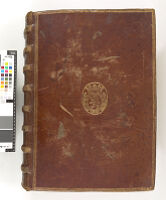
Binding: Post-1600. French, 18th century, with elaborate tooled gilt spine and Foucault’s arms on both boards, marbled endpapers and gilded fore-edges.
- Custodial History:
-
Origin: Western or Southwestern England (Glastonbury or Sherborne?)
Provenance:
The Benedictine abbey of St Mary the Virgin, Sherborne (Dorset): its arms feature in the decoration, feasts of special relevance to Sherborne are included in the Calendar and Sanctorale, such as the feasts of Wulsin, bishop of Sherborne (r. 992-1001) on 8 January; Juthwara (her relics were at Sherborne) on 13 July (p. 489); and the dedication of the church of St Mary, Sherborne on 18 July (p. 492). The manuscript was probably commissioned by Robert Bruyning (fl. 1385-1415), abbot of Sherborne, whose name, portraits and arms feature in the decoration.
Léonor II de Goyon de Matignon (b. 1637, d. 1714), bishop of Lisieux: presented by him to Foucault in 1703, according to a letter written by Foucault to his friend the collector François-Roger de Gaignières in 1703 (quoted in Herbert, The Sherborne Missal (1920), p. 9).
Nicholas Joseph Foucault, marquis of Magny (b. 1643, d. 1721), statesman and archaeologist: his bookplate 'EX BIBLIOTHECA NICOLAI JOSEPH FOUCAULT COMITIS CONSISTORIANI' with his arms: sable a lion rampant, dexter, crowned argent, as supporters two lions argent; his arms on the covers; and his description of the acquisition of the manuscript (see Léonor II de Goyon de Matignon above).
Charles d'Orléans, abbot of Rothelin (b. 1691, d. 1744): his sale in Paris, 1746, lot 248; bought by de Selle.
Marcellin-François-Zacharie de Selle (b. c. 1704, d. 1759), Treasurer-General of the French Navy: included in his sale, 1761, but the manuscript did not reach the reserve.
Charles-Paul de Bourgevin de Vialart de Moligny (b. 1713, d. 1794), Knight of the Order of St-Louis: included in his catalogue: Catalogue des livres du cabinet de Monsieur de Moligny, 1776, by F. F. Fyot (British Library, Add MS 21930; the Sherborne Missal is described on ff. 10v-13r).
George Galwey Mills of Slaughter House, Gloucestershire, member of Parliament (b. 1765, d. 1828): purchased in 1797: his bookplate, and purchase note (f. ii); his sale, 24th February 1800, purchased by Percy for £215.
Hugh Percy, 2nd duke of Northumberland (b. 1742, d. 1817), army officer and politician: his bookplate; passed by descent to Hugh Percy, 10th duke of Northumberland (b. 1914, d. 1988); placed on loan by him at the British Library in 1983 (loan MS 82).
Acquired from Ralph Percy, 12th duke of Northumberland (b. 1956), by the British Library in 1998 in lieu of inheritance tax and with generous support from the National Heritage Memorial Fund.
- Information About Copies:
-
Select digital coverage available for this manuscript; see Virtual Books: http://www.bl.uk/onlinegallery/ttp/sherborne/accessible/introduction.html
Select digital coverage available for this manuscript; see Turning the Pages: http://www.bl.uk/turning-the-pages/?id=181afc99-df1f-4951-8981-df7e26625850&type=book
- Publications:
-
Léopold Delisle, Le Cabinet des Manuscrits de la Bibliothèque Impériale [Nationale]: Étude sur la formation de ce depot, 3 vols (Paris: Imprimerie Nationale, 1868-1881), I, 373-80 (p. 376).
Third Report of the Royal Commission on Historical Manuscripts (1872), Appendix, p. 112.
J.W. Legg, 'Liturgical Notes on the Sherborne Missal, a Manuscript in the Possession of the Duke of Northumberland at Alnwick Castle', Transactions of the St. Paul’s Ecclesiological Society, 4 (1896), 1-31.
E.M. Thompson, 'On the Illuminated Manuscripts in the Exhibition of English Medieval Paintings', Proceedings of the Society of Antiquaries, 2nd ser., 16 (1896), pp. 226-30.
John A. Herbert, The Sherborne Missal: Reproductions of Full Pages and Details of Ornament from the Missal Executed Between the Years 1396 and 1407 for Sherborne Abbey Church and Now Preserved in the Library of the Duke of Northumberland at Alnwick Castle (London: The Roxburghe Club, 1920) [partial facsimile].
Joseph Fowler, Medieval Sherborne (Dorchester: Longmans, 1951), pp. 60-62, 202-04, 207-17.
Margaret Rickert, Painting in Britain: the Middle Ages, 2nd edn (London: Penguin Books, 1965), pp. 163-65, pl. 165.
Richard Marks and Nigel Morgan, The Golden Age of English Manuscript Painting 1200-1500 (London, 1981), pp. 25-26, pls. 28, 29, 30.
Brunson Yapp, 'The Birds of the Sherborne Missal', Proceedings of the Dorset Natural History and Archaeological Society, 104 (1982), 5-15.
John Friedman, ‘John Siferwas and the Mythological Illustrations in the Liber cosmographiae of John de Foxton’, Speculum, 58 (1983), 394-418 (pp. 394, 413-18, figs. 10-13).
T.S. Tolley, 'Some Historical Interests at Sherborne c.1400', England in the Fourteenth Century: Proceedings of the 1985 Harlaxton Symposium, ed. by W. M. Ormrod (Woodbridge : Boydell and Brewer, 1986), pp. 255-66.
Andrew Graham Watson and Neil R. Ker, Medieval Libraries of Great Britain: A List of Surviving Books. Supplement to the Second Edition (London, 1987), p. 62.
T.S. Tolley, 'The use of Heraldry in an English Illuminated Manuscript of the Early Fifteenth Century', The Coat of Arms, n.s. 7 (1988), 122-33.
Ulrich Rehm, 'Accende lumen sensibus: Illustrations of the Sherborne Missal Interpreting Pentecost', Word & Image, 10 (1994), 230-61.
Kathleen L. Scott, Later Gothic Manuscripts 1390-1490, A Survey of Manuscripts Illuminated in the British Isles, 6 (London: Harvey Miller, 1996), I, ills. 44-56 and pl. I; II, no. 9 (as Alnwick Castle, Northumberland, the library of his Grace the Duke of Northumberland, British Library loan 82), pp. 45-60.
John A. Goodall, 'Heraldry in the Decoration of English Medieval Manuscripts', The Antiquaries Journal, 77 (1997), 179-220 (pp. 181, 184, 189-190, 209, 212).
Janet Backhouse, The Sherborne Missal (London: British Library, 1999).
Janet Backhouse, Medieval Birds in the Sherborne Missal (London: British Library, 2001).
Michelle P. Brown, The Sherborne Missal on Turning the Pages, CD-Rom (British Library: 2001).
Timothy Graham, ‘Siferwas, John (fl. 1380–1421)’, rev. Oxford Dictionary of National Biography (Oxford University Press, 2004); online edn, May 2011 [http://www.oxforddnb.com/view/article/37958, accessed 12 Jan 2017]
The Cambridge Illuminations: Ten Centuries of Book Production in the Medieval West, ed. by Paul Binski and Stella Panayotova (London: Harvey Miller, 2005), p. 322.
Julian M. Luxford, The Art and Architecture of English Benedictine Monasteries, 1300-1540: A Patronage History, Studies in the History of Medieval Religion, 25 (Woodbridge: Boydell Press, 2005), pp. 69-70.
Treasures of the British Library, ed. by Nicolas Barker and others (London: British Library, 2005), p. 265.
Michelle Brown, The Holkham Bible: A Facsimile (London, British Library, 2007), p. 18.
Martha Dana Rust, Imaginary Worlds in Medieval Books: Exploring the Manuscript Matrix (New York: Palgrave MacMillan, 2007), pp. 5-6, 171-72, 188 n. 10, fig. I.3.
Philip Howard, The British Library: A Treasure House of Knowledge (London: Scala Publishers, 2008), no. 23.
James Robinson, Masterpieces: Medieval Art (London: British Museum, 2008), pp. 10-11, pl. on p. 1.
Siân Echard, Printing the Middle Ages (Philadelphia: University of Pennsylvania Press, 2009), pp. xv, 198, 205-12, 214, 216, 269, 306.
Richard W. Pfaff, The Liturgy in Medieval England: A History (Cambridge: Cambridge University Press, 2009), pp. 134, 144, 156, 175-78, 236-242, 334, 362, 491.
Michelle Brown, 'The Sherborne Missal and "Roddoke Robertus": The Anatomy of a Major Manuscript Commission', in The Medieval Book: Glosses from Friends and Colleagues of Christopher de Hamel, ed. by James H. Marrow, Richard A. Linenthal, and William Noel (Het Goy: Hess & de Graaf, 2010), 84-97.
Jessica Berenbeim, 'Art of Documentation: The Sherborne Missal and the Role of Documents in English Medieval Art' (unpublished PhD thesis, Harvard University, 2012).
Jessica Berenbeim, 'Personal and Institutional Patronage in the Sherborne Missal', in Patrons and Professionals in the Middle Ages, ed. by Paul Binski and Elizabeth A. New, Harlaxton Medieval Studies, 22 (2012), 261-72.
Jessica Berenbeim, 'Part II: Documents and Authority: Sherborne', in The Art of Documentation: Documents and Visual Culture in Medieval England (Toronto: Pontifical Institute of Mediaeval Studies, 2015), 72-137, Appendix I-II.
Jeffrey Hamburger and Nigel Palmer, The Prayer Book of Ursula Begerin, 2 vols (Zurich: Urs Graf Verlag, 2015), I, pp. 59, 73, 164, 205.
- Exhibitions:
- British Library Treasures, (online), 27 February 2016-
- Material Type:
- Archives and Manuscripts
- Legal Status:
- Not Public Record(s)