Hard-coded id of currently selected item: . JSON version of its record is available from Blacklight on e.g. ??
Metadata associated with selected item should appear here...
Egerton MS 2900
- Record Id:
- 032-001984967
- Hierarchy Root Ancestor Record Id:
- 032-001984967
- MDARK:
- ark:/81055/vdc_100000000057.0x000333
- LARK:
- ark:/81055/vdc_100059294565.0x000001
- SLARK:
- Format:
- ISAD(G)
- Reference (shelfmark):
- Egerton MS 2900
- Title:
- Constantinus Africanus, Viaticum; various medical tracts
- Scope & Content:
-
This volume contains the Viaticum (Provision for a Journey) by Constantine the African (b. c. 1020- d. 1098/9). This is a Latin adaptation of a standard medical manual in Arabic, entitled Kitab Zad al-musafir wa-qut al-hadir (Provision for the Traveller and the Nourishment of the Settled), by Ibn al-Jazzar (d. 979 or 1004-5), a famous physician of Qeirwan in Tunisia. The manuscript also includes a fragment of an unknown medical tract and an adaptation by John of Seville (fl. 1135-1153) of the medical work Secretum secretorum (The Secret of Secrets), attributed to Aristotle (b. 372 BC, d. 287 BC). The manuscript also contains a colophon written in cipher: 'Dkgnxs fst ppfrbrkxs mfrcfdf sxb', in which the vowels have been replaced by the neighbouring letter of the alphabet, and can therefore be decoded as 'Dignus est operarius mercede sua' (Luke 10:7) (f. 102v).
f. 1v-1r: A 14th-century fragment of a medical text incorporating parts of the Epitome Anonyma (The Anonymous Summary) by the physician Vindicianus Afer (fl. 4th century).
ff. 2v-102v: Constantine the African, Viaticum including a cryptographic colophon (f. 102v).
ff. 103r-104r: John of Seville, Epistola Aristotelis ad Alexandrum de regimine sanitatis (Aristotle’s letter to Alexander the Great on health), a medical excerpt from Secretum secretorum, attributed to Aristotle, followed by fifteen hexameters, in the same hand.
Decoration:
8 large initials in brown ink with foliate decoration at the beginning of books and the prologue (ff. 2v, 4r, 21r, 31v, 46r, 62r, 78v, 87v). Small initials in red or blue, some with simple pen-work decoration. Rubrics in red.
- Collection Area:
- Western Manuscripts
- Project / Collection:
- Egerton Manuscripts
England and France 700-1200 Project - Hierarchy Tree:
- [{ "id" : "032-001984967", "parent" : "#", "text" : "Egerton MS 2900: Constantinus Africanus, Viaticum; various medical tracts" , "li_attr" : {"class": "orderable"} }]
- Hierarchy Record Ids:
- 032-001984967
- Is part of:
- not applicable
- Hierarchy:
- 032-001984967
- Container:
- not applicable
- Record Type (Level):
- Fonds
- Extent:
-
A parchment codex
- Digitised Content:
- https://iiif.bl.uk/uv/#?manifest=https://bl.digirati.io/iiif/ark:/81055/vdc_100059294565.0x000001 (opens in a new tab)
- Thumbnail:
-
- Languages:
- Latin
- Scripts:
- Latin
- Start Date:
- 1150
- End Date:
- 1199
- Date Range:
- 2nd half of the 12th century
- Era:
- CE
- Access:
- User Conditions:
- Letter of introduction required to view this manuscript
Please request the physical items you need using the online collection item request form.
Digitised items can be viewed online by clicking the thumbnail image or digitised content link.
Readers who have registered or renewed their pass since 21 March 2024 can request physical items prior to visiting the Library by completing
this request form.
Please enter the Reference (shelfmark) above on the request form.If your Reader Pass was issued before this date, you will need to visit the Library in London or Yorkshire to renew it before you can request items online. All manuscripts and archives must be consulted at the Library in London.
This catalogue record may describe a collection of items which cannot all be requested together. Please use the hierarchy viewer to navigate to individual items. Some items may be in use or restricted for other reasons. If you would like to check the availability, contact our Reference Services team, quoting the Reference (shelfmark) above.
- Physical Characteristics:
-
Materials: Parchment.
Dimensions: 220 x 145 mm (text space: 160 x 90 mm)
Foliation: ff. 105 ( + 1 unfoliated paper flyleaf at the beginning); a book-plate pasted to the unfoliated paper flyleaf has been numbered (i).
Script: Protogothic
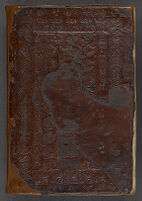
Binding: Pre-1600. Romanesque covers of brown leather, blind tooled, with stamps forming a central vertical panel and border; the designs include Samson and the lion, two dragons interlaced, a cockatrice, a centaur shooting, a lion with a palmated tail, and a stag; rebacked at the British Museum.
- Custodial History:
-
Origin: France.
An unknown monastery: an erased ownership (?) inscription appears to include the word 'monaster[erii]' (f. 2r).
An unknown 13th-century owner: added various notes (f. 105r).
An unknown 15th-century female owner: inscribed a request for prayers 'Orate pro datore huius libri unum pater noster et ave maria quia peccatrix fuit etc.’ (f. 103v).
? An unknown 15th- or 16th-century owner: inscribed 'Lord C[r]ys[t]e [...]' on f. 104b and letters in Rashi Hebrew script on f. 105r).
Sir Thomas Phillipps (b. 1792, d. 1872), baronet, collector of books and manuscripts: inscription 'Phillipps MS 6925' (f. 2r); his sale, 27 April, 1903, lot 287, bought by Bernard Quaritch for £89.
Bernard Quaritch (b. 1819, d. 1899), book-dealer, owned in 1903.
George Dunn (b. 1865, d. 1912) of Woolley Hall, near Maidenhead: his bookplate (inside of the upper cover); his sale, 13 February 1918, lot 451, bought by the British Museum, using the Farnborough Fund (£3,000 bequeathed in 1838 by Charles Long, Baron Farnborough (b. 1761, d. 1838), a cousin of Francis Henry Egerton, 8th Earl of Bridgewater (b. 1756, d. 1829), founder of the collection).
- Information About Originals:
-
Full digital coverage available for this manuscript: see Digitised Manuscripts at http://www.bl.uk.manuscripts/.
Select digital coverage available for this manuscript; see the Catalogue of Illuminated Manuscripts, https://bl.uk/catalogues/illuminatedmanuscripts/.
- Publications:
-
Catalogue of Additions to the Manuscripts in the British Museum in the Years 1911-1915, 2 vols (London: British Museum, 1969), I, pp. 413-15.
A Guide to the Exhibition of Some Part of the Egerton Collection of Manuscripts in the British Museum (London: British Museum, 1929), no. 33.
Geoffrey D. Hobson, English Binding before 1500 (Sandars Lectures, 1927) (Cambridge: Cambridge University Press, 1929), p. 30, pls 29 and 30.
Geoffrey D. Hobson, ‘Further Notes on Romanesque Bindings’, The Library, 4th series, 15 (1934-1935), 161-211 (p. 196 n. 19, 205).
Howard Millak Nixon, 'The Binding of the Winton Domesday', in Winchester in the Early Middle Ages: An Edition and Discussion of the Winton Domesday, ed. by Martin Biddle, Winchester Studies, 1 (Oxford: Clarendon Press, 1976), pp. 526-40 (p. 531).
Christopher F. R. De Hamel, Glossed Books of the Bible and the Origins of the Paris Booktrade (Woodbridge: Brewer, 1984), pp. 66, 68, 79 n. 93.
Mary Frances Wack, Lovesickness in the Middle Ages: The Viaticum and Its Commentaries (Philadelphia: University of Pennsylvania Press, 1990), p. 180.
- Material Type:
- Archives and Manuscripts
- Legal Status:
- Not Public Record(s)
- Notes:
- This manuscript is part of The Polonsky Foundation England and France Project: Manuscripts from the British Library and the Bibliothèque nationale de France, 700-1200.