Hard-coded id of currently selected item: . JSON version of its record is available from Blacklight on e.g. ??
Metadata associated with selected item should appear here...
Egerton MS 3127
- Record Id:
- 032-001985264
- Hierarchy Root Ancestor Record Id:
- 032-001985264
- MDARK:
- ark:/81055/vdc_100000000057.0x00038e
- LARK:
- ark:/81055/vdc_100057739940.0x000001
- SLARK:
- Format:
- ISAD(G)
- Reference (shelfmark):
- Egerton MS 3127
- Title:
- Cocharelli, Treatise on the Vices and Virtues (fragment)
- Scope & Content:
-
This item comprises 2 parchment leaves from the ‘Cocharelli Codex’,of which only 27 leaves and fragments in three different collections survive.
The original codex included two richly-illuminated texts, the first on the vices and virtues and the second on historical events during the time of Frederic II of Sicily (r. 1295-1337). The prologue to the treatise on vices and virtues explains that the texts were compiled by a member of the Cocharelli family of Genoa based on tales recounted by his grandfather, Pellegrino Cocharelli (fl. 1269-1307). The fragments are particularly well-known for their renderings of birds, animals and insects.
Other leaves and cuttings from the original volume are British Library, Additional MS 27695, Additional MS 28841 and Egerton MS 3781; Cleveland, Cleveland Museum of Art, J.H. Wade Fund n. 1953.152; and Florence, Museo del Bargello, inv. 2065.
Contents:
ff. 1-2: Cocharelli, Treatise on the Seven Vices (fragment).
Decoration:
1 miniature of a hunting party filling the space at the end of the text including the borders, in colours and gold (f. 1v). 1 full historiated border illustrating Treachery, with some figures partly unfinished, in colours and gold (f. 2). Text pages with full decorated borders, containing roundels with insects in the lower borders, in colours and gold (ff. 1, 2v). Large and small initials in gold on red and blue grounds. Line fillers made of insects such as caterpillars, etc. (f. 2).
The decoration was formerly assigned to a Genoese ‘Monk of Hyères’, thought to be active around 1370. It is now recognised that at least two artists worked on the illuminations between c. 1330-40, with most of the full-page miniatures painted by the so-called ‘Master of the Cocharelli Codex’ (see Fabbri, ‘Maestro del Codice Cocharelli’ (2004), pp. 495-97).
- Collection Area:
- Western Manuscripts
- Project / Collection:
- Egerton Manuscripts
- Hierarchy Tree:
- [{ "id" : "032-001985264", "parent" : "#", "text" : "Egerton MS 3127: Cocharelli, Treatise on the Vices and Virtues (fragment)" , "li_attr" : {"class": "orderable"} }]
- Hierarchy Record Ids:
- 032-001985264
- Is part of:
- not applicable
- Hierarchy:
- 032-001985264
- Container:
- not applicable
- Record Type (Level):
- Fonds
- Extent:
-
2 parchment leaves, bound in an album
- Digitised Content:
- https://iiif.bl.uk/uv/#?manifest=https://bl.digirati.io/iiif/ark:/81055/vdc_100057739940.0x000001
- Thumbnail:
-
- Languages:
- Latin
- Scripts:
- Latin
- Start Date:
- 1325
- End Date:
- 1340
- Date Range:
- c 1330-1340
- Era:
- CE
- Access:
-
Please request the physical items you need using the online collection item request form.
Digitised items can be viewed online by clicking the thumbnail image or digitised content link.
Readers who have registered or renewed their pass since 21 March 2024 can request physical items prior to visiting the Library by completing
this request form.
Please enter the Reference (shelfmark) above on the request form.If your Reader Pass was issued before this date, you will need to visit the Library in London or Yorkshire to renew it before you can request items online. All manuscripts and archives must be consulted at the Library in London.
This catalogue record may describe a collection of items which cannot all be requested together. Please use the hierarchy viewer to navigate to individual items. Some items may be in use or restricted for other reasons. If you would like to check the availability, contact our Reference Services team, quoting the Reference (shelfmark) above.
- User Conditions:
- Letter of introduction required to view this manuscript.
- Physical Characteristics:
-
Materials: Parchment.
Dimensions: 170 x 105 mm (text space: 125 x 80 mm).
Layout: Written in two columns.
Foliation: Parchments leaves foliated as '1' and '2'.
Script: Gothic.
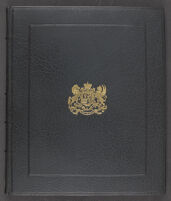
Binding: Post-1600. Parchment leaves in double-sided paper window mounts, bound together in an album of green leather.
- Custodial History:
-
Origin: Italy, N. (Genoa).
Provenance:
The Cocharelli family of Genoa, probably before 1324: the unnamed grandson of Pelegrino Cocharelli describes it as having been made for the children of the family (see Backhouse, The Illuminated Page (1997), no. 115; and Fabbri, 'Maestro del Codice Cocharelli' (2004), pp. 495-97).
Bought by the British Museum in 1934, using the Bridgewater fund (£12,000 bequeathed in 1829 by Francis Henry Egerton, 8th Earl of Bridgewater (b. 1756, d. 1829).
- Information About Copies:
- Full digital coverage available for this manuscript; see the Catalogue of Illuminated Manuscripts, https://bl.uk/catalogues/illuminatedmanuscripts/ or Digitised Manuscripts at http://www.bl.uk/manuscripts.
- Publications:
-
A. C. Crombie, 'Cybo d'Hyères: a fourteenth century zoological artist', Endeavour, 9 (1952), 18-37, figs. 1-2.
British Museum Catalogue of Additions to the Manuscripts 1931-1935 (London: British Museum, 1967), no. Eg. 3127.
Francis Klingender, Animals in Art and Thought to the end of the Middle Ages, ed. by Evelyn Antal and John Harthan (London: Routledge & Kegan Paul, 1971), p. 479, pl. 295.
G. Evelyn Hutchinson, 'Aposematic insects and the Master of the Brussels Initials', American Scientist, 62 (1974), 161-71.
Brunsdon Yapp, Birds in Medieval Manuscripts (London: British Library, 1981), pl. 40.
Europa und der Orient: 800-1900, ed. by Gereon Sievernich and Hendrik Budde (Berlin: Bertelsmann Lexikon, 1989), no. 5/2 [exhibition catalogue].
Janet Backhouse, The Illuminated Page: Ten Centuries of Manuscript Painting in the British Library (Toronto: University of Toronto Press, 1997), no. 115.
British Library Catalogue of Additions to the Manuscripts, New Series 1966-1970, 2 vols (London: British Museum, 1998), I, no. Eg. 3781.
Aristotle's Animals in the Middle Ages and Renaissance, ed. by Carlos Steel, Guildentops and Pieter Beullen (Leuven: University Press, 1999), p. 376, n. 47.
Francesca Fabbri, 'Il "Cocharelli": osservazione e ipotesi per un manoscritto genovese del XIV sec', in Tessuti, oreficerie, miniature in Liguria XIII-XV secoli, ed. by A. R. Calderoni Masetti, C. Di Fabio and M. Marcenaro, Atti del Convegno Internazionale di Studi: Genova-Bordighera, 22-25 May 1995 (Bordighera: Istituto Internazionale di Studi Liguri, 1999), pp. 305-20.
Robert Gibbs, 'Antifonario N: A Bolognese choirbook in the context of Genoese illumination between 1285 and 1385,' in Tessuti, oreficerie, miniature in Liguria XIII-XV secoli, ed. by A. R. Calderoni Masetti, C. Di Fabio and M. Marcenaro, Atti del Convegno Internazionale di Studi: Genova-Bordighera, 22-25 May 1995 (Bordighera: Istituto Internazionale di Studi Liguri, 1999), 247-78, (pp. 270-78, figs. 20-22).
Francesco Mezzalira, Bestie e bestiari: la rappresentazione degli animali dalla preistoria al rinascimento (Turin: Umberto Allemandi, 2001), pp. 42, 46.
Nicholas Bell, Music in Medieval Manuscripts (London: British Library, 2001), pp. 52-53.
Debra Higgs Strickland, Saracens, Demons, & Jews: Making Monsters in Medieval Art (Princeton: Princeton University Press, 2003), fig. 9.
Francesca Fabbri, 'Maestro del Codice Cocharelli', in Dizionario biografico dei miniatori Italiani: Secoli IX-XVI, ed. by Milvia Bollati (Milan: Bonnard, 2004), pp. 495-97, 1040.
Elizabeth Morrison, Beasts: Factual & Fantastic (Los Angeles: J. Paul Getty Museum, 2007), p. 54.
Margaret Scott, Medieval Dress & Fashion (London: British Library, 2007), pl. 51, 54.
Joe Flatman, Ships and Shipping in Medieval Manuscripts (London: British Library, 2009), pl. 6.
Francesca Fabbri, 'Il codice Cocharelli fra Europa, Mediterraneo e Oriente', in La pittura in Liguria: Il Medioevo secoli XII-XIX, ed. by Guiliana Algeri and Anna de Floriani (Genoa: De Ferrari, 2011), pp. 289-310.
Francesca Fabbri, 'Vizi e virtù in due codici realizzati a Genova nel Trecento fra seduzioni d’oriente e apporti toscani', Rivista di Storia della miniatura, 17 (2013), 95-106.
Chiara Concina, 'Unfolding the Cocharelli Codex: Some Preliminary Observations about the Text, with a Theory about the Order of the Fragments', Medioevi: Rivista di letterature e culture medievali, 2 (2016), pp. 189-265.
Anne Dunlop, 'Ornament and Vice: The Foreign, the Mobile, and the Cocharelli Fragments', in Histories of Ornament: From Global to Local, ed. by Gülru Necipoğlu and Alina Payne (Princeton: Princeton University Press, 2016), pp. 228-37.
Simonetta Nicolini, 'Una notizia bibliografica per i frammenti Cocharelli', Intrecci d’arte, 5 (2016), 9-22.
- Material Type:
- Archives and Manuscripts
- Legal Status:
- Not Public Record(s)