Hard-coded id of currently selected item: . JSON version of its record is available from Blacklight on e.g. ??
Metadata associated with selected item should appear here...
Add MS 28260
- Record Id:
- 032-002019611
- Hierarchy Root Ancestor Record Id:
- 032-002019611
- MDARK:
- ark:/81055/vdc_100000000037.0x00023a
- LARK:
- ark:/81055/vdc_100058662978.0x000001
- SLARK:
- Format:
- ISAD(G)
- Reference (shelfmark):
- Add MS 28260
- Title:
-
Moral and didactic texts in French
- Scope & Content:
-
Contents:
ff. 1r-2r: inserted leaves containing fragments of grammatical treatises in Latin in a 13th-century hand;
ff. 3r-33v: Philip of Novara (Philippe de Novare) (b. 1195, d. c. 1270), Les Quatre Ages de l'Homme, a treatise on the four ages of Man, composed between 1265 and 1270 in the Crusader Kingdom of Jerusalem; imperfect at the end, with the fourth section lacking;
ff. 35r-83v: the Lucidaire, a French translation of the Elucidarium, attributed to St. Anselm of Canterbury and to Honorius of Autun;
ff. 84r-100v: Li livres des bestes, or Bestiaire de Gervaise, a short moralistic version of the bestiary in French verse, stated in the prologue to have been adapted by 'Gervases' from the Latin. This is the only known copy of the text in French, but the Latin prose version of the Dicta Chrysostomi version of the Physiologus in Sloane MS. 278, ff. 44r-57r is possibly the original of this work.
ff. 101r-v: Inserted leaf containing Petrus de Riga, the Aurora or Latin metrical biblical history: a fragment comprising part of the story of Bel and the Dragon and of the Book of Judith, in a 13th-century hand.
Decoration:
Pen drawings in the margins, some framed, of animals and hybrid creatures including a mermaid, illustrating the bestiary (ff. 85r, 86r, 86v, 87r, 88v, 89r, 89v, 90r, 91r, 91v, 93r) up to the entry for the raven; initials in red, some with pen-flourishing in the same colour at textual divisions (e.g. ff. 3r, 12r, 24v); 'D' for 'deciple' and 'M' for 'mestre, rubrics and line-fillers in red in the Lucidaire (ff. 35r-83v).
Catchwords.
- Collection Area:
- Western Manuscripts
- Project / Collection:
- Additional Manuscripts
- Hierarchy Tree:
- [{ "id" : "032-002019611", "parent" : "#", "text" : "Add MS 28260: Moral and didactic texts in French" , "li_attr" : {"class": "orderable"} }]
- Hierarchy Record Ids:
- 032-002019611
- Is part of:
- not applicable
- Hierarchy:
- 032-002019611
- Container:
- not applicable
- Record Type (Level):
- Fonds
- Extent:
-
A parchment codex, 101 folios
- Digitised Content:
- https://iiif.bl.uk/uv/#?manifest=https://bl.digirati.io/iiif/ark:/81055/vdc_100058662978.0x000001 (opens in a new tab)
- Thumbnail:
-
- Languages:
- French
Latin - Scripts:
- Latin
- Start Date:
- 1250
- End Date:
- 1299
- Date Range:
- 2nd half of the 13th century
- Era:
- CE
- Access:
- User Conditions:
- Letter of introduction required to use this manuscript.
Please request the physical items you need using the online collection item request form.
Digitised items can be viewed online by clicking the thumbnail image or digitised content link.
Readers who have registered or renewed their pass since 21 March 2024 can request physical items prior to visiting the Library by completing
this request form.
Please enter the Reference (shelfmark) above on the request form.If your Reader Pass was issued before this date, you will need to visit the Library in London or Yorkshire to renew it before you can request items online. All manuscripts and archives must be consulted at the Library in London.
This catalogue record may describe a collection of items which cannot all be requested together. Please use the hierarchy viewer to navigate to individual items. Some items may be in use or restricted for other reasons. If you would like to check the availability, contact our Reference Services team, quoting the Reference (shelfmark) above.
- Physical Characteristics:
-
Materials: parchment.
Dimensions: 150 x 105 mm (text space: 110 x 750 mm).
Foliation: ff. 101 (+1 unfoliated parchment leaf after f. 83).
Script: Gothic.
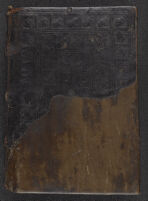
Binding: 15th-century French. Stamped leather over wooden boards.
- Custodial History:
-
Origin: France, N.
Provenance:
Johannes Devanteri alias Sapiens (Jehan Devanteri-Savioz?), perhaps Prior of the Confrérie du Saint-Esprit, Muraz in 1471, or his son, also named John: inscribed, 'Jo[hann]is devantorij al[ia]s Sapientis 1502' (ff. 2v, 3r).
The date of 1521 (or 1529) inscribed in another 16th-century hand (f. 34v).
Bought by the British Museum from Librairie Tross, booksellers of Paris, 9 April 1870.
- Publications:
-
Paul Meyer, 'Le bestiaire de Gervaise', Romania, 1, (1872), 420-43 [an edition of the text].
The British Museum Catalogue of Additions to the Manuscripts, 1861-1875, 2 vols (London: British Museum, 1877), II, pp. 459-60.
Philip of Novara, Les Quatre ages de l'homme, traité moral de Philippe de Navarre, ed. by Marcel de Fréville (Paris: Société des anciens textes français, 1888) [on the text].
Florence McCulloch, Mediaeval Latin and French Bestiaries, North Carolina Studies in the Romance Languages and Literatures, 33 (Chapel Hill: University of North Carolina Press, 1960, 2nd edn. 1962), pp. 41-42, 55
Guy R. Mermier, 'The Bestiaire of Gervaise', Papers of the Michigan Academy of Science, Arts and Letters, 53 (1968), 337-52.
Palémon Glorieux, La Faculté des arts et ses maîtres au XIIIe siècle (Paris: Librairie philosophique J. Vrin, 1971), p. 146.
Xenia Muratova, 'Le bestiaire médiéval et la culture normande' in Manuscrits et enluminures dans le monde normand (Xe-XVe siècles) (Caen: Presses universitaires de Caen, 1999), pp. 151-66 (p. 162).
Monica Türk, 'Lucidaire de grant sapientie' :Untersuchung und Edition der altfranzösischen Übersetzung des Elucidarium von Honorius Augustodunensis (Tübingen: Max Niemeyer Verlag 2000), p. 22.
Jacqueline Leclercq-Marx, ‘La sirène et l’o(ono)centaure dans le Physiologus grec et latin et dans quelques bestiaries: Le texte et l’image’, in Bestiarires médiévaux: Nouvelles perspectives sur les manuscrits de les traditions textuelles, ed. by Baudouin Van den Abelle, Publications de l’Institut d’études médiévales, Collection Textes, études, congrés, 21 (Louvain: Brepols, 2005), pp. 169-82 (p.
Elisabeth Schulze-Busacker, 'Philippe de Novare, les Quatre âges de l'homme', Romania, 127:1-2 (2009), 104-46 [on the text].
- Material Type:
- Archives and Manuscripts
- Legal Status:
- Not Public Record(s)