Hard-coded id of currently selected item: . JSON version of its record is available from Blacklight on e.g. ??
Metadata associated with selected item should appear here...
Add MS 17333
- Record Id:
- 032-002027579
- Hierarchy Root Ancestor Record Id:
- 032-002027579
- MDARK:
- ark:/81055/vdc_100000000054.0x0003ce
- LARK:
- ark:/81055/vdc_100057737525.0x000001
- SLARK:
- Format:
- ISAD(G)
- Reference (shelfmark):
- Add MS 17333
- Title:
- Apocalypse (the 'Val-Dieu Apocalypse')
- Scope & Content:
-
Content:
Apocalypse (Revelation), in parallel Latin and French.
Latin version:
ff. 1r-47v: 'Apocalipsis Ihesu Christi quam dedit illi Deus palam facere servis suis'. Ending: ' Et fratrum tuorum prophetarum et corum qui servant verba libri huius. Deus adora'.
Old French version:
ff. 1r-47v: 'Cest la revelation de Iesu Crist que deu le pere li donna por fere assavoir a ses serjans'. Ending: 'Iesu ton compagnon est servise et a tes freres les prophetes et a ceus qui gardent les paroles de cest livre. Dieu aoure'.
Decoration:
83 half-page images in colours with gold on diapered grounds, some with partial foliate borders containing birds and animals. Framed initials in colours or gold on coloured grounds.
The upper halves of 4 folios containing the images have been removed, leaving only lower half with the text (ff. 9, 13, 35, 44). One of these, f. 44 has been misbound. It should follow f. 45 as it contains the French text corresponding to the Latin on f. 45v.
This manuscript is connected stylistically with a group of Apocalypse manuscripts created in Normandy around 1320-1330: the Apocalypse of Saint-Victor (Paris, BnF MS lat. 14410), the Cloisters Apocalypse (New York, Metropolitan Museum of Art, Cloisters Collection MS 68.174) and Namur, Grand Seminaire, MS 77. All four are related to the Pontifical of Guillaume de Thiéville (Paris, BN lat. 973), see Morgan, 'French Interpretations' (2000), p. 142, and Avril, Fastes (1981), p. 304.
Based on an English source, according to Deuchler and Hoffeld, Cloisters Apocalypse (1971), p. 10.
The subjects of the images are as follows:
f. 1r: St John the Divine sleeping on the Island of Naxos, holding a book; an angel tells him to write down what he sees in his vision; a ship at anchor (Revelation 1: 4-11);
f. 1v: St John kneels to the Lord, seated with a sword in his mouth and the seven candlesticks beside him (Revelation 1: 12-20);
f. 3r: The seven churches of Asia minor (Revelation 2-3);
f. 3v: John’s vision of Heaven with the Lord in a mandorla holding a book, surrounded by 24 crowned Elders with musical instruments (Revelation 4:14-22);
f. 4r: The Elders worship the four Beasts of the Apocalypse: the lion, the ox, the eagle, and the man (Revelation 4: 10-11)
f. 4v: The Lamb on his throne surrounded by the four Beasts and the Elders (Revelation 6: 6) ;
f. 5r: The Lamb takes the book with Seven Seals from the Lord (Revelation 6:7);
f. 5v: The first seal: the rider on the white horse; the lion hands a scroll down from heaven (Revelation 6:1-2);
f. 6r: The second seal: the rider on the red horse, with men fighting (Revelation 6:3-4)
f. 6v: The third seal: the rider on the black horse holding scales or balances (Revelation 6:5);
f. 7r: The fourth seal: the rider on the pale horse with a hell mouth and fire consuming souls behind him (Revelation 6:7-8);
f. 7v: The fifth seal: the souls of the Martyrs beneath an altar Revelation 6:9-11);
f. 8r: The sixth seal: the earthquake, with men hiding in the mountains and the stars falling (Revelation 6: 12-17);
f. 8v: Angels holding the four winds (Revelation 7: 1);
f. 9r: The seventh seal: an angel pours fire from a censer on the earth, causing thunder, lightning and earthquake (Revelation 8: 1-5);
f. 9v: Angels holding the four winds:
f. 10r: The first trumpet: hail and fire on the earth (Revelation 8:7);
f. 10v: The seven angels with seven trumpets (Revelation 8:6);
f. 11r: The second trumpet: fire on the sea and ships destroyed (Revelation 8: 8-9);
f. 11v: The third trumpet: a star falls from Heaven on the rivers and fountains, making them bitter so that men die (Revelation 8: 10-11);
f. 12r: The fourth trumpet: a third of the sun and moon are darkened and an eagle flies over holding a banner with the words ‘v[a]e v[a]e v[a]e’ (woe woe woe) (Revelation 8: 12);
f. 12v: The fifth trumpet: a star falls into the earth, the angel holds the key and opens the bottomless pit so that smoke rises and locusts like horses emerge, led by Abaddon (Revelation 9: 1-11);
f. 14r: The sixth trumpet: an angel releases the four angels who will slay a third of men (Revelation 9:15)
f. 14v: Horsemen kill people by fire and brimstone (Revelation 9: 17-20);
f. 15r: An angel comes down from heaven with a rainbow on his head and his feet pillars of fire (Revelation 10: 1-2);
f. 15v: An angel gives the book to John to eat (Revelation 10: 10);
f. 16r: An angel gives John a rod to measure the Temple (Revelation 11: 1);
f. 16v: The two witnesses prophesy (Revelation 11: 3-6);
f. 17r: The witnesses are killed by the beast (Revelation 11: 7-8);
f. 17v: The bodies of the witnesses lie in the streets while people make merry, then the spirit of enters them (Revelation 11: 8-11);
f. 18r: The witnesses ascend in a cloud and an earthquake destroys the city (Revelation 11: 12-13);
f. 18v: The seventh trumpet: the 24 Elders worship in heaven (Revelation 11: 15-16);
f. 19r: The dragon with seven heads attacks the Woman clothed with the sun, who gives her child to an angel; she opens a book (right) (Revelation 12: 1-5);
f. 19v: War in Heaven: Michael and his angels attack the dragon (Revelation 12: 7-8);
f. 20r: The dragon attacks the Woman, who is given eagle’s wings by an angel (Revelation 12: 14);
f. 20v: The Woman flies to the wilderness; the dragon follows her and spews out water (Revelation 12: 14-15);
f. 21r: The dragon attacks the descendants of the Woman (Revelation 12: 17);
f. 21v: A beast emerges from the sea and is given power by the dragon (Revelation 13: 1-2);
f. 22r: People worship the dragon and the beast (Revelation 13: 4);
f. 22v: The beast makes war on the saints (Revelation 13: 7);
f. 23r: A false prophet or beast with lamb’s horns rises from the earth, he performs false miracles and people worship him (Revelation 13: 13-14);
f. 23v: The false prophet gives power to the image of the beast and people worship him; his followers kill righteous people who will not worship the beast (Revelation 13: 15);
f. 24r: People receive the mark of the beast on their right hand (Revelation 13: 16);
f. 24v: John’s vision of the Lamb on Mount Sion and the 144 0000 worshippers (Revelation 14: 1);
f. 25r: An angel preaches the gospel to the dwellers on earth (Revelation 14: 6);
f. 25v: The fall of Babylon announced by an angel (Revelation 14: 8);
f. 26r: An angel points to the wine of the wrath of God in the cup of his indignation, in the presence of the Lamb (Revelation 14: 10);
f. 26v: A voice from heaven tells John to write, ‘Blessed are the dead’, and the souls of the righteous are taken up to heaven by two angels (Revelation 14: 13);
f. 27r: The Son of man is on a cloud with a sickle and he comes down to harvest the earth (Revelation 14:14-16);
f. 27v: An angel gathers grapes from a vine for the winepress (Revelation 14: 19);
f. 28r: The angel feeds the winepress of the wrath of God outside the city, and a stream of red wine flows past two horses (Revelation 14: 20);
f. 28v: Seven angels with harps, representing the seven plagues, a sea of glass with fire and a female figure with a veil and halo (the Virgin Mary?) watches, with a white dove at her feet (Revelation 15: 1-2);
f. 29r: Seven angels with gold girdles and come out of the temple and are given gold vials by a winged beast (representing the four Beasts of the Apocalypse) (Revelation 15: 6-7);
f. 29v: The first angel pours his vial on the earth, and men with the mark of the beast are afflicted (Revelation 16: 2)
f. 30r: The second angel pours his vial on the sea; it turns to blood and all die (Revelation 16: 3);
f. 30v: The third angel pours his vial on the rivers and springs; another angel stands at an altar (Revelation 16: 6-7);
f. 31r: The fourth angel pours his vial on the sun and men are scorched with great heat (Revelation 16: 8-9)
f. 31v: The fifth angel pours his vial on the seat of the beast, and people gnaw their tongues in pain (Revelation 16: 10);
f. 32r: The sixth angel pours his vial on the Euphrates rive and it dries up, opening the way for the kings of the East (Revelation 16: 12);
f. 32v: Frogs emerge from the mouths of the dragon, the beast and the false prophet (Revelation 16: 13-14);
f. 33r: The dragon, the beast and the false prophet gather the kings of the earth for battle (Revelation 16:14);
f. 33v: The seventh angel pours his vial into the air and a voice comes from heaven, with thunder, lightning and earthquake, causing the cities to fall (Revelation 16: 17-19);
f. 34r: An angel leads John to the wilderness to see the wicked woman of Babylon, dressed in red and purple and holding a golden cup (Revelation 17: 3-4);
f. 34v: The angel holds John in his arms, showing the wicked woman seated on the beast (Revelation 17: 7);
f. 36r: An angel calls down the evil birds on the city of Babylon, filled with beasts and devils (Revelation 18: 2-9)
f. 36v: People leave the burning city of Babylon (Revelation 18: 18);
f. 37r: People lament the fall of Babylon (Revelation 18: 19);
f. 37v: An angel casts a millstone in the sea, with a figure in a boat in the background (Revelation 18: 21);
f. 38r: John watches angels and elders worshipping God in heaven; the wicked woman lies on the ground (Revelation 19: 1-4);
f. 38v: The marriage feast of the Lamb: a crowned woman in white kisses the lamb and fish and loaves are laid out on a table (Revelation 19: 7-8);
f. 39r: An angel tells John to write the true sayings of God; John worships the angel (Revelation 19: 9-10);
f. 39v: Heaven opens and the Lord, a bloody rider on a white horse appears with a sword in his mouth; the armies of heaven clothed in white, follow him; the Lord treads the winepress ((Revelation 19: 11-16);
f. 40r: An angel standing in the sun calls the birds together to eat the flesh of the fallen kings and their armies (Revelation 19: 17-18);
f. 40v: The armies of the Lord and the beast fight one another (Revelation 19: 19);
f. 41r: The Lord watches as a devil casts the beast and the false prophet into a pit of fire (Revelation 19: 20);
f. 41v: An angel leads the dragon and unlocks the pit where he will be imprisoned (Revelation 20: 1-2);
f. 42r: The First Resurrection: the souls of the dead wait, while those of the faithful are seated on thrones (Revelation 20: 4-5);
f. 42v: The followers of Satan are defeated and devoured by fire, while people watch from a city (Revelation 20: 8-9);
f. 43r: The devil, the beast and the false prophet are cast into hell mouths (Revelation 20: 10);
f. 43v: The dead stand before God on Judgement Day (Revelation 20: 12);
f. 45r: John sees a vision of the New Jerusalem (Revelation 21: 1-2);
f. 45v: An angel takes John to show him Jerusalem descending from Heaven (Revelation 21: 9-10);
f. 46r: The River of Life flows from the throne of God and the Lamb onto the city (Revelation 22: 1-2);
f. 46v: The angel shows John the light of God (Revelation 22: 5);
f. 47r: John worships Christ, who holds the Book of Life (Revelation 22: 7-20).
- Collection Area:
- Western Manuscripts
- Project / Collection:
- Additional Manuscripts
- Hierarchy Tree:
- [{ "id" : "032-002027579", "parent" : "#", "text" : "Add MS 17333: Apocalypse (the 'Val-Dieu Apocalypse')" , "li_attr" : {"class": "orderable"} }]
- Hierarchy Record Ids:
- 032-002027579
- Is part of:
- not applicable
- Hierarchy:
- 032-002027579
- Container:
- not applicable
- Record Type (Level):
- Fonds
- Extent:
-
A parchment codex, 47 folios.
- Digitised Content:
- https://iiif.bl.uk/uv/#?manifest=https://bl.digirati.io/iiif/ark:/81055/vdc_100057737525.0x000001
- Thumbnail:
-
- Languages:
- French, Old
Latin - Scripts:
- Latin
- Start Date:
- 1320
- End Date:
- 1330
- Date Range:
- c. 1320-1330
- Era:
- CE
- Access:
-
Please request the physical items you need using the online collection item request form.
Digitised items can be viewed online by clicking the thumbnail image or digitised content link.
Readers who have registered or renewed their pass since 21 March 2024 can request physical items prior to visiting the Library by completing
this request form.
Please enter the Reference (shelfmark) above on the request form.If your Reader Pass was issued before this date, you will need to visit the Library in London or Yorkshire to renew it before you can request items online. All manuscripts and archives must be consulted at the Library in London.
This catalogue record may describe a collection of items which cannot all be requested together. Please use the hierarchy viewer to navigate to individual items. Some items may be in use or restricted for other reasons. If you would like to check the availability, contact our Reference Services team, quoting the Reference (shelfmark) above.
- User Conditions:
- Letter of introduction required to view this manuscript
- Physical Characteristics:
-
Materials: Parchment.
Dimensions: 325 x 225 (190/250 x 185) mm.
Layout: in two columns.
Foliation: ff. 47 (+ 2 unfoliated paper flyleaves, one marbled, and 2 unfoliated parchment flyleaves at the beginning and 2 unfoliated parchment flyleaves and 1 paper flyleaf at the end).
Script: Gothic.
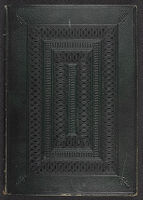
Binding: Post-1600. Green leather with gold tooling.
- Custodial History:
-
Origin: France, Normandy.
Provenance:
Dimidiating or split armorial shields (unidentified: Party per or, a lion passant rouge and azur, fretty or), repeated in the intials on ff. 11v, 12, 13, 14, 15 16 and 16v, suggest that the patrons were a husband and wife, perhaps the couple pictured in NY, Metropolitan Museum, Cloisters MS (see Michael Michael, 'Last Things' (1999)).
The Chartreuse of Valdieu near Mortagne, in the diocese of Séez, inscribed 'Ex Libris Cartusiae Vallis Dei' in a hand of the 17th century (f. 1).
Thomas Rodd, London bookseller, bought from him by the British Museum, 6 May 1848.
- Information About Copies:
-
Select digital coverage available for this manuscript: see Catalogue of Illuminated Manuscripts at http://www.bl.uk/catalogues/illuminatedmanuscripts/welcome.htm
Full digital coverage available for this manuscript: see Digitised Manuscripts at http://www.bl.uk.manuscripts
- Publications:
-
Catalogue of Additions to the Manuscripts in the British Museum in the Years 1848-1853 (London: British Museum, 1868), p. 6.
Walter de Gray Birch and Henry Jenner, Early Drawings and Illuminations: An Introduction to the Study of Ilustrated Manuscripts (London: Bagster and Sons, 1879), p. 9.
Paul Meyer, 'Version Anglo-Normande en vers de l'apocalypse', Romania, 25 (1896), 174-257 (p. 184).
Léopold Delisle and Paul Meyer, L'Apocalypse en français au XIIIe siècle (Paris, 1901), no. 13, pp. xc-xci.
Georg Graf Vitzthum, Die Pariser Miniaturmalerei von der Zeit des hl. Ludwig bis zu Philipp von Valois und ihr Verhältnis zur Malerei in Nordwesteuropa (Leipzig: Quelle & Meyer, 1907), pp. 159-62.
British Museum: Reproductions from Illuminated Manuscripts, Series 1, 3rd edn (London: British Museum, 1923), pl. 23.
Eric G. Millar, Les principaux manuscrits à peintures du Lambeth Palace à Londres (Paris, 1924-1925), pp. 40, 42, 43-65.
Schools of Illumination: Reproductions from Manuscripts in the British Museum, 6 vols (London: British Museum, 1914-1930), V: Carolingian and French to early 14th century (1926), pl. 15.
Montague Rhodes James, The Apocalypse in Art, The Schweich Lectures of the British Academy, 1927 (London: British Academy, 1931), no. 13.
Illuminated Manuscripts Exhibited in the Grenville Library (London, British Museum, 1967), no. 44.
Florens Deuchler and Jeffrey M. Hoffeld, 'Introduction', in The Cloisters Apocalypse, 2 vols (Zurich: Conzett and Huber, 1971), II, pp. 9-17 (p. 10).
Francis Klingender, Animals in Art and Thought to the end of the Middle Ages, ed. by Evelyn Antal and John Harthan (London: Routledge & Kegan Paul, 1971), p. 404 , pl. 237.
Lucy Freeman Sandler, The Peterborough Psalter in Brussels and other Fenland Manuscripts (London: Harvey Miller, 1974), p. 100.
François Avril, Françoise Baron and Danielle Gaborit-Chopin, Les Fastes du Gothique: le siècle de Charles V (Paris: Editions de la réunion des Musées Nationaux, 1981), pp. 304-05, [exhibition catalogue].
Richard Kenneth Emmerson and Suzanne Lewis, 'Census and Bibliography of Medieval Manuscripts containing Apocalypse Illustrations, ca. 800-1500 II', Traditio: Studies in Ancient and Medieval History, Thought and Religion, 41 (1985), 367-409, no. 76.
Michael Michael, 'The Last Things: Representing the Unrepresentable' in The Apocalypse and the Shape of Things to Come, ed. by Frances Carey (London: British Museum, 1999), p. 87, no. 17 [exhibition catalogue].
Nigel Morgan, 'Some French Interpretations of English Illustrated Apocalypses c. 1290-1330', in England and the Continent in the Middle Ages: Studies in Memory of Andrew Martindale, ed. by John Mitchell, Harlaxton Medieval Studies, 8 (Stamford: Shaun Tyas, 2000), pp.137-56 (pp. 142, 144-45, pls 3, 9).
Joe Flatman, Ships and Shipping in Medieval Manuscripts (London: British Library, 2009), pl. 55.
Nigel J. Morgan, ‘History and context of illustrated Apocalypses’, in Apocalipsis Yates Thompson (MS. 10) (London: British Library, 2010), p. 20.
Alison Stones. Gothic Manuscripts 1260-1320, A Survey of Manuscripts Illuminated in France (Turnhout: Brepols, 2013-14), Part 1, 2 vols,, I, p. 58; Part 2, 2 vols, II, pp. 11-28, 547, ills. 16, 18, 20, 29, 52, pls. 6, 8, 17.
Val-Dieu Apocalypse: The British Library, London (Barcelona: Moleiro, 2016) [facsimile edition with commentary].
- Material Type:
- Archives and Manuscripts
- Legal Status:
- Not Public Record(s)