Hard-coded id of currently selected item: . JSON version of its record is available from Blacklight on e.g. ??
Metadata associated with selected item should appear here...
Add MS 21984
- Record Id:
- 032-002034447
- Hierarchy Root Ancestor Record Id:
- 032-002034447
- MDARK:
- ark:/81055/vdc_100000000043.0x000301
- LARK:
- ark:/81055/vdc_100165146222.0x000001
- SLARK:
- Format:
- ISAD(G)
- Reference (shelfmark):
- Add MS 21984
- Title:
-
Cicero, De senectute, written by Ippolita Maria Sforza
- Scope & Content:
-
This manuscript contains De senectute, a Latin treatise on the subject of aging and death, by the Roman statesman Marcus Tullius Cicero (b. 106 BC, d. 43 BC). The manuscript's colophon indicates that it was written by Ippolita Maria Sforza (b. 1445, d. 1488), daughter of Francesco I Sforza (b. 1401, d. 1466), Duke of Milan, under her tutor, the Italian humanist Baldo Martorelli, in July 1458, when she was only 13.
Contents:
f. 1r: A later description of the manuscript, written in Italian, added in the 19th century: 'Questo codice e singolarissimo e di gran Prezzo perche scritto di pugno d'Ippolita Maria figlia di Francesco Sforza Duca di Milano, quale Ippolita fu regina di Napoli...'
f. 1v: The number 'CXXXII' in Roman numerals, the number of the volume in the catalogues of the Sessoriana, the library of the Basilica di Santa Croce in Gerusalemme, where it was housed during the 18th and 19th centuries.
f. 2r: An added set of Latin verses, including, 'Si possent homines delinimentis capi'.
ff. 3r-71v: Cicero, De senectute, beginning, 'O Tite, si quid ego adiuto curameue leuasso', and ending with a colophon, 'Ego Hippolyta Maria Vicecomes filia Illustrimi principis Francisci Sforciae ducis Mediolani exscripsi mea manu hunc labellum sub tempus pueritiae meae et sub Baldo praeceptore anno a natali christiani MCCCCLVIII octavo idus julius' (f. 71r-v). The text features corrections and marginal notes throughout.
f. 72r: An added inscription in Italian, beginning, 'Di questa Ippolita Maria me scriue...'
ff. 73v-74r: A set of Latin verses and moral sayings, including 'Superbia est amor propriae excellentiae' and a list of the three parts of penitence.
ff. 2v, 72v, 73r , and 74v are blank.
Decoration:
A 3-sided border in colours and gold, with foliate decoration, featuring an initial 'O' in blue ink on gold grounds; the letters 'IHS' beneath a golden crown; the syllables 'Hip Ma', corresponding to the first syllables of the name Ippolita Maria Sforza, written in gold; a wreathed medallion enclosing her emblem of a palm tree and silver scales; and a scroll with the motto, 'Iustus ut palma florebit et sicut cedurs Libani multiplicantur' (f. 3r).
2-line initials in alternating gold and blue ink at the beginning of each section of the text (ff. 5r, 15r, 23r, 32v, 55v).
Manicules (ff. 4v, 6v, 7r, 7v, 8v, 14r, 16v, 22r, 22v, 25r, 27r, 28v, 40r, 47r, 47v, 49r, 56v, 57v, 60r, 69v).
- Collection Area:
- Western Manuscripts
- Project / Collection:
- Additional Manuscripts
Medieval and Renaissance Women - Hierarchy Tree:
- [{ "id" : "032-002034447", "parent" : "#", "text" : "Add MS 21984: Cicero, De senectute, written by Ippolita Maria Sforza" , "li_attr" : {"class": "orderable"} }]
- Hierarchy Record Ids:
- 032-002034447
- Is part of:
- not applicable
- Hierarchy:
- 032-002034447
- Container:
- not applicable
- Record Type (Level):
- Fonds
- Extent:
- 1 volume
- Digitised Content:
- https://iiif.bl.uk/uv/#?manifest=https://bl.digirati.io/iiif/ark:/81055/vdc_100165146222.0x000001
- Thumbnail:
-
- Languages:
- Italian
Latin - Scripts:
- Latin
- Start Date:
- 1458
- End Date:
- 1458
- Date Range:
- 1458
- Era:
- CE
- Access:
-
Please request the physical items you need using the online collection item request form.
Digitised items can be viewed online by clicking the thumbnail image or digitised content link.
Readers who have registered or renewed their pass since 21 March 2024 can request physical items prior to visiting the Library by completing
this request form.
Please enter the Reference (shelfmark) above on the request form.If your Reader Pass was issued before this date, you will need to visit the Library in London or Yorkshire to renew it before you can request items online. All manuscripts and archives must be consulted at the Library in London.
This catalogue record may describe a collection of items which cannot all be requested together. Please use the hierarchy viewer to navigate to individual items. Some items may be in use or restricted for other reasons. If you would like to check the availability, contact our Reference Services team, quoting the Reference (shelfmark) above.
- User Conditions:
- Letter of introduction required to view this manuscript
- Physical Characteristics:
-
Material: Paper.
Dimensions: 143 x 100 mm (written space: 70 x 50 mm).
Foliation: ff. 74 (+ 4 unfoliated paper flyleaves at the beginning + 4 unfoliated paper leaves after f. 72 + 4 unfoliated paper flyleaves at the end).
Vertical catchwords (ff. 10v, 18v, 26v, 34v, 42v, 50v, 58v, 66v). Quire signatures, mainly trimmed.
Script: Humanistic, written by Ippolita Maria Sforza.
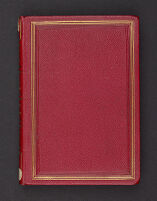
Binding: Post-1600. Red leather, gold-tooled; marbled endpapers; gilt fore-edges.
- Custodial History:
-
Origin:
Italy (probably Milan).
Provenance:
Ippolita Maria Sforza (b. 1445, d. 1488), daughter of Francesco I Sforza and later Queen of Naples, wrote the manuscript: her colophon inscribed, 'Hippolyta Maria Vicecomes filia Illustrimi principis Francisci Sforciae ducis Mediolani exscripsi mea manu hunc labellum sub tempus pueritiae meae et sub Baldo praeceptore anno a natali christiani MCCCCLVIII octavo idus julius' (f. 71r-v; 'I, Ippolita Maria Visconti, daughter of the most illustrious prince Francesco Sforza, Duke of Milan, wrote this little book in my hand around the time of my childhood and under my tutor Baldo, 8 July 1458).
Gioacchino Besozzi (b. 1679, d. 1755), Italian cardinal of the Basilica di Santa Croce in Gerusalemme, scholar and book collector: the manuscript bought by him in Pavia in 1723 and brought with him to Santa Croce when he became its cardinal in 1744, according to a note attributable to him, recorded by Girolamo Bottino, librarian of the Sessoriana of Sancte Croce between 1840 and 1845, in his 1842 inventory of the library's collection: 'Questo Cicerone MS de Senectute e un Codice singolarissimo e di sommo prezzo, perche scritto di pugno d'Ippolita Maria Figlia di Francesco Sforza Duca di Milano [...] Quale io D. Gioacchino Besozzi acquistai in Pavia l'anno 1723, e l'ho portato qui meco venendo Abbate di questo Monistero di S. Croce' (see Trasselli, 'Il Cardinale Gioacchino Besozzi Collezionista', (2009), p. 890).
The Sessoriana of the Basilica di Santa Croce in Gerusalemme: the number 'CXXXII' in Roman numerals (f. 1v), recorded as 'Sess. 132' in the catalogues of the library's collection made by Alberico Amatori (b. 1810, d. 1875), librarian of the Sessoriana 1835-1840 and 1845-1850, and Girolamo Bottino (see above); apparently remained at the Sessoriana until 1849, when it subsequently disappeared along with three other volumes, only two of which were recovered (see Jemolo-Palma, Sessoriani dispersi (1984), p. 23).
Purchased by the British Museum through Messrs Boone, booksellers, Payne and Foss sale, 30 April 1857, lot 94, for £12.
- Publications:
-
Catalogue of Additions to the Manuscripts in the British Museum in the Years 1854-1860 (London: British Museum, 1875), p. 567.
Élisabeth Pellegrin, La bibliothèque des Visconti et des Sforza ducs de Milan, au XVe siècle, Publications de l’Institut de recherche et d’histoire des textes, 5 (Paris, 1955), p. 364.
Andrew G. Watson, Catalogue of Dated and Datable Manuscripts c. 700-1600 in the Department of Manuscripts, British Library, 2 vols (London: British Museum, 1979), I, no. 255.
Vivana Jemolo and Marco Palma, Sessoriani dispersi: contributo all'identificazione di codici provenienti dalla Biblioteca romana di S. Croce in Gerusalemme (Rome: Storia e letteratura, 1984), pp. 15, 23.
Paul Oskar Kristeller, Iter Italicum: Accedunt Alia Itinera: A Finding List of Uncatalogued or Incompletely Catalogued Humanistic Manuscripts of the Renaissance in Italian and other Libraries, 7 vols (London: Warburg Institute; Leiden: Brill, 1963-1997), IV (1989), p. 108.
Judith Bryce, '"Fa finire uno bello studio et dice volere studiare": Ippolita Sforza and Her Books', Bibliotheque d'Humanisme et Renaissance, 64 (2002), 55-69 (p. 59).
Gennaro Tosca, 'Livres et lectures de deux princesses de la cour d'Aragon de Naples: Isabella de Chiaromonte et Ippolita Maria Sforza', in Livres et lectures de femmes en Europe entre Moyen Age et Renaissance, ed. by Anne-Marie Legare (Turnhout: Brepols, 2007), pp. 295-310 (p. 299).
Luisa Miglio, 'Donne e cultura scritta nel medioevo: http://edu.let.unicas.it/womediev/' , in Governare l'alfabeto: donne, scrittura e libri nel medioevo (Rome: Viella, 2008), pp. 207-24 (pp. 216-17).
Franca Trasselli, 'Il Cardinale Gioacchino Besozzi Collezionista di Codici, Quadri, Medaglie e Altre Antichita', Aevum, 83: 3 (2009), 875-933 (pp. 889, 890, 923).
Brian Richardson, Women and the Circulation of Texts in Renaissance Italy (Cambridge: Cambridge University Press, 2020), pp. 83-86.
- Material Type:
- Archives and Manuscripts
- Legal Status:
- Not Public Record(s)