Hard-coded id of currently selected item: . JSON version of its record is available from Blacklight on e.g. ??
Metadata associated with selected item should appear here...
Add MS 37518
- Record Id:
- 032-002053888
- Hierarchy Root Ancestor Record Id:
- 032-002053888
- MDARK:
- ark:/81055/vdc_100000000046.0x000372
- LARK:
- ark:/81055/vdc_100063636051.0x000001
- SLARK:
- Format:
- ISAD(G)
- Reference (shelfmark):
- Add MS 37518
- Title:
-
Lexicon Tironianum
- Scope & Content:
-
This 9th-century French manuscript contains a lexicon of Tironian notes: a shorthand attributed to Tiro (b. 94, d. 4 BC), slave of Cicero (b. 106, d. 43 BC), that consisted of 4000 signs in its medieval variant. The manuscript was produced at the Benedictine abbey of Saint-Germain-des-Prés, as is indicated by the style of its decorated initials (e.g. see Nordenfalk, ‘Les miniatures’ (1965), p. 261 (no. 433)). However, it appears to have been in England by the late 15th or early 16th century.
Contents:
ff. 1r-115v: Lexicon Tironianum (Lexicon of Tironian Notes).
The manuscript contains a bifolium from an 8th-century Sacramentary:
ff. 116r-116v: Prayers from the Gelasian Sacramentary ('Orationes matutin[ales et vespertinales]'); written in an uncial script.
ff. 117r-117v: Gospel pericopes (John 14.7-14; Luke 24.49-53; and Mark 16.15-24); written in an uncial script.
Decoration:
2 large full-page initials in black ink with foliate motifs, knotwork and zoomorphic figures (ff. 1r, 51r); 2 half-page in black ink with foliate motifs, knotwork and zoomorphic figures (ff. 63r, 91v); 28 medium and small Tironian initials decorated with pen-work in black ink, some with foliate motifs, knotwork and zoomorphic figures (ff. 5v, 8v, 9r, 9v, 14r, 18r, 22v, 27r, 33r, 34v, 39r, 39v, 40v, 41r, 46r, 48v, 60v, 67v, 74v, 77v, 80v, 81v, 87r, 96v, 101v, 104v, 109v, 114r). Display script (decorated initials from the Roman alphabet) at the Tironian initials. Tironian notes and Latin script highlighted with red on f. 50v.
- Collection Area:
- Western Manuscripts
- Project / Collection:
- Additional Manuscripts
England and France 700-1200 Project - Hierarchy Tree:
- [{ "id" : "032-002053888", "parent" : "#", "text" : "Add MS 37518: Lexicon Tironianum" , "li_attr" : {"class": "orderable"} }]
- Hierarchy Record Ids:
- 032-002053888
- Is part of:
- not applicable
- Hierarchy:
- 032-002053888
- Container:
- not applicable
- Record Type (Level):
- Fonds
- Extent:
-
A parchment codex
- Digitised Content:
- https://iiif.bl.uk/uv/#?manifest=https://bl.digirati.io/iiif/ark:/81055/vdc_100063636051.0x000001 (opens in a new tab)
- Thumbnail:
-
- Languages:
- Latin
- Scripts:
- Latin
- Start Date:
- 0800
- End Date:
- 0824
- Date Range:
- 1st quarter of the 9th century
- Era:
- CE
- Access:
- User Conditions:
- Letter of introduction required to view this manuscript
Please request the physical items you need using the online collection item request form.
Digitised items can be viewed online by clicking the thumbnail image or digitised content link.
Readers who have registered or renewed their pass since 21 March 2024 can request physical items prior to visiting the Library by completing
this request form.
Please enter the Reference (shelfmark) above on the request form.If your Reader Pass was issued before this date, you will need to visit the Library in London or Yorkshire to renew it before you can request items online. All manuscripts and archives must be consulted at the Library in London.
This catalogue record may describe a collection of items which cannot all be requested together. Please use the hierarchy viewer to navigate to individual items. Some items may be in use or restricted for other reasons. If you would like to check the availability, contact our Reference Services team, quoting the Reference (shelfmark) above.
- Physical Characteristics:
-
Materials: Parchment.
Dimensions: 265 x 190 mm (text space: 205 x 140 mm).
Foliation: ff. iv + 116; ff. i-iii are paper leaves; f. i is a paper (180 x 115 mm) pasted on a paper stub; f. ii is a modern paper; f. iii is a paper pastedown on a paper leaf attached to a paper stub; f. iv originally was a parchment flyleaf; f. 115 and f. 116 originally were parchment flyleaves and are a bifolium from a Sacramentary; 1 parchment stub between f. 1 and f. 2; f. 76 and f. 77; and f. 77 and f. 78; 4 parchment stubs between f. 2 and f. 3; early modern pagination throughout the manuscript.
Script: Caroline minuscule; Uncial (ff. 116r-117v).
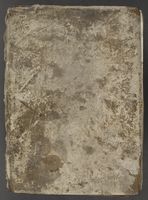
Binding: Pre-1600. White leather over a wooden board for the upper cover; no leather binding over the wooden board of the lower cover; the spine is exposed. White endpapers.
- Custodial History:
-
Origin: Paris, Central France.
Provenance:
The Benedictine abbey of Saint-Germain-des-Prés at Paris: produced the manuscript, as is indicated by the style of its decoration (e.g. see Nordenfalk, ‘Les miniatures’ (1965), p. 261 (no. 433)).
An unknown religious institution, owned in the 12th century: added a reference to the dedication of a church to St Nicholas (f. 115v), in a 12th-century script.
An unknown 14th- or 15th-century owner: inscribed the formula ‘Jhesus Christus Tetragramat[o]n Agla’, in a 14th- or 15th-century script, on f. iv verso.
An unknown 15th-century English owner: added Middle English prayers-invocations, in a 15th-century script, to the upper margins of f. 84v and f. 85r (f. 84v: ‘O good ladi helpe me evir amen for sen cherite blessid ladi rue hon me’; f. 85r: ‘Lord for þou wondes smarte and thy bitter passion kepe me fro sine and same and evyn þat the last / O swete ihesu rue on me has p[ut] dust apon a thre’).
An unknown 15th- or 16th-century English owner: an English inscription, in a 15th- or 16th-century script, on f. 1r: ‘Cicero his dictionary of cyfers’.
? John Lumley, 1st baron Lumley (b. c.1533, d. 1609), collector and conspirator: his name perhaps inscribed in the lower margin of f. 117v.
John Fortescue (b. 1533, d. 1607), administrator, Chancellor of the Exchequer and Chancellor of the Duchy of Lancaster, Keeper of the Wardrobe under Elizabeth I, owned after 1559; probably his shelfmark and ownership inscription (although not in his autograph), written in a 16th- or 17th-century script, on f. 1r: ‘M IO: 95 J. Fortescu[e] de salden’; Fortescue moved to Salden (Buckinghamshire) after being granted lease of the manor in 1559.
? Francis Fortescue (b. c. 1563, d. 1624), English politician, of Salden: probably inherited the manuscript from his father, John Fortescue; after Francis's death, it appears to have passed on to his wife, Lady Grace Fortescue, née Manners of Hardwick Hall (fl. c. 1550-1650), who moved to Bosworth Hall in 1630. It must have remained there when, in 1763, Elizabeth Fortescue left the manor of Husbands-Bosworth to Francis [assumed 'Fortescue'-] Turville.
Francis Fortescue-Turville of Bosworth Hall (d. 1839): his bookplate and name (‘F. Fortescue Turvile’) pasted on the inside of the upper cover; also owned the so-called Bosworth Psalter (Add MS 37517); he had the manuscript examined by Thomas Astle (b. 1735, d. 1803), archivist and collector of books and manuscripts, since f. ii recto contains a manuscript description signed by Astle and dated to 24 April 1793; inscribed on f. ii verso in Astle's hand: 'Mr Turville's M.S.'. The manuscript then passed down to his descendants George Fortescue-Turville (b. 1782, d. 1859); and Francis Charles Fortescue-Turville (b. 1832, d. 1889), who after dying childless, was succeeded by his widow Lady Lisgar (d. 1895), his unmarried sister Mary (d. 1910), and his third cousin Oswald [assumed 'Turville'-] Petre.
Oswald Turville-Petre (b. 1862, d. 1941), of Bosworth Hall, owned in 1907: purchased from him by the British Museum on 13 July 1907 (see note on the inside upper cover); a description of the manuscript (as no. '3'), apparently made for the sale of Bosworth Hall's manuscripts, has been pasted on f. iii recto. The manuscript was purchased together with the Bosworth Psalter for £ 3,000.
- Information About Copies:
- Complete digital coverage available for this manuscript; see Digitised Manuscripts, https://bl.uk/manuscripts/.
- Publications:
-
New Palaeographical Society: Facsimiles of Ancient Manuscripts, etc., First Series, 2 vols, ed. by Edward Maunde Thompson and others (London: [n. pub.], 1903-1912), 1 [-2], pl. 133.
Un manuel tironien du Xe siècle, publié d'après le manuscrit 1597 A de la Bibliothèque nationale, ed. by Paul Legendre (Paris: Champion, 1905), passim [for an edition from another manuscript].
Paul Legendre, Études tironiennes: Commentaire sur la VIe églogue de Virgile tiré d'un manuscrit de Chartres, Bibliothèque de l'École practique des hautes études: Science philologiques et historiques, 167 (Paris: Champion, 1907), p. 52 (no. 10).
Ulrich Friedrich Kopp, Lexicon Tironianum: Nachdruck aus Kopps Palaeographica critica von 1817 mit Nachwort und einem Alphabetum Tironianum von Bernhard Bischoff (Osnabrück: Zeller, 1965) [for an edition from another manuscript].
Edgar Simmons Buchanan, 'A Sixth-Century Fragment of St Mark', The Journal of Theological Studies, 13:51 (1912), 369-71.
Edgar Simmons Buchanan, The Four Gospels from the Latin Text of the Irish Codex Harleianus numbered Harl. 1023 in the British Museum Library (London: Heath, Cranton & Ouseley, 1914), p. ix.
Codices Latini Antiquiores, ed. by Elias Avery Lowe, 11 vols (Oxford: Clarendon Press, 1934-1966), II (1935): Great Britain and Ireland, no. 176.
Geneviève L. Micheli, L’enluminure du haut moyen age et les influences irlandaises (Brussels: Éditions de la Connaissance, 1939), p. 190.
Klaus Gamber, Alban Dold, and Bernhard Bischoff, Sakramentartypen. Versuch einer Gruppierung der Handschriften und Fragmente bis zur Jahrtausendwende, Texte und Arbeiten, 49-50 (Beuron: Beuron Archabbey, 1958), p. 63.
Carl Nordenfalk, ‘Les miniatures’, in Charlemagne: Oeuvre, Rayonnement et Survivances, ed. by Wolfgang Braunfels (Düsseldorf: Schwann, 1965), pp. 220-304 (p. 261 (no. 433)).
Catalogue of Additions to the Manuscripts in the British Museum in the Years 1906-1910 (London: British Museum, 1912; repr. 1969), pp. 67-68.
Bernhard Bischoff, Manuscripts and Libraries in the Age of Charlemagne, trans. and ed. by Michael Gorman, Cambridge Studies in Palaeography and Codicology, 1 (Cambridge: Cambridge University Press, 1994), p. 25 n. 19 [translation of Bernhard Bischoff, Mittelalterliche Studien: Ausgewählte Aufsätze zur Schriftkunde und Literaturgeschichte, 1-3 (Stuttgart: Hiersemann, 1966-1981)].
Richard Gameson, ‘The Earliest Books of Christian Kent’, in St Augustine and the Conversion of England, ed. by Richard Gameson (Stroud: Sutton, 1999), pp. 313-73 (pls 13.22-13.23).
Bernhard Bischoff, Katalog der festländischen Handschriften des neunten Jahrhunderts, 3 vols (Wiesbaden: Harrassowitz, 1998-2014), II (2004): Laon-Paderborn, ed. by Birgit Ebersperger, p. 103 (no. 2404).
Richard W. Pfaff, The Liturgy in Medieval England: A History (Cambridge: Cambridge University Press, 2009), pp. 41-42.
Helmut Gneuss and Michael Lapidge, Anglo-Saxon Manuscripts: A Bibliographical Handlist of Manuscripts and Manuscript Fragments Written or Owned in England up to 1100 (Toronto: University of Toronto Press, 2014), pp. 222-23 (no. 292) [for literature on ff. 116-117].
- Material Type:
- Archives and Manuscripts
- Legal Status:
- Not Public Record(s)
- Notes:
- This manuscript is part of The Polonsky Foundation England and France Project: Manuscripts from the British Library and the Bibliothèque nationale de France, 700-1200.