Hard-coded id of currently selected item: . JSON version of its record is available from Blacklight on e.g. ??
Metadata associated with selected item should appear here...
Add MS 40007
- Record Id:
- 032-002059978
- Hierarchy Root Ancestor Record Id:
- 032-002059978
- MDARK:
- ark:/81055/vdc_100000000039.0x0003a4
- LARK:
- ark:/81055/vdc_100056002010.0x000001
- SLARK:
- Format:
- ISAD(G)
- Reference (shelfmark):
- Add MS 40007
- Title:
-
Ralph de Diceto, Opuscula; Letter to William de Longchamp; Abbreviationes Chronicorum (extracts); Letter to John of Poitiers; Ymagines Historiarum (excerpts); Geoffrey of Monmouth, Prophetia Merlini; Anonymous prophecies
- Scope & Content:
-
This manuscript consists of letters and historical works written by Ralph of Diceto (d. 1199/1200), chronicler, ecclesiastic and dean of St Paul's Cathedral, London. This volume was probably produced in the scriptorium of St Paul's. The prefatory letter to William de Longchamp (d. 1197), chancellor of England and bishop of Ely, is found only in this manuscript, suggesting that it might have been the original copy presented to William de Longchamp (see Sharpe and Willoughby, Medieval Libraries (2015)). The list of writers on f. 35v that ends with Ralph de Diceto states that he finished his historical work in 1195 (see Watson, Catalogue of Dated and Datable Manuscripts (1979)).
Cotton MS Faustina A VIII (from the Augustinian priory of St Mary Overy) and Cotton MS Tiberius A IX (from the Augustinian abbey of Osney) have the same contents, except the prefatory letter to William de Longchamp.
Contents:
ff. 5r-34v: Ralph de Diceto, Opuscula (Minor Works). It includes Ralph de Diceto's prefatory letter to William de Longchamp, beginning: Willelmo de Longo Campo Rad[ulfus] de Diceto. Sicut a multis accepimus'. (ff. 5r-v); chronological tables of prelates, popes and kings, including historical accounts of the history of Britons, English and Normans, beginning: 'Apostolus ait: omnis anima potestatibus subdita sit sublimioribus'. A life of St Thomas Becket has been inserted between these lists (ff. 12r-15v), beginning: 'Quotiens inter enumeratos, ending: 'ab omnibus reportasse triumphum' (ff. 6r-34v).
ff. 35r-35v: Extract from Ralph de Diceto's Abbreviationes Chronicorum (Abbreviations of Chronicles), related to eminent writers, including Ralph de Diceto himself at the end, beginning: 'De viris illustribus quo tempore scripserint. Trogus Pompeius a tempore Nini regis Assiriorum', ending: 'Radulfus Lundoniensis ecclesie decanus ab incarnatione anno MoCoXLVII librum qui dicitur ymagines hystoriarum inchoavit et perduxit usque ad annum MC [in the margin] XCV'.
ff. 35v-36v: Nomina regionum XI (Names of the Eleven Regions), also included in the Abbreviationes Chronicorum of Ralph de Diceto.
ff. 36v-37v: Ralph de Diceto, Letter to John of Poitiers, archbishop of Lyons, relating to the omission of Britain in the list of provinces, and his reply. These two letters are followed by extracts from C. Iulius Caesar (b. 100 BC, d. 44 BC), L. Annaeus Florus (fl. early 2nd century), Hugh of Saint-Victor (b. c 1096, d. 1141) and Bede (b. c. 673, d. 735) on the provinces of Gaul (ff. 36v-37v), extracts preceded by a 5-line introduction.
ff. 37v-39r: Extract from Ralph de Diceto's Abbreviationes Chronicorum, borrowed from two anonymous compilations: the Commendatio Brittanie (Praise of Britain), a historical compilation about Britain (ff. 37v-38r), followed by the De mirabilibus Brittanie (Wonders of Britain) (ff. 38v-39r).
ff. 39r-39v: Genealogy of Henry II, beginning with Noah, excerpted from Aelred of Rievaulx (b. 1109, d. 1167), De genealogia regum Anglorum (On the genealogy of kings of England). Ralph de Diceto used this genealogy in his Ymagines Historiarum (Images of History).
f. 39v: De situ Hibernie (On Ireland); excerpt on the description of Ireland from Henry of Huntingdon (b. 1084, d. 1155), Historia Anglorum (History of the English).Ralph de Diceto included this description in his Ymagines Historiarum. Followed by the genealogy of William the Lion, king of Scotland (imperfect), excerpted from the Ymagines Historiarum (f. 39v).
ff. 40r-41v: Geoffrey of Monmouth (d. 1157), Prophetia Merlini (Prophecies of Merlin), excerpted from the Historia regum Britanniae (History of the Kings of Britain), Book VII, .
f. 41v: Anonymous, Arbor fertilis (The Tree of Fertility), a prophecy attributed to Merlin Sylvester by the rubric Prophecia Merlini Sylvestris.
f. 42r: Anonymous, A prophecy attributed to Merlin Sylvester that was revealed to Edward the Confessor, beginning: 'Prophetia Merlini Silvestris Anglorum Eadwardo regi Sancto nominis huius tertio revelata'. This text was written by a 13th-century cursive hand.
Decoration:
Puzzle initials in red and blue with pen-flourishing in green and brown, throughout (e. g., ff. 2r, 7r); simple initials in red or blue, with green and brown pen-flourishing and penwork decoration (e. g., ff. 12v, 21r, 23v); small initials in red or blue. Rubrics in red. A human figure added in the margin of the text (f. 21r). Maniculae in the margin (f. 22r).
- Collection Area:
- Western Manuscripts
- Project / Collection:
- Additional Manuscripts
England and France 700-1200 Project - Hierarchy Tree:
- [{ "id" : "032-002059978", "parent" : "#", "text" : "Add MS 40007: Ralph de Diceto, Opuscula; Letter to William de Longchamp; Abbreviationes Chronicorum (extracts); Letter to John of Poitiers; Ymagines…" , "li_attr" : {"class": "orderable"} }]
- Hierarchy Record Ids:
- 032-002059978
- Is part of:
- not applicable
- Hierarchy:
- 032-002059978
- Container:
- not applicable
- Record Type (Level):
- Fonds
- Extent:
-
A parchment codex
- Digitised Content:
- https://iiif.bl.uk/uv/#?manifest=https://bl.digirati.io/iiif/ark:/81055/vdc_100056002010.0x000001 (opens in a new tab)
- Thumbnail:
-
- Languages:
- Latin
- Scripts:
- Latin
- Start Date:
- 1190
- End Date:
- 1200
- Date Range:
- c 1195
- Era:
- CE
- Access:
- User Conditions:
- Letter of introduction required to view this manuscript
Please request the physical items you need using the online collection item request form.
Digitised items can be viewed online by clicking the thumbnail image or digitised content link.
Readers who have registered or renewed their pass since 21 March 2024 can request physical items prior to visiting the Library by completing
this request form.
Please enter the Reference (shelfmark) above on the request form.If your Reader Pass was issued before this date, you will need to visit the Library in London or Yorkshire to renew it before you can request items online. All manuscripts and archives must be consulted at the Library in London.
This catalogue record may describe a collection of items which cannot all be requested together. Please use the hierarchy viewer to navigate to individual items. Some items may be in use or restricted for other reasons. If you would like to check the availability, contact our Reference Services team, quoting the Reference (shelfmark) above.
- Physical Characteristics:
-
Materials: Parchment.
Dimensions: 415 x 285 mm (text space: 300/20 x 200/230 mm, in 2 or 3 columns).
Foliation: ff. 43 (+ 1 unfoliated paper flyleaf at the beginning + 2 unfoliated paper flyleaves at the end); ff. 1, 43 are former medieval pastedowns.
Script: Protogothic.
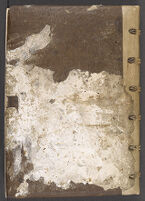
Binding: Pre-1600 binding. 14th-century binding with wooden boards, originally covered with white parchment. The parchment cover is now fragmentary; marks of a chain and clasp: a small part of the iron chain remains on the back cover; a 14th-century book-label in horn (inscribed: 'Cronica Ricardi de Diceto') remains on the back cover. The manuscript was rebacked in 1922; the spine inscribed in gold at the British Museum: 'R. DE DICETO OPERA MINORA'.
- Custodial History:
-
Origin: ? London, Southeastern England.
Provenance:
? Cathedral church of St Paul, London: produced for William of Longchamp, whose brother Robert de Longchamp was abbot of St Mary's (between 1197-1239). It is probably through him that the manuscript passed to St Mary's abbey, York (see Watson, Catalogue of Dated and Datable Manuscripts (1972) and Sharpe and Willoughby, Medieval Libraries (2015)).
The Benedictine abbey of St Mary, York, founded in 1088: two 13th-century ownership inscriptions: 'Liber sancte Marie Ebor' (f. 42r); a 14th-century title: 'Cronica R. de Diceto' (f. 3v; lower outside cover); a 14th-century inscription 'Cronica R. de Diceto eiusdem. G. de Lascy' (f. 2v); a late 14th-century or early 15th-century press mark 'In .A. xi' (f. 5r); an erased inscription mentioning William Wells, abbot of St Mary (between 1423-1426): 'Iste liber acquisitus [?] fuit per fratrem Willelmum Wellys abbatem anno Mo CCCCo XXIIIo' (f. 4r), cited in Leland's catalogue (c. 1536-1540), see Sharpe and Willoughby, Medieval Libraries (2015); also added a late 13th-century or early 14th-century genealogy of kings of England written between 1284 and 1307, citing Edward I as the king and mentioning his last daughter, Elizabeth of Ruddlhan (b. 1282, d. 1316) and the obit of his son Alphonso (d. 1284) (f. 3v); and 14th-century notes: 'Hugo Floriacensis' in the list of eminent writers (f. 35r) and 'Iste Radulfus de Diceto qui hunc librum compilavit' (f. 35v).
Sir Henry Day Ingilby (b. 1826; d. 1911), 2nd Baronet of Ripley Castle: his initials 'HDI' (ff. 5r, 42v) his library press-mark 'Cronica Rad[ulphi] de Diceto No. 4' (f. 3r).
Sir William Henry Ingilby (b. 1874; d. 1950), 4th Baronet of Ripley Castle: his sale, Sotheby's, London, 21 October 1920, lot. 41 (inscribed f. [i] recto), bought by Bernard Quaritch on behalf of the British Museum for £160.
- Information About Copies:
- Full digital coverage available for this manuscript: see Digitised Manuscripts at http://www.bl.uk.manuscripts/.
- Publications:
-
[Ralph de Diceto], Ralph de Diceto decani Lundoniensis: Opera Historica. The Historical Works of Master Ralph de Diceto, ed. by William Stubbs, 2 vols (London: Longman, 1876), I, pp. xcvii-xcix; II, pp. 177-288.
Catalogue of Additions to the Manuscripts 1916-1920 (London: The British Museum, 1933), pp. 282-285.
A. G. Watson, Catalogue of Dated and Datable Manuscripts c.700-1600 in the Department of Manuscripts, The British Library, 2 vols (London: The British Library, 1979), I, no. 401.
Neil R. Ker, Medieval Libraries of Great Britain, 2nd edition (London: The Royal Historical Society, 1964), p. 217.
Lesley Ann Coote, Prophecy and Public Affairs in Later Medieval England (York: York Medieval Press, 2000), pp. 56, 253.
Julian Harrison, 'The English Reception of Hugh of Saint-Victor’s Chronicle', eBLJ, 1 (2002), 1-33 (p. 30) https://www.bl.uk/eblj/2002articles/pdf/article1.pdf [accessed 21 April 2017].
M. P. Parkes, Their Hands Before Our Eyes: A Closer Look at Scribes (Aldershot: Ashgate, 2008), pl. 59.
Simon Keynes, 'The Burial of King Aelthelred the Unready at St Paul's', in The English and Their Legacy, 900-1200: Essays in Honour of Ann Williams, ed. by David Roffe (Woodbridge: Boydell, 2012), pp. 129-48 (p. 132).
J. Crick, 'Historical Literacy in the Archive: Post-Conquest Imitative Copies of Pre-Conquest Charters and Some French Comparanda', in The Long Twelfth-Century View of the Anglo-Saxon Past, ed. by Martin Brett and David A. Woodman (London: Routledge, 2015), pp. 159-90 (p. 189).
Richard Sharpe and James Willoughby, Medieval Libraries of Great Britain (Oxford: The Bodleian Libraries, 2015) [accessed 21 April 2017].
- Material Type:
- Archives and Manuscripts
- Legal Status:
- Not Public Record(s)
- Notes:
- This manuscript is part of The Polonsky Foundation England and France Project: Manuscripts from the British Library and the Bibliothèque nationale de France, 700-1200.