Hard-coded id of currently selected item: . JSON version of its record is available from Blacklight on e.g. ??
Metadata associated with selected item should appear here...
Add MS 41623
- Record Id:
- 032-002085314
- Hierarchy Root Ancestor Record Id:
- 032-002085314
- MDARK:
- ark:/81055/vdc_100000000052.0x0000a5
- LARK:
- ark:/81055/vdc_100165149757.0x000001
- SLARK:
- Format:
- ISAD(G)
- Reference (shelfmark):
- Add MS 41623
- Title:
-
An illustrated Herbal (the 'Codex Bellunensis')
- Scope & Content:
-
ff. 1-147v: A herbal from northern Italy; the text is chiefly an adaptation of Dioscorides, De Materia Medica in Latin, with occasional entries in Italian, including a list or index of plants (ff. 137r, 138r-v, 142r-145r, 147r-v). Other texts inserted in the main text are:
ff. 128r-v, 134r-v, 133r-v, 141r-v, 140r-v, 135r: Thessalus, De virtutibus herbarum, a treatise on the properties of nineteen herbs according to the influence of the zodiacal signs and planets;
ff. 135r-136r, 137v: Alexander the Great (attribution in the rubric), De virtutibus herbarum, a treatise on the properties of seven herbs as influenced by the planets;
ff. 146v, 146r, 132r-v: Prologus Apollo et Ypocrates et Ypocentaurus, a tract on medicine and surgery;
f. 148r: Charms in Italian against 'mal de carbon'.
Additional MS 41966 V, consisting of two paper leaves from an illustrated Herbal of north Italian origin, is thought to be part of a companion volume. The folios correspond to ff. 28r-v, 48v and 49r of this manuscript, with minor differences.
Decoration:
180 large (mostly full-page) painted drawings of plants, in colours, including the earliest known depictions of local plants such as Edelweiss (f. 35v) and Carline thistle (Oculis bovis). Large painted drawings of fruits (ff. 121r-122r), snails (f. 123r), milk, cheese and bread (ff. 124r-v), small animals (125r), scorpions (f. 130r) and an anatomical diagram of a man (f. 126r).
- Collection Area:
- Western Manuscripts
- Project / Collection:
- Additional Manuscripts
- Hierarchy Tree:
- [{ "id" : "032-002085314", "parent" : "#", "text" : "Add MS 41623: An illustrated Herbal (the 'Codex Bellunensis')" , "li_attr" : {"class": "orderable"} }]
- Hierarchy Record Ids:
- 032-002085314
- Is part of:
- not applicable
- Hierarchy:
- 032-002085314
- Container:
- not applicable
- Record Type (Level):
- Fonds
- Extent:
-
Paper codex
- Digitised Content:
- https://iiif.bl.uk/uv/#?manifest=https://bl.digirati.io/iiif/ark:/81055/vdc_100165149757.0x000001
- Thumbnail:
-
- Languages:
- Italian
Latin - Scripts:
- Latin
- Start Date:
- 1400
- End Date:
- 1440
- Date Range:
- Early 15th century
- Era:
- CE
- Access:
- Restrictions to access apply please consult British Library staff
Please request the physical items you need using the online collection item request form.
Digitised items can be viewed online by clicking the thumbnail image or digitised content link.
Readers who have registered or renewed their pass since 21 March 2024 can request physical items prior to visiting the Library by completing
this request form.
Please enter the Reference (shelfmark) above on the request form.If your Reader Pass was issued before this date, you will need to visit the Library in London or Yorkshire to renew it before you can request items online. All manuscripts and archives must be consulted at the Library in London.
This catalogue record may describe a collection of items which cannot all be requested together. Please use the hierarchy viewer to navigate to individual items. Some items may be in use or restricted for other reasons. If you would like to check the availability, contact our Reference Services team, quoting the Reference (shelfmark) above.
- User Conditions:
- Letter of introduction required to use this manuscript.
- Physical Characteristics:
-
Materials: paper.
Dimensions: 300 x 210 mm (text space: 290 x 200mm).
Foliation: ff. 148 + ii (f. i is a paste-down to the inside upper binding and f. ii is paper flyleaf at the end + 5 unfoliated paper flyleaves at the beginning and 5 at the end).
Script: Italian cursive.
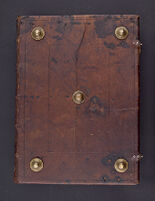
Binding: Pre-1600. Brown leather binding over wooden boards, metalwork bosses and remains of metal clasps .
- Custodial History:
-
Origin: Italy, N. E. (?Belluno or Feltre).
Provenance:
Master Pandophus, chaplain, perhaps copied by him: his note on f. 49v: 'Dns. pandolphus capelanu, dni. leopoldii dixit mihi quod ista herba vocatur herba vulnerum in partibus suis' (Master Pandolphus, chaplain, Master Leopold told me that this plant is called herba vulnerum in his region', beneath which is written in a later Italian hand, 'Nota quod Albertus et Leopoldus Duces Austrie Stirie Carinthie nec non Comites Tirolis de anno 1378 fuerunt etiam Domini huius Ciuitatis Belluni et Feltri et hic residebant' (Note that Albert and Leopold Dukes of Austria, Styria, Carinthia and also Counts of the Tyrol in the year 1378 were also Lords of the cities, Belluno and Feltre).
Taeuber and Weil, antiquarian booksellers of Munich, a catalogue description of the early 20th century on their letterhead; bought from them by the British Museum in July, 1928 for 246 pounds, 6 shillings and 6 pence.
- Information About Copies:
- Full digital coverage available for this manuscript: see Digitised Manuscripts at http://www.bl.uk.manuscripts/.
- Publications:
-
Robin Flower, 'A North Italian Herbal of the Fifteenth century', The British Museum Quarterly, 3.2 (September, 1928), 55-56.
The British Museum Catalogue of Additions to the Manuscripts, 1926-1930 (London: British Museum, 1959), pp. 96-98.
Felix Andreas Baumann, Das Erbario Carrarese und die Bildtradition des Tractatus de herbis, Berner Schriften zur Kunst, 12 (Bern: Benteli, 1974), pp. 128-29.
Wolf-Dieter Müller-Jahncke, ‘Die botanische Illustratione des 14. und 15. Jahrhunderts in Italien’, in Die Kunst und das Studium der Natur vom 14. zum 16. Jahrhundert, ed. by Wolfram Prinz and Andreas Beyer (Cologne: Acta humaniora, 1987), pp. 75-81 (p. 78, pl. 4).
Minta Collins, Medieval Herbals: The Illustrative Traditions (London: British Library, 2000), pp. 280-81, 297, fig. 80.
Anna Maria Spiazzi, A Nord di Venezia, Scultura e pittura nelle vallate dolomitiche tra Gotico e Rinascimento (Milan: Silvano, 2004), no. 14 [exhibition catalogue].
Enrico Castelnuovo, 'Art in the Dolomites, Belluno', Burlington Magazine, 47, no. 1223 (2005), 139-40 (pp. 139-40) [exhibition review].
Giordana Canova Mariani, Codex Bellunensis: erbario bellunese del XV secolo: Londra, British Library, Add. 41623: facsimile e commentario, 2 vols (Feltre: Parco nazionale Dolomiti bellunesi, 2006).
Sarah Rozalja Kyle, 'The Carrara herbal in context : imitation, exemplarity, and invention in late fourteenth-century Padua' (unpublished doctoral dissertation, Emory University, 2010).
- Material Type:
- Archives and Manuscripts
- Legal Status:
- Not Public Record(s)