Hard-coded id of currently selected item: . JSON version of its record is available from Blacklight on e.g. ??
Metadata associated with selected item should appear here...
Add MS 41997
- Record Id:
- 032-002085827
- Hierarchy Root Ancestor Record Id:
- 032-002085827
- MDARK:
- ark:/81055/vdc_100000000052.0x0000ed
- LARK:
- ark:/81055/vdc_100060367448.0x000001
- SLARK:
- Format:
- ISAD(G)
- Reference (shelfmark):
- Add MS 41997
- Title:
- Burchard of Bellevaux, Apologia de Barbis
- Scope & Content:
-
This manuscript contains the only surviving copy of the Apologia de Barbis (The Defence of Beards) that Burchard (d. 1163), Cistercian Abbot of Bellevaux wrote for the lay brothers of the Abbey of Rosières, a daughter house of Bellevaux. The Apologia is made up of three sermones (speeches) discussing the cleanliness, composition, and nature of beards. It is the only known work on beards to survive from the Middle Ages.
Contents:
ff. 1r-94v: Burchard, Apologia de Barbis, beginning: ‘Apologia B abbatis Bellevallis ad fratres de Roseriis ad conservationem barbarum et salutem’.
[f. 95v is blank].
Decoration:
3 large initials with anthropomorphic, zoomorphic, and foliage decoration in red, yellow, and green, at the beginning of the three sermones (ff. 1r, 14r, 33v). Medium-sized initials with pen-flourishing alternating between red and green, sometimes with yellow. Occasional highlighting in red. Capitals in red. Drawings of nine bearded faces added in a later medieval hand (f. 95r).
- Collection Area:
- Western Manuscripts
- Project / Collection:
- Additional Manuscripts
England and France 700-1200 Project - Hierarchy Tree:
- [{ "id" : "032-002085827", "parent" : "#", "text" : "Add MS 41997: Burchard of Bellevaux, Apologia de Barbis" , "li_attr" : {"class": "orderable"} }]
- Hierarchy Record Ids:
- 032-002085827
- Is part of:
- not applicable
- Hierarchy:
- 032-002085827
- Container:
- not applicable
- Record Type (Level):
- Fonds
- Extent:
-
A parchment codex
- Digitised Content:
- https://iiif.bl.uk/uv/#?manifest=https://bl.digirati.io/iiif/ark:/81055/vdc_100060367448.0x000001
- Thumbnail:
-
- Languages:
- Latin
- Scripts:
- Latin
- Start Date:
- 1150
- End Date:
- 1174
- Date Range:
- 3rd quarter of the 12th century
- Era:
- CE
- Access:
-
Please request the physical items you need using the online collection item request form.
Digitised items can be viewed online by clicking the thumbnail image or digitised content link.
Readers who have registered or renewed their pass since 21 March 2024 can request physical items prior to visiting the Library by completing
this request form.
Please enter the Reference (shelfmark) above on the request form.If your Reader Pass was issued before this date, you will need to visit the Library in London or Yorkshire to renew it before you can request items online. All manuscripts and archives must be consulted at the Library in London.
This catalogue record may describe a collection of items which cannot all be requested together. Please use the hierarchy viewer to navigate to individual items. Some items may be in use or restricted for other reasons. If you would like to check the availability, contact our Reference Services team, quoting the Reference (shelfmark) above.
- User Conditions:
- Letter of introduction required to view this manuscript
- Physical Characteristics:
-
Materials: Parchment.
Dimensions: 140 x 95 mm (text space: 100 x 60 mm).
Foliation: ff. 95 ( + 1 unfoliated parchment flyleaf at the beginning).
Script: Protogothic.
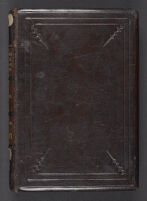
Binding: Post-1600. Brown leather binding with blind tooling, the spine inscribed in gold at the British Museum: ‘Burchard. Apologia de barbis xii cent’.
- Custodial History:
-
Origin: France.
Provenance:
Ernest Philip Goldschmidt (b. 1887, d. 1954), scholar and book-dealer: acquired the manuscript in Geneva in 1929 (Apologia Dvae, ed. by Huygens (1985), p. 130). Purchased from him by the British Museum on 11 January 1930 (sanctioned in committee) for £200.
- Information About Copies:
- Full digital coverage available for this manuscript: see Digitised Manuscripts at http://www.bl.uk.manuscripts/.
- Publications:
-
Catalogue of Additions to the Manuscripts in the British Museum in the Years 1926-1930 (London: British Museum, 1959), pp. 164-65.
Andrew G. Watson, Catalogue of Dated and Datable Manuscripts c.700-1600 in the Department of Manuscripts, The British Library, 2 vols (London: British Library, 1979), I, p. 409.
Robin Flower, ‘An Apology for Beards’, The British Museum Quarterly, 4 (1929-30), 109-11.
Apologiae Dvae. Gozechini Epistola ad Walcherum. Burchardi, ut Videtur, Abbatis Bellevallis: Apologia de Barbis, ed. by Robert B. C. Huygens, Corpus Christianorum: Continuatio Medievalis, 62 (Turnhout: Brepols, 1985), pp. 130-32.
Charles H. Talbot, ‘A list of Cistercian Manuscripts in Great Britain’, Traditio, 8 (1952), 402-18 (p. 408).
- Material Type:
- Archives and Manuscripts
- Legal Status:
- Not Public Record(s)
- Notes:
- This manuscript is part of The Polonsky Foundation England and France Project: Manuscripts from the British Library and the Bibliothèque nationale de France, 700-1200.