Hard-coded id of currently selected item: . JSON version of its record is available from Blacklight on e.g. ??
Metadata associated with selected item should appear here...
Add MS 15102
- Record Id:
- 032-002086795
- Hierarchy Root Ancestor Record Id:
- 032-002086795
- MDARK:
- ark:/81055/vdc_100000000052.0x0001a6
- LARK:
- ark:/81055/vdc_100165142472.0x000001
- SLARK:
- Format:
- ISAD(G)
- Reference (shelfmark):
- Add MS 15102
- Title:
- Hildegard von Bingen, Collectio epistolarum, Ordo virtutum, and other texts
- Scope & Content:
-
This manuscript contains an extensive collection of letters and other Latin works by Hildegard von Bingen (b. c. 1098, d. 1179), a German Benedictine abbess, polymath and medieval mystic. One of these works is her Ordo Virtutum (Order of the Virtues), one of the earliest examples of an allegorical morality play, set to music. The volume also includes a Latin Life of Hildegard, compiled by the monk Theoderic of Echternach after she died and drawing on the Libellus of Godfrey of Disibodenberg.
The manuscript was commissioned by Johannes Trithemius (b. 1462, d. 1516), abbot of the Benedictine monastery of Sponheim Abbey in 1487 (see his note on f. 1v). The volume is a copy of the Wiesbaden Codex, also known as the 'Riesencodex' (now Wiesbaden, Hess.LB, Hs. 2), a giant manuscript of Hildegard's collected works, made around 1200.
Other copies of Hildegard's works housed at the British Library are now Add MS 15418 and Harley MS 1725.
Contents:
f. 1r: A title 'Epistolare sancta hildegardis v[ir]ginis chr[ist]i et abbatisse in monte S. ruperti byngen' and added ex-libris inscription from the Benedictine monastery of St James's Abbey, Würzburg, 'Ex libris monasterij S. Jacobi Scotorum Herbipoli'.
f. 1v: A Latin account of the manuscript's production, written by Johannes Trithemius in his hand and subscribed with his initials (I. T. A. S.), beginning, 'Anno domini m. c. lxiij. floruit sancta virgo hildegardis...'
ff. 2r-145v: Hildegard von Bingen, Collectio epistolarum, a collection of her letters, interspersed with several of her other Latin works, including:
ff. 70v-76r: Liber Questionum, beginning, 'Matri sanctissimae Hildegardi Guilbertus...'
ff. 96v-101v: Vita sancti Roberti dilectissimi patroni nostri, beginning, 'Nam ut in vera visione video...'
ff. 128r-134r: Explanatio Regulae sancti Benedicti, beginning, 'Et ego paupercula feminea forma...'
ff. 137v-145v: Vita sancti Disibodi episcopi, beginning, 'In mistica visione quoque ut Deus voluit...'
ff. 146r-191r: Hildegard von Bingen, Expositio evangeliorum, beginning, 'Homo quidam qui hominem creavit...'
ff. 191r-192r: A letter from the monks of Villarenser, sent after Hildegard's death, beginning, 'Religiose famule Cristi I. vocatione divina abbatisse de Bingis…'
ff. 192r-206r: Hildegard von Bingen, Epistola ad prælatos Moguntienses, beginning, 'In visione que anime mea, antequam...'
ff. 207r-221r: Hildegard von Bingen, Ordo virtutum de patriarchis et prophetis, beginning, 'Qui sunt hi qui ut nubes…'
ff. 224r-245r: Vita sanctae Hildegardis, a Latin Life of Hildegard compiled by Theoderic of Echternach, beginning, 'Dominis uenerabilibus Ludouico et Godefrido abbatibus Theodoricus...'
ff. 221v-223v are ruled with five-line staves but left unwritten; ff. 206v and 245v are blank.
Decoration:
Large and small initials in red ink. Titles, rubrics and paraph marks in red.
Musical notation on a five-line stave, accompanying the Ordo virtutum (ff. 207r-221r).
- Collection Area:
- Western Manuscripts
- Project / Collection:
- Additional Manuscripts
Medieval and Renaissance Women - Hierarchy Tree:
- [{ "id" : "032-002086795", "parent" : "#", "text" : "Add MS 15102: Hildegard von Bingen, Collectio epistolarum, Ordo virtutum, and other texts" , "li_attr" : {"class": "orderable"} }]
- Hierarchy Record Ids:
- 032-002086795
- Is part of:
- not applicable
- Hierarchy:
- 032-002086795
- Container:
- not applicable
- Record Type (Level):
- Fonds
- Extent:
- 1 volume
- Digitised Content:
- https://iiif.bl.uk/uv/#?manifest=https://bl.digirati.io/iiif/ark:/81055/vdc_100165142472.0x000001 (opens in a new tab)
- Thumbnail:
-
- Languages:
- Latin
- Scripts:
- Latin
- Start Date:
- 1487
- End Date:
- 1487
- Date Range:
- 1487
- Era:
- CE
- Access:
-
Please request the physical items you need using the online collection item request form.
Digitised items can be viewed online by clicking the thumbnail image or digitised content link.
Readers who have registered or renewed their pass since 21 March 2024 can request physical items prior to visiting the Library by completing
this request form.
Please enter the Reference (shelfmark) above on the request form.If your Reader Pass was issued before this date, you will need to visit the Library in London or Yorkshire to renew it before you can request items online. All manuscripts and archives must be consulted at the Library in London.
This catalogue record may describe a collection of items which cannot all be requested together. Please use the hierarchy viewer to navigate to individual items. Some items may be in use or restricted for other reasons. If you would like to check the availability, contact our Reference Services team, quoting the Reference (shelfmark) above.
- Physical Characteristics:
-
Material: Paper.
Dimensions: 268 x 195 mm (text space: 200 x 130 mm).
Foliation: ff. i + 247 (+ 3 unfoliated paper flyleaves and 2 paper stubs at the beginning and 5 unfoliated paper flyleaves and 2 paper stubs at the end); f. i is a paper pastedown to the inside upper cover.
Script: Gothic cursive.
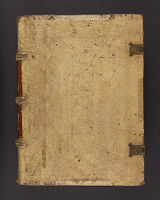
Binding: Pre-1600. Blind-stamped 15th- or 16th-century pigskin over wooden boards; remains of metalwork clasps.
- Custodial History:
-
Origin:
Sponheim, Germany.
Provenance:
The manuscript was copied in 1487 for the Benedictine monastery of Sponheim Abbey, Germany, on the order of its abbot Johannes Trithemius (b. 1462, d. 1516): his account of the manuscript's production, '... hec omnes que sequuntur epistole… scripte sunt Anno domini millesimo cccco octogesimo septimo per quondam monachum sancti benedicti de cenobio spanheim iubente me eiusdem Monasterij abbate... (f. 1v).
The Benedictine monastery of St James's Abbey, Würzburg: probably came to the monastery after Trithemius' resignation from Sponheim Abbey in 1506 and his subsequent appointment as abbot of St James's; inscribed, 'Ex libris monasterij S. Jacobi Scotorum Herbipoli' (f. 1r).
The Benedictine monastery of Lampspringe Abbey, Hanover: subsequently housed in their library; inscribed, 'Liber monast. Lamspring O. S. B. Cons. Angl. S. II' (inside upper cover). The monastery was secularised in 1803 by the Kingdom of Prussia and the contents of the library then dispersed.
Purchased by the British Museum from the London bookseller Thomas Rodd the Younger (b. 1763, d. 1822), 13 April 1844: see the inscription (f. [i] recto).
- Publications:
-
Catalogue of Additions to the Manuscripts in the British Museum in the Years 1841-1845 (London: British Museum, 1850), no. 15102.
Augustus Hughes-Hughes, Catalogue of Manuscript Music in the British Museum, 3 vols (London: British Museum, 1964-66), I: Sacred Vocal Music, pp. 242-43.
Andrew G. Watson, Catalogue of Dated and Datable Manuscripts c.700-1600 in the Department of Manuscripts, The British Library (London: The British Library, 1979), I, no. 114.
Hildegard von Bingen: Ordo Virtutum, ed. by Audrey Ekdahl Davidson (Kalamazoo: Medieval Institute Publications, 1985).
Peter Dronke, 'Platonic-Christian Allegories in the Homilies of Hildegard of Bingen', in From Athens to Chartres: Neoplatonism and Medieval Thought, Studies in Honour of Edouard Jeauneau, ed. by Haijo Jan Westra (Leiden: Brill, 1992), pp. 381-96 (p. 381).
Kathryn Kerby-Fulton, 'Hildegard and the Male Reader: a Study in Insular Reception', in Prophets Abroad: The Reception of Continental Holy Women in Late-Medieval England, ed. by Rosalynn Voaden (Woodbridge: D. S. Brewer, 1996), pp. 1-19 (p. 12).
Peter Dronke, Sources of Inspiration: Studies in Literary Transformation, 400-1500 (Rome: Edizioni di storia e letteratura, 1997), pp. 61-81.
Michael Embach, Die Schriften Hildegards von Bingen: Studien zu ihrer Überlieferung im Mittelalter und in der Frühen Neuzeit (Berlin: Akademie Verlag, 2003), pp. 58, 60, 168, 185, 203, 209, 215, 240, 246-47, 249, 254, 304, 401, 463, 480-81.
Audrey Ekdahl Davidson, 'Another manuscript of the Ordo Virtutum of Hildegard of Bingen', in The Dramatic Tradition of the Middle Ages, ed. by Clifford Davidson (New York: AMS Press, 2005), pp. 79-83.
Hildegardis Bingensis: Opera minora, ed. by Peter Dronke et al (Turnhout: Brepols, 2007), pp. 34, 150-53, 493.
Peter Dronke, Forms and Imaginings: From Antiquity to the Fifteenth Century (Rome: Edizioni di storia e letteratura, 2007), p. 283.
Michael Embach and Martina Wallner, Conspectus der Handschriften Hildegards von Bingen (Münster: Aschendorff, 2013), pp. 136-37.
Michael Embach, 'Hildegard of Bingen (1098-1179): A History of Reception', in A Companion to Hildegard of Bingen, ed. by Beverly Mayne Kienzle, Debra L. Stoudt and George Ferzoco (Boston: Brill, 2014), pp. 273-304 (p. 278).
Margot E. Fassler, 'Allegorical Architecture in Scivias: Hildegard's Setting for the Ordo Virtutum', Journal of the American Musicological Society, 67: 2 (2014), 317-78 (p. 322, n. 16).
Jennifer Bain, Hildegard of Bingen and Musical Reception: The Modern Revival of a Medieval Composer (Cambridge: Cambridge University Press, 2015), pp. 66-67.
Hildegardis Bingensis, Opera minora II, ed. by Jeroen Deploige et al (Turnhout: Brepols, 2016), pp. 19-20.
Johannes Helmrath, 'Perception of the Middle Ages and Self-Perception in German Humanism: Johannes Trithemius and the Cathalogus illustrium virorum Germaniam... exornantium', in Biography, Historiography, and Modes of Philosophizing: The Tradition of Collective Biography in Early Modern Europe, ed. by Patricia Baker (Leiden: Brill, 2017), pp. 177-208 (p. 193).
Ordo Virtutum: Hildegarda de Bingen, ed. by Mariona Vernet and Eulalia Vernet (Barcelona: Universitat de Barcelona Edicions, 2018), pp. 35, 122, 125-26.
Jennifer Bain, 'Music, Liturgy, and Intertextuality in Hildegard of Bingen's Chant Repertory', in The Cambridge Companion to Hildegard of Bingen, ed. by Jennifer Bain (Cambridge: Cambridge University Press, 2021), pp. 207-34 (p. 212).
- Material Type:
- Archives and Manuscripts
- Legal Status:
- Not Public Record(s)