Hard-coded id of currently selected item: . JSON version of its record is available from Blacklight on e.g. ??
Metadata associated with selected item should appear here...
Add MS 35167
- Record Id:
- 032-002088564
- Hierarchy Root Ancestor Record Id:
- 032-002088564
- MDARK:
- ark:/81055/vdc_100000000051.0x000025
- LARK:
- ark:/81055/vdc_100059099639.0x000001
- SLARK:
- Format:
- ISAD(G)
- Reference (shelfmark):
- Add MS 35167
- Title:
- Glossed Gospel of St Luke
- Scope & Content:
-
This manuscript contains the Gospel of St Luke with the Glossa Ordinaria. Typically associated with Anselm of Laon, the Glossa Ordinaria (marginal and interlinear) was a commentary designed to help readers interpret the Bible.
Contents:
ff. 1r-3r: A prologue without glosses, beginning ‘Lucas Syrus Antiocenus’.
f. 3r: A prologue without glosses, beginning ‘Lectorem obsecro studiose paginas’.
ff. 3r-76r: The Gospel of Luke with Glossa Ordinaria.
[f. 76v is blank].
Decoration:
A small half-length portrait of St Luke with a winged ox in the background, added at a later date (f. 1r). Two large initials with zoomorphic and foliate decoration in red and green (ff. 3r, 3v). A large red initial, with the sole instance of gilding in the manuscript, added at a later date (f. 1r). Numerous initials in oxidized red.
- Collection Area:
- Western Manuscripts
- Project / Collection:
- Additional Manuscripts
England and France 700-1200 Project - Hierarchy Tree:
- [{ "id" : "032-002088564", "parent" : "#", "text" : "Add MS 35167: Glossed Gospel of St Luke" , "li_attr" : {"class": "orderable"} }]
- Hierarchy Record Ids:
- 032-002088564
- Is part of:
- not applicable
- Hierarchy:
- 032-002088564
- Container:
- not applicable
- Record Type (Level):
- Fonds
- Extent:
-
A parchment codex
- Digitised Content:
- https://iiif.bl.uk/uv/#?manifest=https://bl.digirati.io/iiif/ark:/81055/vdc_100059099639.0x000001 (opens in a new tab)
- Thumbnail:
-
- Languages:
- Latin
- Scripts:
- Latin
- Start Date:
- 1125
- End Date:
- 1149
- Date Range:
- 2nd quarter of the 12th century
- Era:
- CE
- Access:
- User Conditions:
- Letter of introduction required to view this manuscript
Please request the physical items you need using the online collection item request form.
Digitised items can be viewed online by clicking the thumbnail image or digitised content link.
Readers who have registered or renewed their pass since 21 March 2024 can request physical items prior to visiting the Library by completing
this request form.
Please enter the Reference (shelfmark) above on the request form.If your Reader Pass was issued before this date, you will need to visit the Library in London or Yorkshire to renew it before you can request items online. All manuscripts and archives must be consulted at the Library in London.
This catalogue record may describe a collection of items which cannot all be requested together. Please use the hierarchy viewer to navigate to individual items. Some items may be in use or restricted for other reasons. If you would like to check the availability, contact our Reference Services team, quoting the Reference (shelfmark) above.
- Physical Characteristics:
-
Materials: Parchment.
Dimensions: 270 x 160 mm (text space: 135 x 180 mm, in 3 columns).
Foliation: ff. 76 (+ 1 unfoliated modern paper flyleaf at the beginning + 1 at the end); lacking three quires after f. 64r, two leaves of the following quire and a quire after f. 70r; damage caused by damp throughout the manuscript.
Script: Protogothic.
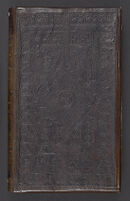
Binding: Pre-1600. Original 12th-century binding, brown leather (goatskin) binding over wooden boards, the spine inscribed in gold at the British Museum: ‘EVANGELIUM SEC LUCAM, SAEC. XII.’.
- Custodial History:
-
Origin: Paris, Central France.
Provenance:
A workshop in Paris: Stirnemann and Schmidt-Kunstmüller, following De Hamel, have argued that the manuscript should be regarded as belonging to a group of related manuscripts produced in Paris before 1146; see De Hamel, Glossed Books (1984), p. 75; Schmidt-Kunstmüller, Die Abendländischen (1985), p. 49; Stirnemann, `Où ont été fabriqués les livres de la glose ordinaire' (1994), pp. 267-68.
An unknown 15th-century owner: added a title 'Evangelia Luce evangelia glosata' (f. 1r).
'William Yonge', in 1649: his name is inscribed on f. 1r: ‘Ex dono Guil. Yonge Dr medic. 1649. Pembroch’.
'William Brodhurst', in 1650: his name was inscribed on f. 1r but it is now illegible due to damage; in 1901 the inscription on f.1r read ‘Wm.(?) Brodhurst his booke, 1650’; see the Catalogue of Additions to the Manuscripts in the British Museum in the Years 1894-1899 (1901), p. 195.
Maurice Johnson (b. 1688, d. 1755), antiquary, barrister and librarian to the Society of Antiquaries: a portion of his library, including this book, was sold at Sotheby's, London, 24 March 1898, lot 1027 (see the note on f. [i] recto). Purchased by the British Museum through Bernard Quaritch for £31.10.
- Information About Copies:
-
Full digital coverage available for this manuscript: see Digitised Manuscripts at http://www.bl.uk.manuscripts/.
- Publications:
-
Catalogue of Additions to the Manuscripts in the British Museum in the Years 1894-1899 (London: British Museum, 1901), pp. 194-95.
G. Mallows Youngman, ‘Manuscripts of the Vulgate in the British Museum’, The American Journal of Theology, 14:4 (1910), 608-26 (p. 611).
William H. J. Weale, Early Stamped Bookbindings in the British Museum (London: British Museum, 1922), pp. 1-2.
Arthur Haseloff, ‘Der Einband der Handschrift des Marcusevangeliums des Harderadus’, in Miscellanea Francesco Ehrle: Studi e Testi, 41 (Rome: Biblioteca Apostolica Vaticana, 1924), 507-28 (p. 519).
Aleksander Birkenmajer, Oprawa rękopisu 2470 Bibljoteki Jagiellońskiej i inne oprawy tej samej pracowni introligatorskiej (Krakow: Drukarna Narodowa, 1925), pp. xxi-xiii.
Theodor Gottlieb, Englische Einbände des XII. Jahrhunderts in französischem Stil (Wien: Krystall, 1926), pp. 15-23.
Geoffrey D. Hobson, 1929, English Binding before 1500 (Cambridge: The University Press, 1929), p. 2.
Geoffrey D. Hobson, ‘Further Notes on Romanesque Bindings’, The Library, 15 (1934-5), 161-211 (pp. 197, 205).
Louise Rapacka, Aleksander Birkenmajer, ‘Comptes Rendus’, Scriptorium, 37:2 (1983), 296-98 (p. 297b).
Christopher De Hamel, Glossed Books of the Bible and the Origins of the Paris Booktrade (Woodbridge: Brewer, 1984), pp. 65, 71, 75, 79.
Friedrich A. Schmidt-Kunstmüller, Die Abendländischen romanischen Blindstempeleinbände (Stuttgart: Hiersemann, 1985), p. 49.
Patricia Stirnemann, 'Où ont été fabriqués les livres de la glose ordinaire dans la première moitié du XIIe siècle?', in Le XIIe siècle: Mutations et renouveau en France dans la première moitié du XIIe siècle, ed. by Françoise Gasparri (Paris: Le Léopard d'Or, 1994), pp. 257-301 (p. 268).
Pierre Cockshaw and Frank Olaf Büttner, ‘Bulletin codicologique’, Scriptorium, 51:2 (1997) 117-219, (p. 151, n. 462).
- Material Type:
- Archives and Manuscripts
- Legal Status:
- Not Public Record(s)
- Notes:
- This manuscript is part of The Polonsky Foundation England and France Project: Manuscripts from the British Library and the Bibliothèque nationale de France, 700-1200.