Hard-coded id of currently selected item: . JSON version of its record is available from Blacklight on e.g. ??
Metadata associated with selected item should appear here...
Add MS 46203
- Record Id:
- 032-002102059
- Hierarchy Root Ancestor Record Id:
- 032-002102059
- MDARK:
- ark:/81055/vdc_100000000041.0x0003d8
- LARK:
- ark:/81055/vdc_100062815372.0x000001
- SLARK:
- Format:
- ISAD(G)
- Reference (shelfmark):
- Add MS 46203
- Title:
-
Missal
- Scope & Content:
-
This late 12th-century Cistercian manuscript contains a ‘Winter missal’, so-called because its Temporale begins on Pentecost XIX (the 19th Sunday after Trinity) and runs to Quinquagesima. The style of the decorated initials suggests that the manuscript was produced at a Cistercian abbey in Northern England, possibly Fountains Abbey in North Yorkshire.
Contents:
ff. 1r-48r: Temporale: Pentecost XIX – Quinquagesima.
ff. 48v-52v: Preface of the Apostles, Common Preface and Canon of the Mass.
ff. 53r-88r: Sanctorale: St Michael (29 September) - St Agatha (5 February).
ff. 88r-97r: Votive Masses, Mass and collects for the dead and general collects: a Cistercian feature is the Offertory 'Verbum Crucis' in the Mass of the Cross (f. 92r).
[f. v verso is blank].
The manuscript contains a number of additions:
ff. ii recto, ii verso, viii recto, viii verso: Leaves from a Cistercian missal (Use of York) written before 1218 when the Feast of St John and St Paul (added in margin, f. ii verso) was authorized for the Cistercian Order.
f. vi verso: A note on the manuscript: ‘Hic liber omnium librorum optimo depingitur (ut videri habet) puritatis venustatis more pingentis calamo’, added in the late 12th century; copied twice on f. vi verso in the 15th century.
f. vii verso: A note on the Temporale: ‘Iste liber incipit in dominica nonadecima et durat usque in capite ieiunii.’, added in the late 12th century; a note on the manuscript (same as on f. vi verso), added in a 15th-century hand.
ff. 97r-97v: Collects for St Etheldreda and All Saints, added in a hand of the first half of the 13th century.
ff. iii recto-v recto: A letter (ff. iii recto-iv verso) concerning and a description (f. v recto) of the manuscript, added in the 20th century.
Decoration:
3 large initials in green and red with arabesque penwork decoration in red, blue and green (ff. 48v [2x], 49r). Medium and small initials in red, green, and blue, some with arabesque penwork decoration in the same colour or penwork decoration (some with foliate motifs) inside the letter in the opposite colour. Rubrics and Roman numerals in red.
- Collection Area:
- Western Manuscripts
- Project / Collection:
- Additional Manuscripts
England and France 700-1200 Project - Hierarchy Tree:
- [{ "id" : "032-002102059", "parent" : "#", "text" : "Add MS 46203: Missal" , "li_attr" : {"class": "orderable"} }]
- Hierarchy Record Ids:
- 032-002102059
- Is part of:
- not applicable
- Hierarchy:
- 032-002102059
- Container:
- not applicable
- Record Type (Level):
- Fonds
- Extent:
-
A parchment codex
- Digitised Content:
- https://iiif.bl.uk/uv/#?manifest=https://bl.digirati.io/iiif/ark:/81055/vdc_100062815372.0x000001 (opens in a new tab)
- Thumbnail:
-
- Languages:
- Latin
- Scripts:
- Latin
- Start Date:
- 1175
- End Date:
- 1199
- Date Range:
- 4th quarter of the 12th century
- Era:
- CE
- Access:
-
Please request the physical items you need using the online collection item request form.
Digitised items can be viewed online by clicking the thumbnail image or digitised content link.
Readers who have registered or renewed their pass since 21 March 2024 can request physical items prior to visiting the Library by completing
this request form.
Please enter the Reference (shelfmark) above on the request form.If your Reader Pass was issued before this date, you will need to visit the Library in London or Yorkshire to renew it before you can request items online. All manuscripts and archives must be consulted at the Library in London.
This catalogue record may describe a collection of items which cannot all be requested together. Please use the hierarchy viewer to navigate to individual items. Some items may be in use or restricted for other reasons. If you would like to check the availability, contact our Reference Services team, quoting the Reference (shelfmark) above.
- Physical Characteristics:
-
Materials: Parchment.
Dimensions: 240 x 170 mm (text space: 175 x 105 mm).
Foliation: ff. viii + 97 ( + 1 unfoliated modern paper flyleaf at the beginning + 1 at the end); f. i is the inside of the upper cover [wooden board without a paper or parchment pastedown]; ff. ii and viii are leaves from a Cistercian missal; ff. iii-v are modern paper leaves mounted on paper guards; ff. vi-vii are original parchment endleaves; 1 unfoliated parchment stub between f. vii and f. 1; 2 unfoliated parchment stubs between f. 88 and f. 90; the foliation does not include f. 89; a paper pastedown on f. [98]r (note of foliation).
Script: Protogothic.
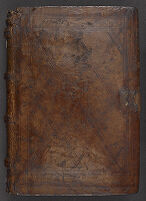
Binding: Pre-1600. Late 15th- or early 16th-century blind-tooled (vertical lozenges in a rectangular frame) brown calf over oak boards, with a leather strip attached to the front cover that fits onto a copper pin protruding from a decorated (clover-shaped) copper boss at the centre of the lower cover; the spine inscribed in black ink ‘17’; off-set of the text on f. ii recto and f. viii verso on the inside covers.
- Custodial History:
-
Origin: ? Fountains Abbey, Northern England.
Provenance:
? The Cistercian monastery of Fountains abbey in North Yorkshire, founded in 1132, perhaps produced the manuscript and owned it until its dissolution in 1538: the manuscript has previously been associated with the Cistercian abbey of Waverley on account of its inclusion of St Swithun, a Winchester saint (see The British Library Catalogue of Additions to the Manuscripts 1946-1950, 3 vols (London: The British Library, 1979), I: Descriptions, pp. 14-15); Waverley was the only Cistercian house in Winchester at this time. However, the manuscript’s decorated initials are typical of late 12th-century manuscripts from Cistercian monasteries in Northern England. Lawrence-Mathers attributes the manuscript to Rievaulx Abbey (Manuscripts in Northumbria (2003), p. 210 n. 69); Watson suggests a similar origin (Catalogue of Dated and Datable Manuscripts (1979), p. 85 (no. 415)), but lists the manuscript under the surviving books from the Cistercian abbey of St Mary the Virgin, Fountains (North Yorkshire) in his supplement to Ker’s Medieval Manuscripts in British Libraries (see Medieval Libraries, ed. by Ker and Watson (1987), p. 37): this attribution probably owes to the fact that the manuscript’s flyleaves (ff. ii, viii) are from a 12th-century Cistercian missal (Use of York) from which other leaves survive as flyleaves in two cartularies from Fountains Abbey: Add MS 40009 (ff. i, iv) and Cotton MS Tiberius C XII (ff. 2, 3, 331, 332). Date of the manuscript: the manuscript’s inclusion of St Thomas of Canterbury provides a terminus post quem of 1173 (year of canonization); the addition of the feast of St Malachy in the margin of f. 64r may provide a terminus ante quem of 1192, which is when the feast was first observed at Clairvaux Abbey.
Sir Henry Day Ingilby (b. 1826, d. 1911), 2nd Baronet, Ripley Castle (North Yorkshire): his manuscript number inscribed on the spine ('17') and on f. vi recto; his possession of the manuscript is recorded in the Sixth Report of the Royal commission on Historical Manuscripts (1877), p. 355 (no. 17). The manuscript may have been in the Ingilby family since the 16th century: their ancestral home at Ripley Castle is situated within less than 5 miles from Fountains Abbey; it passed down to Henry’s successors Sir William Ingilby (b. 1829, d. 1918), 3rd Baronet and Sir William Henry Ingilby (b. 1874, d. 1950), 4th Baronet.
Sir William Henry Ingilby (b. 1874, d. 1950), 4th Baronet, Ripley Castle (North Yorkshire): his sale, London, Sotheby’s, 21 October 1920, lot 154.
‘Ellis’, owned in 1920: purchased at Ingilby’s sale, according to the British Library’s annotated copy of the Sotheby’s catalogue.
John Meade Falkner (b. 1858, d. 1932), armaments manufacturer and writer, owned (?) 1920-1932: possibly purchased the manuscript from ‘Ellis’; his sale, London, Sotheby’s, 13 December 1932, lot 103.
Bernard Quaritch, Ltd, owned in 1932: purchased the manuscript at Falkner’s sale for £210.0.0, according to the British Library’s annotated copy of the Sotheby’s catalogue.
Sir John Henry Brunel Noble (b. 1865, d. 1938), 1st Baronet Noble of Ardkinglas, Cairndow, Argyll, owned (?) 1932-1933: his letter, dated 26 January 1933, addressed to Charles Harry St John Hornby on ff. iii recto-iv verso.
Charles Harold St John Hornby (b. 1867, d. 1946), businessman and private printer, owned 1933-1946: his pressmark 'M. 89' on the inside of the upper cover (f. i); his letter dated March 1933 on f. iv verso.
Cicely Rachel Emily Hornby (née Barclay) (b. 1877), spouse of Charles Harold St. John Hornby: presented the manuscript to the British Museum on 1 October 1946 in memory of her husband.
- Information About Copies:
- Full digital coverage available for this manuscript; see Digitised Manuscripts, https://bl.uk/manuscripts/.
- Publications:
-
Alfred J. Horwood, ‘The Manuscripts of Sir Henry Ingilby, Bart., of Ripley Castle, Co. York’, in Sixth Report of the Royal Commission on Historical Manuscripts (London: Eyre and Spottiswoode, 1877), pp. 352-95 (p. 355).
Andrew G. Watson, Catalogue of Dated and Datable Manuscripts c. 700-1600 in The Department of Manuscripts: The British Library, 2 vols (London: British Library, 1979), I: The Text, p. 85 (no. 415).
The British Library Catalogue of Additions to the Manuscripts 1946-1950, 3 vols (London: The British Library, 1979), I: Descriptions, pp. 14-15 (no. 46203).
David Chadd, ‘Liturgy and Liturgical Music: The Limits of Uniformity’, in Cistercian Art and Architecture in the British Isles, ed. by Christopher Norton and David Park (Cambridge: Cambridge University Press, 1986), pp. 299-314 (pp. 307, 311).
Medieval Libraries of Great Britain: A List of Surviving Books, Supplement to the Second Edition, ed. by Neil Ripley Ker and Andrew G. Watson, Royal Historical Society Guides and Handbooks, 15 (London: Royal Historical Society, 1987), p. 37.
The British Library Catalogue of Additions to the Manuscripts 1956-1965, 3 vols (London: British Museum, 2000), I: Descriptions, pp. 593-94 (‘Eg. 3760’).
Anne Lawrence-Mathers, Manuscripts in Northumbria in the Eleventh and Twelfth Centuries (Woodbridge: Brewer, 2003), p. 210 n. 69.
Malcolm Beckwith Parkes, 'Handwriting in English Books', in The Cambridge History of the Book in Britain (Cambridge: Cambridge University Press, ) II (2008): 1100-1400, ed. by Nigel Morgan and Rodney M. Thomson, pp. 110-35 (p. 114 n. 23 and n. 25)
Richard Pfaff, The Liturgy in Medieval England: A History (Cambridge: Cambridge University Press, 2009), pp. 252-53, 254, 262, 263.
Erik Kwakkel, Rosamond McKitterick, and Rodney Thomson, Turning Over a New Leaf: Change and Development in the Medieval Book (Leiden: Leiden University Press, 2012), pp. 90 n. 23, 122 (no. 268).
Robert Bartlett, Why Can the Dead Do Such Great Things? Saints and Worshippers from the Martyrs to the Reformation (Princeton: Princeton University Press, 2013), pp. 117 n. 13, 643.
Anne J. Duggan, 'Becket is Dead! Long Live St Thomas', in The Cult of St Thomas Becket in the Plantagenet World, c. 1170-c. 1120, ed. by Paul Webster and Marie-Pierre Gelin (Woodbridge: Boydell, 2016), pp. 25-52 (p. 36 n. 56).
- Material Type:
- Archives and Manuscripts
- Legal Status:
- Not Public Record(s)
- Notes:
- This manuscript is part of The Polonsky Foundation England and France Project: Manuscripts from the British Library and the Bibliothèque nationale de France, 700-1200.