Hard-coded id of currently selected item: . JSON version of its record is available from Blacklight on e.g. ??
Metadata associated with selected item should appear here...
Add MS 47967
- Record Id:
- 032-002104406
- Hierarchy Root Ancestor Record Id:
- 032-002104406
- MDARK:
- ark:/81055/vdc_100000000042.0x000106
- LARK:
- ark:/81055/vdc_100058080615.0x000001
- SLARK:
- Format:
- ISAD(G)
- Reference (shelfmark):
- Add MS 47967
- Title:
-
Orosius, Historia adversus paganos ('The Old English Orosius' or 'The Tollemache Orosius' )
- Scope & Content:
-
The Tollemache Orosius (also known as the Lauderdale Orosius or Helmingham Hall 46) contains the oldest known copy of the Old English translation of Orosius's Historia adversus paganos. The compiler condensed this text in some places and augmented it in others to explain classical allusions and to add more information about northern European geography and other topics. This translation has traditionally been attributed to King Alfred, but it is now generally believed to be the work of an anonymous West Saxon author between 870 and 930 (Bately, Old English Orosius (1980), pp. lxxiii-lxxx; Godden, 'The Old English Orosius and its Sources' (2011), p. 297). The manuscript was probably copied in Winchester in the early 10th century. The sole scribe of the main text seems to be the same as the second scribe or one of the second batch of scribes of the A-text of the Anglo-Saxon Chronicle (Cambridge, Corpus Christi College, MS 173, ff. 16v-25v), even if the Parker Chronicle's compiler does not seem to have been the same person as the translator of the Old English Orosius (see Ker, Catalogue of Manuscripts Containing Anglo-Saxon (1957), p. 164; Bately, 'World history' (1979), pp. 179-94; Bately, MS A (1986), pp. xxv-xxxiv). This scribe was also a corrector of the Junius Psalter (Oxford, Bodleian Library, MS Junius 27). Moreover, the initials in the Tollemache Orosius closely resemble those in the Junius Psalter and the Tanner Bede (Bodleian MS Tanner 10) (see Parkes, 'The palaeography' (1976), p. 157). The original second quire (ff. 4-16), containing an account of the journeys of Ohthere and Wulfstan, has been lost and replaced with a 17th-century copy based on the Junius transcript (Bodleian Library, MS Junius 15) of the text in Cotton MS Tiberius B I.
Folio 1 contains musical notation, drawings of the four Evangelist symbols, runes, partial Latin alphabets, and Latin phrases in a rectangular script and various forms of Anglo-Caroline minuscule and Anglo-Saxon vernacular minuscule. These were probably added around 1000, and Stokes has argued the vernacular minuscule might have been written at Winchester (Stokes, English Vernacular Minuscule (2014), p. 88).
On f. 87v, there is some very faded or rubbed out Old English lines about Adam which Ker dated to the early 11th century (Ker, Catalogue of Manuscripts Containing Anglo-Saxon (1957), p. 165). Ker also identified Old English additions, which he dated to the 12th century, on f. 5r and the paste down at the end of the volume.
Contents:
ff. 1, 48r, 63v: runes, partial Latin alphabets and Latin phrases in Anglo-Caroline minuscule and vernacular minuscule from the 10th or early 11th century
ff. 2r-8, 17-87r: Old English translation and compilation of Orosius written in the early 10th century
ff. 9-16: early modern replacement for missing second quire
f. 87v: very faded or erased Old English passages on Adam, in a late tenth or early 11th century hand
Decoration: Pen drawings of Evangelist symbols made in the late 10th or early 11th centuries (f. 1). Musical notation (ff. 1, end past down). Figural sketches (f. 1v). Zoomorphic intials with interlace elements drawn in pen at the beginning of the first five books (ff. 5v, 21r, 31v, 48v, 65v). A space was left for another initial at the beginning of the sixth book (f. 75v). Marginal sketches of interlace and geometric motifs (ff. 54r, 61v, 63v, 87r). Small sketches of animals to conceal holes in the manuscript (f. 62). Letter 'c' in green (f. 85v).
- Collection Area:
- Western Manuscripts
- Project / Collection:
- Additional Manuscripts
- Hierarchy Tree:
- [{ "id" : "032-002104406", "parent" : "#", "text" : "Add MS 47967: Orosius, Historia adversus paganos ('The Old English Orosius' or 'The Tollemache Orosius' )" , "li_attr" : {"class": "orderable"} }]
- Hierarchy Record Ids:
- 032-002104406
- Is part of:
- not applicable
- Hierarchy:
- 032-002104406
- Container:
- not applicable
- Record Type (Level):
- Fonds
- Extent:
-
Parchment codex
- Digitised Content:
- https://iiif.bl.uk/uv/#?manifest=https://bl.digirati.io/iiif/ark:/81055/vdc_100058080615.0x000001
- Thumbnail:
-
- Languages:
- English
English, Old
Latin - Scripts:
- Latin
Runic - Start Date:
- 0900
- End Date:
- 1699
- Date Range:
- 900-1699
- Era:
- CE
- Access:
- Restrictions to access apply please consult British Library staff
Please request the physical items you need using the online collection item request form.
Digitised items can be viewed online by clicking the thumbnail image or digitised content link.
Readers who have registered or renewed their pass since 21 March 2024 can request physical items prior to visiting the Library by completing
this request form.
Please enter the Reference (shelfmark) above on the request form.If your Reader Pass was issued before this date, you will need to visit the Library in London or Yorkshire to renew it before you can request items online. All manuscripts and archives must be consulted at the Library in London.
This catalogue record may describe a collection of items which cannot all be requested together. Please use the hierarchy viewer to navigate to individual items. Some items may be in use or restricted for other reasons. If you would like to check the availability, contact our Reference Services team, quoting the Reference (shelfmark) above.
- User Conditions:
- Letter of introduction required to view this manuscript
- Physical Characteristics:
-
Materials: Parchment and ink
Dimensions: 295 x 205 mm
Foliation: ff. ii + 87 (ff. i and ii are flyleaves formed from fragments of Exchequer Rolls for 19 and 20 April 1347 + 1 modern flyleaf at the beginning, containing an article clipped from a journal entitled '14. The Library at Helmingham')
Script: early Anglo-Saxon square minuscule, English Caroline minuscule, English vernacular minuscule
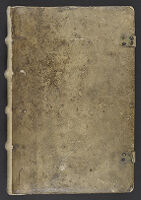
Binding: Pre-1600. 15th-century binding made from boards and white leather deer sking with a repaired spine, possibly in pig skin. The binding is secured by metal clasps, inscribed 'IHC' and 'M', on modern leather thongs.
- Custodial History:
-
Origin: Winchester. Created at the same scriptorium, probably in Winchester, as several other Old English texts produced in the late 9th and early 10th centuries. In particular, the scribe of the Tollemache Orosius seems also to have been one of the scribes of the second batch of entries in the Parker Library manuscript (MS A) of the Anglo-Saxon Chronicle (Cambridge Corpus Christi College, MS 173) and a corrector of the Junius Psalter (Ker, Catalogue of Manuscripts Containing Anglo-Saxon (1957), p. 165). The decorated initials of the Tollemache Orosius are also very similar to those in the Junius Psalter (Oxford, Bodleian Library, MS Junius 27) and the Tanner Bede (Oxford, Bodleian Library, MS Tanner 10), and the manuscripts may have had the same decorator.
Provenance:
? Winchester, late 10th or early 11th century: Scriptural notes, figural drawings, Old English text on Adam, and musical notation added (ff. 1, 1v, 87v, [88]) (see Stokes, English Vernacular Minuscule (2014), p. 88).
Latin and Old English phrases added in a 12th-century hand (f. [88]).
Two flyleaves of fragments of an Exchequer roll recording payments for 19 and 20 April 1347 (ff. i, iii), probably added in the 17th century.
? John Dee (b. 1527, d. 1609), mathematician, astrologer, and antiquary: owned by him, according to George Hickes (b. 1642, d. 1715), librarian of the Duke of Lauderdale's library and clergyman (see Hickes and Wanley, Antiquae Literaturae Septentrionalis Libri Duo, II, 303).
Inscribed 'Joan Davysun', 17th century (f. i).
John Maitland, duke of Lauderdale (b. 1616, d. 1682), politician, by 1676-78: manuscript 167 in his library (see Hickes and Wanley, Antiquae Literaturae Septentrionalis Libri Duo (1705), II, 303).
Collated by Thomas Marshall (d. 1685) with Junius's transcript of British Library Cotton Tiberius B I translation of Orosius (ff. 9-16).
?Elizabeth Murray, Countess of Dysart, Duchess of Lauderdale (bap.1626, d. 1698): bequeathed to her son from her first marriage, Sir Lionel Tollemache (see Bosworth, King Alfred's (1859), p. xvii).
Lionel Tollemache, 4th baronet of Helmingham and 3rd earl of Dysart (b. 1649, d. 1727); the Tollemache family of Helmingham: Helmingham Hall manuscript 46; loaned by them to Joseph Bosworth (b. 1787/8, d. 1876), Old English scholar, in 1850-1854 (see Roberts, Guide to Scripts (2005), p. 54).
John Tollemache, 1st Baron Tollemache (b. 1805, d. 1890): inscribed 'John Tollemache' (f. i verso); printed notice clipped from a journal, entitled '14. The Library at Helmingham (ii) Of the Lauderdale Manuscript' by John Earle: f. ii recto; deposited with the British Museum from 1948; acquired in 1953 from the trustees of Lord Tollemache for £10,000, £7,500 from Exchequer funds, and the remainder being contributed by the Trustees from their trust and other funds.
- Information About Copies:
-
Full digital coverage available for this manuscript: see Digitised Manuscripts at http://www.bl.uk.manuscripts.
The Tollemache Orosius (i.e. the Old English Version of the 'Historiae adversum paganos') British Museum Additional Manuscript 47967 ed. by Alistair Campbell (Copenhagen: Rosenkild and Bagger, 1953) [facsimile].
- Publications:
-
George Hickes and Humphrey Wanley, Antiquae Literaturae Septentrionalis Libri Duo, 2 vols (Oxford, 1705), II, 303.
Joseph Bosworth, A Literal Translation of King Alfred's Anglo-Saxon Version of the Compendious History of the World By Orosius (London: Longman, Brown, Green, and Longmans, 1855) [includes translation].
Joseph Bosworth, King Alfred's Anglo-Saxon Version of the Compendious History of the World by Orosius (London: Longman, Brown, Green, and Longmans, 1859).
King Alfred's Orosius, ed. by Henry Sweet, Early English Text Society, o. s., 79 (London: Trübner & Co, 1883) [includes edition].
Simeon Potter, 'Commentary on King Alfred's Orosius', Anglia: Zeitschrift fur englische Philologie, 71 (1953), 385-47.
N.R. Ker, Catalogue of Manuscripts Containing Anglo-Saxon (Oxford: Clarendon Press, 1957), no. 133 [includes a reconstruction of the Old English text on Adam on f. 87v].
N.R. Ker, Medieval Libraries of Great Britain: A List of Surviving Books, 2nd edn (Oxford: Clarendon Press, 1964), p. 200 n. 7.
M.B. Parkes, 'The paleography of the Parker manuscript of the Chronicle, laws and Sedulius, and historiography at the Winchester in the late ninth and tenth centuries', Anglo-Saxon England, 5 (1976), 149-71 (pp. 156-57).
Janet Bately, 'World History in the Anglo-Saxon Chronicle: its sources and its separateness from the Old English Orosius', Anglo-Saxon England, 8 (1979), 177-94.
The Old English Orosius ed. by Janet Bately, Early English Text Society s.s., 6 (Oxford: Oxford University Press, 1980) [includes edition and commentary].
The Anglo-Saxons, ed. by James Campbell and others (London: Penguin, 1982), p. 158.
Catalogue of Additions to the Manuscripts, 1951-1955, 3 parts (London: British Library, 1982), I, 121-23.
The Golden Age of Anglo-Saxon Art, 966-1066, ed. by Janet Backhouse, D.H. Turner and Leslie Webster (Bloomington: Indiana University Press, 1984), no. 2.
Francis Wormald, Collected Writings I: Studies in Medieval Art from the Sixth to the Twelfth Centuries, ed. by J.J.G. Alexander, T.J. Brown and Joan Gibbs (Oxford: Oxford University Press, 1984), pp. 57-59, 76.
Janet Bately, The Anglo-Saxon Chronicle: MS A,The Anglo-Saxon Chronicle: A Collaborative Edition, ed. by D. Dumville and S. Keynes, 3 (Cambridge: 1986), pp. xxv-xxxiv.
The Making of England: Anglo-Saxon Art and Culture AD 600-900, ed. by Janet Backhouse and Leslie Webster (Toronto: University of Toronto Press, 1991), no. 238.
David N. Dumville, Wessex and England from Alfred to Edgar: Six Essays on Political, Cultural, and Ecclesiastical Revival Studies in Anglo-Saxon History, 3 (Woodbridge: Boydell, 1992), pp. 65, 67-68, 72-73, 120, 135.
Patrick Conner, Anglo-Saxon Exeter: A Tenth Century Cultural History (Woodbridge: Boydell, 1993), p. 53.
A.S.G. Edwards and Jeremy Griffiths, 'The Tollemache Collection of Medieval Manuscripts ', The Book Collector, 49 (2000), 349-64 (pp. 351, 356).
Jane Roberts, A Guide to Scripts Used in English Writings Up to 1500 (London: The British Library, 2005), pp. 52-55.
Michelle P. Brown, Manuscripts from the Anglo-Saxon Age (London: British Library, 2007), pp. 85-86, no. 71.
Irmeli Valtonen, The North in the Old English Orosius: A Geographical Narrative in Context Mémoires de la Société Néophilologique de Helsinki, 73 (Helsinki: Société Néophilologique, 2008), pp. 9, 259-60, 263, 271, 492.
Malcolm Godden, 'The Old English Orosius and its sources', Anglia: Zeitschrift fur englische Philologie, 129 (2011), 297-320.
Richard Gameson, 'The material fabric of early British books' in The Cambridge History of the Book in Britain 6 vols (Cambridge: Cambridge University Press, 1999-2012), I: 400-1100 (2012), ed. by Richard Gameson, pp. 13-93 (p. 39 n. 95, 59 n. 195).
David Ganz, 'Square Minuscule' in The Cambridge History of the Book in Britain, 6 vols (Cambridge: Cambridge University Press, 1999-2012), I: 400-1100 (2012), ed. by Richard Gameson, pp. 188-96 (pp. 188 n. 4, 189).
Richard Gameson, 'Book decoration in England' in The Cambridge History of the Book in Britain 6 vols (Cambridge: Cambridge University Press, 1999-2012), I: 400-1100 (2012), ed. by Richard Gameson, pp. 249-93 (p. 287 n. 133).
Malcolm Godden, 'The Old English Orosius and its Context: who wrote it, for whom, and why', Quaestio Insularis, 12 (2012), 1-30.
Peter A. Stokes, English Vernacular Minuscule from Æthelred to Cnut circa 990-1035 (D.S. Brewer: Cambridge, 2014), pp. 19, 88, 94-95.
- Material Type:
- Archives and Manuscripts
- Legal Status:
- Not Public Record(s)