Hard-coded id of currently selected item: . JSON version of its record is available from Blacklight on e.g. ??
Metadata associated with selected item should appear here...
Add MS 89000
- Record Id:
- 032-002226193
- Hierarchy Root Ancestor Record Id:
- 032-002226193
- MDARK:
- ark:/81055/vdc_100000000063.0x00014e
- LARK:
- ark:/81055/vdc_100165152658.0x000001
- SLARK:
- Format:
- ISAD(G)
- Reference (shelfmark):
- Add MS 89000
- Title:
- The St Cuthbert Gospel
- Scope & Content:
-
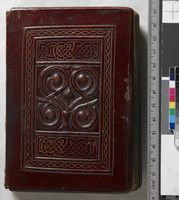
The St Cuthbert Gospel (formerly known as the Stonyhurst Gospel) retains its original binding and is the oldest intact European book. Made in the early 8th century, the manuscript contains a copy of the Gospel of John. Previously dated to the end of the 7th century (The Stonyhurst Gospel, ed. T. J. Brown (1969), pp. 12–13), R. Gameson has dated the script to c. 710–c. 730 and L. Webster has dated the decoration on the covers to c. 700–c. 730 (The St Cuthbert Gospel, eds C. Breay and B. Meehan (2015), pp. 33, 80). The Gospel is intimately connected with St Cuthbert (c. 635–687): Cuthbert was re-interred at Lindisfarne in 698, his coffin was removed following Viking raids in the 9th century and was later taken to Durham, where it was opened in September 1104 on the occasion of the translation of his remains. The Gospel was discovered inside the coffin:
"Ewangelium Iohannis quod inuentum fuerat ad capud beati patris nostri Cuthberti in sepulcro iacens anno translacionis ipsius" (13th-century note added on f. ii verso: 'The Gospel of John which was found at the head of our blessed father Cuthbert lying in his tomb in the year of his translation'). A near-identical note in a 12th-century hand has been erased in the upper margin of f. 1r.
An account of the miracles performed by Cuthbert, composed at Durham in the 1120s or 1130s, records that when the outer lid of the coffin was raised in 1104, the monks saw 'a book of the Gospels lying at the head of the board' (R. Gameson in The St Cuthbert Gospel, eds C. Breay and B. Meehan (2015), pp. 129-36; The Stonyhurst Gospel, ed. T. J. Brown (1969), pp. 2–5; Symeonis Monachi Opera Omnia, ed. T. Arnold, 2 vols, Rolls Series (1882–85), i, pp. 247–61, ii, pp. 359–62). During a sermon preached on the day of the translation, Ranulf Flambard, bishop of Durham (1099–1128), showed the people a Gospel of John in miraculously perfect condition, which had a satchel-like container of red leather with a badly-frayed sling made of silken threads. According to Reginald of Durham, writing in the 1160s or 1170s, William FitzHerbert, archbishop of York (1141–1147, 1153–1154), was shown a manuscript, apparently the St Cuthbert Gospel, when visiting Cuthbert's tomb at Durham in 1153 or 1154.
The contents of the St Cuthbert Gospel are as follows:
f. i recto–verso. An inserted, late-13th century leaf containing a court-roll of the prior of Durham, and not part of the original binding structure. Written no earlier than 6 August 1264 (heading on f. i recto, line 2).
f. ii recto–verso. The original pastedown (?), with the note 'Ewangelium Iohannis quod inuentum fuerat ad capud beati patris nostri Cuthberti in sepulcro iacens anno translacionis ipsius' on f. ii verso.
ff. 1r–90v. The Gospel of John.
lower pastedown (formerly numbered f. 91). An 18th-century, pasted paper leaf, recording the donation of the gospel-book to the English Jesuit College at Liège: 'Hunc Evangelii Codicem dono accepit ab Henrico Comite de Litchfield, et dono dedit Patribus Societatis Iesu, Collegii Anglicani, Leodii, Anno 1769; rectore eiusdem Collegii Ioanne Howard: Thomas Phillips Sac. Can. Ton.'
There are 8th-century marginal annotations on the following pages, marking offices for the dead:
f. 20v 'pro defunctis' (beside John v. 21);
f. 27r 'pro defunctis' (beside John vi. 37);
f. 28v 'de mortuorum' (beside John vi. 51);
f. 51r 'de mortuorum' (beside John xi. 21).
- Collection Area:
- Western Manuscripts
- Project / Collection:
- Additional Manuscripts
- Hierarchy Tree:
- [{ "id" : "032-002226193", "parent" : "#", "text" : "Add MS 89000: The St Cuthbert Gospel" , "li_attr" : {"class": "orderable"} }]
- Hierarchy Record Ids:
- 032-002226193
- Is part of:
- not applicable
- Hierarchy:
- 032-002226193
- Container:
- not applicable
- Record Type (Level):
- Fonds
- Extent:
-
1 volume
- Digitised Content:
- https://iiif.bl.uk/uv/#?manifest=https://bl.digirati.io/iiif/ark:/81055/vdc_100165152658.0x000001 (opens in a new tab)
- Thumbnail:
-
- Languages:
- Latin
- Scripts:
- Latin
- Start Date:
- 0700
- End Date:
- 0740
- Date Range:
- Early 8th century
- Era:
- CE
- Access:
- Restrictions to access apply please consult British Library staff
-
Please request the physical items you need using the online collection item request form.
Digitised items can be viewed online by clicking the thumbnail image or digitised content link.
Readers who have registered or renewed their pass since 21 March 2024 can request physical items prior to visiting the Library by completing
this request form.
Please enter the Reference (shelfmark) above on the request form.If your Reader Pass was issued before this date, you will need to visit the Library in London or Yorkshire to renew it before you can request items online. All manuscripts and archives must be consulted at the Library in London.
This catalogue record may describe a collection of items which cannot all be requested together. Please use the hierarchy viewer to navigate to individual items. Some items may be in use or restricted for other reasons. If you would like to check the availability, contact our Reference Services team, quoting the Reference (shelfmark) above.
- Physical Characteristics:
-
Materials: parchment codex (the lower pastedown is made of 18th-century paper).
Foliation: fos. ii + 90. Note: the inserted leaf from the Durham court-roll has been numbered f. i, and the upper endleaf f. ii.
Dimensions: approximately 137 × 95 mm.
Script: written in capitular uncial, with a few initials and red letters in text uncial. Marginalia on ff. 20v, 27r, 51r written in Insular minuscule and on f. 28v in a hybrid of Insular half-uncial and set minuscule.
Binding: original, early 8th-century binding, described in The St Cuthbert Gospel, eds C. Breay and B. Meehan (2015), pp. 41–63 (technical description of the binding by Nicholas Pickwood), and in The Stonyhurst Gospel, ed. T. J. Brown (1969), pp. 13–23, 45–55 (technical description of the binding by Roger Powell and Peter Waters). The boards are of the same size as the leaves, almost certainly of birch, and cut on the quarter. The left board is c. 2.4 mm thick and the right c. 1.5 mm thick. Shallow slots were cut in both faces of the boards from the holes to the back edges to accommodate the thread, which was made of flax and with an S-twist. There were neither thongs or cords; thread alone joins the boards to the sections, and the sections to each other. The binding is covered in tanned goatskin, stained a deep crimson on the outer surface, and c. 1.3 mm thick. The leather was stuck to the boards and moulded over the foundations of the design while it was still damp. The decoration of the boards was enriched by tooling and colouring lines on the surface, with the tip of a fine folder or a stylus. The left board is decorated with a rectangular frame with interlace patterns in the upper and lower fields and a larger central field containing a chalice from which stems project, terminating in a leaf or bud and four fruits. This raised motif was apparently made using a matrix, with a clay-like substance beneath the leather. The lines of the left board are filled in yellow (orpiment) and grey-blue (indigo). The right board has a rectangular panel containing a double-armed cross, constructed on a grid, with the lines filled alternately with yellow and grey-blue.
Decoration: simple red initials mark important sections in the text (e.g. ff. 1r, 2v, 5r, 11r, 12v, 21v, 25v, 27r, 30v, 33v, 36v, 38v, 45v, 49v, 53v, 55v, 56v, 59v, 63r, 64v), some of which are followed by further letters in red.
- Custodial History:
-
Origin:
Apparently produced at Wearmouth-Jarrow in the early 8th century.
Provenance:
According to inscriptions on f. ii verso and f. 1r, the book was found in 1104 in Cuthbert’s coffin at Durham Cathedral Priory, which was dissolved in 1540.
By the early-17th century, the book was owned by Thomas Allen (d. 1632), of Oxford.
By the 18th century it was owned by George Henry Lee, 3rd Earl of Lichfield (d. 1772), who gave the book to the Reverend Thomas Phillips, S.J. (d. 1774), canon of Tongres.
In 1769, Phillips donated the book to the English community of the Society of Jesus in Liège. It was subsequently kept at the Jesuit college of Stonyhurst.
The Society of Jesus (British Province) placed the book on loan at the British Library in 1979 (Loan MS 74).
Purchased by the British Library in 2012, with the assistance of the National Heritage Memorial Fund, the Art Fund and many other donors following a public appeal. For a full list of donors to the acquisition fund, see The St Cuthbert Gospel, eds. C. Breay and B. Meehan (2015), p. x.
The manuscript has been exhibited on the following occasions:
Special Exhibition of Works of Art on loan in the South Kensington Museum, 1862.
English Illuminated Manuscripts and Specimens of Medieval Book-binding. Victoria and Albert Museum, 1920-21.
Medieval English Art. Victoria and Albert Museum, 1930.
Exhibited:
The manuscript has been exhibited on a regular basis at the Sir John Ritblat Gallery: Treasures of the British Library, as well as on the following occasions:
Saint Cuthbert and his Heritage (Durham Cathedral, 1987).
The Making of England: Anglo-Saxon Art and Culture AD 600-900 (British Museum, 1991).
Treasures from the Lost Kingdom of Northumbria (Newcastle-upon-Tyne, Laing Art Gallery, 1996).
The Transformation of the Roman World AD 400-900 (British Museum, 1997).
Painted Labyrinth: The World of the Lindisfarne Gospels (British Library, 2003).
Sacred: Discover What We Share (British Library, 2007).
Lindisfarne Gospels Durham (Durham University, Palace Green Library, 2013).
Bound to Last: Book Binding from the Middle Ages to the Modern Day (Durham University, Palace Green Library, 2014-15).
Anglo-Saxon Kingdoms: Art, Word, War (British Library, 2018-19).
The Lindisfarne Gospels (Newcastle-upon-Tyne, Laing Art Gallery, 2022).
- Former Internal References:
- Loan MS 74
- Publications:
-
John Milner, 'Account of an Ancient Manuscript of St John's Gospel, by the Rev. John Milner, F.A.S. in a Letter to Rev. John Brand, Read June 5, 1806', Archæologia, 16 (January 1812), 17–21, item V.
John C. Robinson, The Art Wealth of England (London: P. & D. Colnaghi, Scott and Co., 1862), item 42.
Sarah Prideaux, An Historical Sketch of Bookbinding (London: Lawrence & Bullen, 1893), pp. 4–5.
William Salt Brassington, A History of the Art of Bookbinding, with some account of the books of the ancients (London: Elliot Stock, 1894), pp. 84–85.
W.H. James Weale, Bookbindings and Rubbings of Bindings in the National Art Library South Kensington, 1 (London: HMSO, 1898), p. xxii.
Jean Loubier, Der Bucheinband in alter und neuer Zeit (Berlin and Leipzig: Hermann Seemann Nachfolger, 1904), pp. 59-60.
G.D. Hobson, English Binding before 1500 (Cambridge: University Press, 1929), pp. 1-2.
Exhibition of English Mediaeval Art, 1930, Victoria and Albert Museum (London: Victoria and Albert Museum, 1930), no. 1, p. 1.
Egerton Beck, ‘Medieval English Art at the Victoria and Albert Museum’, The Burlington Magazine for Connoisseurs, 56, no. 327 (June 1930), 292–305 (pp. 292, 297).
Douglas Cockerell, ‘The Development of Bookbinding Methods - Coptic Influence’, The Library, 4th ser., 13, no. 1 (1932), 1–19 (pp. 3-4).
Codices Latini Antiquiores, ed. E.A. Lowe, 11 volumes and supplement (Oxford: Clarendon Press, 1934-72), 2: Great Britain and Ireland (1935), p. 39, no. 260.
B. van Regemorter, ‘La reliure des manuscrits de S. Cuthbert et de S. Boniface’, Scriptorium, 3 (1949), pp. 45–51.
Patrick McGurk, ‘The Irish Pocket Gospel Book’, Sacris Erudiri, 8 (1956), 249–70 (pp. 264, 266).
R.A.B. Mynors and Roger Powell, 'The Stonyhurst Gospel', in The Relics of Saint Cuthbert, ed. by C.F. Battiscombe (Oxford: Printed for the Dean and Chapter of Durham Cathedral at the University Press, 1956), pp. 356–74.
E.A. Lowe, English Uncial (Oxford: Clarendon Press, 1960), pp. 9, 18, pl. VII.
Patrick McGurk, Latin Gospel Books from AD 400 to AD 800 (Paris: Standaard-Boekhandel, 1961), p. 42.
D.H. Wright, 'The Relics of St Cuthbert, by C.F. Battiscombe', Art Bulletin, 43 (1961), 141–60 (pp. 153–55) [book review].
Medieval Libraries of Great Britain: A List of Surviving Books, ed. by N.R. Ker, 2nd edn, Royal Historical Society Guides and Handbooks, 3 (London: Royal Historical Society, 1964), p. 75.
The Stonyhurst Gospel of Saint John, ed. by T. Julian Brown with a technical description of the binding by Roger Powell and Peter Waters, Roxburghe Club (Oxford: University Press for the Roxburghe Club, 1969).
Paul Needham, Twelve Centuries of Bookbindings, 400-1600 (New York: Pierpont Morgan Library/Oxford University Press, 1979), pp. 57–58.
R.D. Stevick, 'The St Cuthbert Gospel Binding and Insular Design', Artibus et Historiae, 8, no. 15 (1987), 9–19.
Gerald Bonner and Roger Norris, Saint Cuthbert and his Heritage (Durham: Dean and Chapter, 1987), item 4.
Gerald Bonner, St Cuthbert, his Cult and his Community (Woodbridge: Boydell Press, 1989), pp. 153, 227, 298, 392, 460.
Michelle P. Brown, Anglo-Saxon Manucripts (London: British Library, 1991), pp. 47–49.
Michelle P. Brown, 'Continental Symptoms in Insular Codicology: Historical Perspectives', in Pergament: Geschichte, Struktur, Restaurierung, Herstellung, ed. by P. Rück, Historische Hilfswissenschaften, 2(Sigmaringen: Thorbecke, 1991), pp. 57–62.
The Making of England: Anglo-Saxon Art and Culture AD 600–900, ed. by Leslie Webster and Janet Backhouse (Toronto: University of Toronto Press, 1991), p. 121.
Howard M. Nixon and Mirjam M. Foot, The History of Decorated Bookbinding in England, Lyell Lectures in Bibliography (Oxford: Clarendon Press, 1992), pp. 1–2, pl. 1.
B. van Regemorter, Binding Structures in the Middle Ages, trans. by J. Greenfield (London: Maggs Bros, 1992), pp. 43–51.
Christopher de Hamel, A History of Illuminated Manuscripts, 2nd edn (London: Phaidon, 1994), pp. 36–38, pls 27–28.
The Transformation of the Roman World, AD 400–900, ed. by Leslie Webster and Michelle P. Brown (London: British Museum, 1997), pp. 234–35.
Mirjam M. Foot, The History of Bookbinding as a Mirror of Society, The Panizzi Lectures 1997 (London: British Library, 1998), p. 12.
The Blackwell Encyclopedia of Anglo-Saxon England, ed. by Michael Lapidge and others (Oxford: Blackwell, 1998), p. 429.
P.J.M. Marks, The British Library Guide to Bookbinding History and Techniques (London: British Library, 1998), pp. 32, 63–65.
J.A. Szirmai, The Archaeology of Medieval Bookbinding (Aldershot: Ashagte, 1999), pp. 95–98.
Dominic Marner, St Cuthbert: his Life and Cult in Medieval Durham (London: British Library, 2000), pp. 22, 46.
Helmut Gneuss, Handlist of Anglo-Saxon Manuscripts: A List of Manuscripts and Manuscript Fragments Written or Owned in England up to 1100, Medieval and Renaissance Texts and Studies, 241 (Tempe, Arizona: Arizona Center for Medieval and Renaissance Studies, 2001), p. 86, no. 501.2.
Michelle P. Brown, The Lindisfarne Gospels: Society, Spirituality and the Scribe (London: British Library, 2003), passim.
Michelle P. Brown, Painted Labyrinth: The World of the Lindisfarne Gospels (London: British Library, 2003), pp. 16–17.
Don C. Skemer, Binding Words: Textual Amulets in the Middle Ages (University Park: Pennsylvania State University Press, 2006), pp. 50–52.
Michelle P. Brown, 'The Book as Sacred Space', in Sacred Space: House of God, Gate of Heaven, a Celebration of the 75th Anniversary of the Anglican Shrine of Walsingham, ed. by J. and P. North (London: Continuum, 2007), p. 56.
Michelle P. Brown, Manuscripts from the Anglo-Saxon Age (London: British Library, 2007), pp. 15, 37, 38.
Sacred: Books of the Three Faiths: Judaism, Christianity, Islam (London: British Library, 2007), p. 186.
Michelle P. Brown, ‘The Triumph of the Codex: The Manuscript Book before 1100’, in A Companion to the History of the Book, ed. by S. Eliot and J. Rose (Oxford: Blackwell, 2009), pp. 179–93 (p. 190).
Richard Gameson, Manuscript Treasures of Durham Cathedral (London: Third Millennium, 2010), p. 28.
Richard Gameson, From Holy Island to Durham: The Contexts and Meanings of the Lindisfarne Gospels (London: Third Millennium, 2013), pp. 117, 119, 156–57, ill. 65.
The St Cuthbert Gospel: Studies on the Insular Manuscript of the Gospel of John, ed. by Claire Breay and Bernard Meehan (London: British Library, 2015).
Anglo-Saxon Kingdoms: Art, Word, War, ed. by Claire Breay and Joanna Story (London: The British Library, 2018), no. 32 [exhibition catalogue].
Richard Gameson, ‘Writing at Wearmouth-Jarrow’, in Manuscripts in the Anglo-Saxon Kingdoms: Cultures and Connections, ed. by Claire Breay and Joanna Story with Eleanor Jackson (Dublin: Four Courts, 2021), pp. 28-44 (pp. 34, 36, 81 n. 50).
- Material Type:
- Archives and Manuscripts
- Legal Status:
- Not Public Record(s)