Hard-coded id of currently selected item: . JSON version of its record is available from Blacklight on e.g. ??
Metadata associated with selected item should appear here...
Add MS 89442
- Record Id:
- 032-003707019
- Hierarchy Root Ancestor Record Id:
- 032-003707019
- MDARK:
- ark:/81055/vdc_100108484913.0x000001
- LARK:
- ark:/81055/vdc_100108506588.0x000001
- SLARK:
- Format:
- ISAD(G)
- Reference (shelfmark):
- Add MS 89442
- Title:
- Lewis of Caerleon, collected astronomical and mathematical works
- Scope & Content:
-
An opera omnia of the Welsh physician and astronomer Lewis of Caerleon (d. in or after 1495), representing the largest and most complete collection of his astronomical and mathematical works.
Written under Lewis's supervision, the manuscript contains self-referential rubrics (‘per me Lodowycum Caerlyon’) and personal annotations in Latin and signatures of his name in the vernacular (‘Lewys’) throughout. The manuscript was carefully planned, featuring astronomical tables and diagrams in a layout and style that closely resemble those of other Lewis of Caerleon manuscripts (e.g. Royal MS 12 G I), and was executed in an unusually large size, suggesting that it was a presentation copy. Lewis is known to have donated copies of his tables of eclipses to colleges in both Cambridge and Oxford. This manuscript contains calculations for Cambridge (pp. 49 and 55), and so it may have been intended for the University of Cambridge.
Lewis's works focus especially on lunar and solar eclipses and equinoxes, but also deal with mathematical subjects related to astronomy. His calculations are based on those of leading English astronomers such as Simon Bredon (d. 1372) and Richard of Wallingford (d. 1336), Abbot of St Albans, both fellows of Merton College, Oxford, and John Holbroke [Holbrook] (d. 1437), proctor and chancellor of the University of Cambridge. He also drew upon the works of Arabic astronomers such as Al-Battānī (b. c. 858, d. 929) (‘Albategni’, p. 1 etc.), Jabir ibn Aflah (b. c. 1100, d. c. 1160) (‘Geber’, p. 47), and Abū Ishāq Ibrāhīm al-Zarqālī (b. 1029, d. 1087) (‘Arzachel’, p. 118). Lewis did not merely copy the works of previous astronomers, but actively improved and expanded them using his own calculations.
Lewis of Caerleon studied medicine at Cambridge and was personal physician to Elizabeth Woodville (b. c. 1437, d. 1492), Queen of England, and Lady Margaret Beaufort (b. 1443, d. 1509) and her son, the later King Henry VII (r. 1485-1509). In 1484, his loyalty to the Tudors caused King Richard III (r. 1483-1485) to order his arrest. He remained incarcerated at the Tower of London until 1485. As he notes in this manuscript (pp. 65 and 121), he continued working on his tables with calculations for lunar eclipses during his imprisonment.
Contents:
pp. 1-33: An astronomical table attributed to Lewis of Caerleon, (pp. 1-30), entitled: ‘Tabula cordarum mediatarum magistri Symonis Bredonis expansa ad [? singulas medietates] per me Lodowycum et est precisiosor quam tabula Albategni quia calculatur pro singulis .15. minutis usque ad .8. Sed hic non posui nisi .4. verificata pro singulis .15. minutis’; followed by a text (pp. 31-32), beginning: ‘Quia in precedentibus expandi tabulas cordarum’; and ending: ‘Expliciunt canones tabularum mearum de corda et archu’; and a related text (pp. 32-33), beginning: ‘Ad maiorem intellectum precedencum de cordis mediatis’; and ending: ‘Explicit Opusculum Lodowyci Caerlyon in medicina doctoris de corda et Archu’.
pp. 34-38: An astronomical table attributed to Lewis of Caerleon (p. 34), entitled: ‘Tabula altitudinis per umbram versam usque .45. gradus altitudinis calculata per ypothemisam umbre per me Lodowycum’; followed by another table attributed to Lewis of Caerleon (p. 35), entitled: ‘Tabula altitudinis per umbram rectam A .45. gradus ad .90. calculata per me Lodowycum cuius calculatio patet in exemplis sequentibus’; and a text (pp. 36-38), beginning: ‘Circa compositionem tabularum umbre recte et verse’; featuring a mathematical table (p. 37), entitled: ‘Quadratum .12. punctorum’; and ending: ‘Explicit opus Lodowyci Caerlyon in medicinis doctoris circa tabulas umbrarum Anno Incarnacionis imperfecto .1482. 30. die mensis Aprilis Apud Londonis’.
pp. 39-41: An astronomical text on eclipses attributed to Lewis of Caerleon (pp. 39-40), entitled: ‘Hic Incipit opus Eclipsium per me Lodowycum Anno Christi imperfecto .1482. qui me dirigat sua gracia per semitam veritatis’; followed by eclipse tables (pp. 40-41), with the second to last one attributed to Al-Battānī and expanded by Lewis Caerleon in 1482 (‘Tabule Eclipsium in suo ordine constitute et per me Lodowcym secundum semidiametros albategni noviter facte anno Christi .1482. [? quorum] calculacio hic per ordinem preponitur’); and the last table attributed to Richard Wallingford (p. 41), entitled: ‘Sequitur quantitas diametrorum solis lune et umbre secundum Ricardum de Sancto Albano abbatem’; followed by a text (pp. 42-43), entitled: ‘Sequitur calculacio tabularum eclipsium solis et lune secundum semidiametros solis lune et umbre A Ricardo Wallingforthe abbate de Sancto Albano positos libro suo primo de composicione albionis. [? conclusione] . 18. 19. et 21. sub hac serie verborum [? conclusione] .18.’; and tables attributed to Richard of Wallingford and Lewis of Caerleon (pp. 42-43), the last one entitled: ‘Tabula Eclipsis Solis ad longitudinem propiorem lune et mediam solis secundum dyametros Ricardi noviter facta anno Christi imperfecto .1482.’.
pp. 44-60: A collection of astronomical texts and tables, including a text (p. 44), beginning: ‘Quia repperi tabulam proporcionis que dicitur tabula minutorum proportionalium’; followed by tables (pp. 45-46), including one that is attributed to Lewis of Caerleon (p. 45), entitled: ‘Eadem tabula minutorum proportionalium que a plerisque vocatur tabula proporcionis vel affinitatis seu porciones longitudinem ad eclipses a me lowowyco noviter facta secundum demonstraciones precedentes hic [? significatur secunda] expansa per me ad singulos gradus argumenti veri lune’; a collection of shorter texts (pp. 46-49), beginning: ‘Tabulam diversitatis aspectus lune in longitudine et latitudine ad opus eclipsium solis’; featuring subsections entitled ‘De ascensione signorum in circulo obliquo sub latitudine quacumque data sequitur compendiose’ (p. 48); ‘Invencio eiusdem [? dicere] per maximam declinacionem Bredonis et meam’ (p. 48); ‘Conpositio seu continuatio tabule ascensionis in circulo obliquo’ (pp. 48-49); another collection of shorter texts referring to John Holbroke (pp. 49-55), beginning: ‘Sequitur examinacio tabularum ascensionum quas ut dicitur magister holbroke edidit ad meridiem Cantebrigie [etc].’; featuring subsections entitled: ‘Execucio propositi mei secundum declinationem Bredonis a mea observatione [? infrascripta] variantem’ (p. 49) and ‘tabula ascensionis signorum [etc.]’ (pp. 49-52); this is followed by a collection of tables (pp. 53-55), including a ‘Tabule ascensionis signorum in circulo recto’ (p. 53) and a ‘Tabula ascensionis signorum in circulo directo’ (p. 53), similar tables (pp. 54-55), and a table that refers to Cambridge (p. 55), entitled ‘Tabula archus diurni et medietatis eiusdem pro signis septentrionalibus et archus nocturni et medietatis eiusdem pro signis meridionalibus [...] sicut suppono latitudinem Cantebrigie . quam instrumentaliter non certificavi’; a text (p. 56), entitled: ‘Signata aliqua hora ante meridiem vel post diversitatem aspectus lune’; followed by various short tables (pp. 56-58); a text (p. 58), beginning: ‘Si autem velis operari secundum modum Albategni’, followed by a table and calculations attributed to Al-Battānī (p. 59): ‘Exemplum calculandis processum albatgeni [etc.]’; and a table signed by Lewis of Caerleon (p. 60): ‘Tabula diversitatis aspectus in longitudine et latitudine ubi polus elevatur .42. gradus. 20. minutae [etc.]’.
pp. 61-64: Lunar eclipse tables attributed to Al-Battānī and expanded by Lewis of Caerleon (pp. 61-63), entitled: ‘Tabula Eclipsis lunaris secundum diametros Albategni .100. 30. et .43. ad longitudinem longiorem cum differentia praedicatorum et minutorum casus et more ad longitudinem propiorem noviter facta et expansa ad [? singula minuta] argumenti latitudinis lune per me Lodowycum Anno Christi .1482.’; followed by similar eclipse tables for the Sun (pp. 63-64).
pp. 65-68: An eclipse table attributed to Richard of Wallingford and expanded by Lewis of Caerleon (p. 65), entitled: ‘Hic Incipit tabula Eclipsis lunaris secundum dyametros Ricardi abbatis de Sancto Albano libro suo primo de compositione Albionis [? conclusione] 18. 19. et 21. ad longitudinem longiorem cum differentia punctorum et minutorum casus et more ad longitudinem propiorem noviter facta et expansa ad [? singula minuta] argumenti latitudinis lune per me Lodowycum facta Anno Christi .1482. et huic tabule finaliter adhereo ut in principio huius operis premisi’; with a note in the lower margin in which Lewis Caerleon refers to eclipse tables that were taken from him at his arrest in 1484, and new ones that he made while he was incarcerated in the Tower of London: ‘Nota quod post compositionem istarum tabularum quas amiseram per exspoliationem Regis Ricardi Ego existens incarceratus in turre Londoniorum composui alias tabulas eclipsium [etc.]’; followed by other eclipse tables attributed to Richard of Wallingford (pp. 66-68), with one (p. 67) expanded by Lewis of Caerleon, dated to 1482.
p. 69: An astronomical table attributed to Lewis of Caerleon, entitled: ‘Tabula latitudinis lune infra terminos eclipsium expansa ad [? singula minuta] argumenti latitudinis lune per me Lodowycum’; followed by smaller tables by Lewis of Caerleon, one of which is dated 1483.
p. 70: An astronomical text, beginning: ‘Postquam nonas tabulas eclipsium composuerim cum simul tabulam ad easdem pertinentibus’.
p. 71: A short astronomical text, entitled: ‘Exemplum calculandi eclipsium solis per novas tabulas que contigit Anno domini imperfecto .1485. post meridiem .16. marcij ut sequitur’; ending with the note: ‘hoc totum secundum diametryos wallynforth [sic] abbatis et geometri eximij’.
pp. 72-116: A large collection of astronomical tables, the first one entitled: ‘Tabula Revolucionis conjunctionum et oppositionum solis et lune cum motibus ad idem requisitis . cuius canones quere ad finem tabularum’.
pp. 117-118: An astronomical text, beginning: ‘Pro medijs conjunctionibus et oppositionibus habendis per tabulas revolucionis conjunctionum et oppositionum solis et lune’; featuring the date 1482. The margin of p. 118 features a solar symbol (☉) at the beginning of a new section (beginning: ‘Quia tabula [? composicionis] equacionis dierum quam composuit Arzachel’) with the note ‘Novum opus’.
pp. 119-120: An astronomical table attributed to Lewis of Caerleon, entitled: ‘Compositio tabule equacionis dierum per me Lodowycum anno Christi .1485. supponendo [? auguste] solis in primo gradu cancri perfecto cuius compositionis canones proponuntur in proximo folio ad signum tale ☉’.
p. 121: An astronomical table attributed to Lewis of Caerleon, entitled: ‘Tabula equacionis dierum in motu et in tempore per me Lodowycum Caerlyon noviter facta anno domino .1485. in turre Londoniarum’; followed by a text, beginning: ‘Pro tabula minutorum proportionalium’.
pp. 122-126: A mathematical table, entitled: ‘Tabula multiplicationis et divisionis et radicum extraccionis et vocatur tabula minutorum proportionalium a quibusdam et ab alijs tabula tabularum’ (p. 122); followed by another table (pp. 123-124), entitled: ‘Residuum eiusdem tabule’; and a text (pp. 124-126), beginning: ‘Si ergo velis scire quantitatem semidiametri solis’; featuring two short tables attributed to Al-Battānī and Richard Wallingford (p. 124), entitled: ‘Dyametri secundum Albategni’ and ‘Dyametri secundum Ricardum Wallyngforth Abbatem’); and ending: ‘Explicit opus magistri Lodowyci Caerlyon et Eclipsibus lune et solis excepto quod in Eclipsi Solis accipies semidiametrum solis in vice semidiametri umbre’.
pp. 126-128: An astronomical text (pp. 126-127), beginning: ‘Pro diversitate aspectus lune in longitudine et latitudine calculenda paucas permittam suppociones’; followed by sections entitled ‘Practica’ (pp. 126-127) and ‘Modus operandi Albategni’ (pp. 127-128), and two tables (p. 128), entitled: ‘Diversitas aspectus tabula solis quam lune in circulo altitudinis secundum Albategni [etc.]’ and ‘Residuum eiusdem tabule’.
The manuscript contains a few marginal notes that were added at later stages:
p. 36: A marginal note highlighting the name of ‘Johannis de linerijs’ [John of Lignéres (fl. 1320-1335), a Parisian astronomer and mathematician] in Lewis of Caerleon's text; added by an unknown 17th-century reader.
p. 39: Marginal notes about Simon Bredon and Richard of Wallingford; added by an unknown 16th-century reader.
p. 121: A marginal note ‘signa argumenti ☉ et debes addendum unum gradum continue ad ☉ argumentum [etc.]’; added in a late 15th-century hand.
Decoration:
22 astronomical and mathematical diagrams (geometrical figures) in brown or brown and red ink drawn in spaces left open in single columns or in margins (pp. 31 [3x], 32, 33 [2x], 36 [3x], 39, 44 [2x], 49, 50 [3x], 51 [2x], 52 [2x], 126 [2x]). Tables consisting of rasters drawn in brown ink with vertical lines in red ink for major divisions, featuring headers and arabic numerals in brown or red ink (pp. 1-30, 34-35, 37-38, 40-46, 53-69, 72-116, 119-124, 128). Large (5-line or 3-line) blue initials in square frameworks of red penwork decoration. Small (1-line) initials higlighted in red. Titles of new works or sections rubricated in red ink. Red and blue paraphs throughout the text. Underlining in red ink.
- Collection Area:
- Western Manuscripts
- Project / Collection:
- Additional Manuscripts
- Hierarchy Tree:
- [{ "id" : "032-003707019", "parent" : "#", "text" : "Add MS 89442: Lewis of Caerleon, collected astronomical and mathematical works" , "li_attr" : {"class": "orderable"} }]
- Hierarchy Record Ids:
- 032-003707019
- Is part of:
- not applicable
- Hierarchy:
- 032-003707019
- Container:
- not applicable
- Record Type (Level):
- Fonds
- Extent:
-
1 volume
- Digitised Content:
- https://iiif.bl.uk/uv/#?manifest=https://bl.digirati.io/iiif/ark:/81055/vdc_100108506588.0x000001 (opens in a new tab)
- Thumbnail:
-
- Languages:
- Latin
- Scripts:
- Latin
- Start Date:
- 1485
- End Date:
- 1500
- Date Range:
- 1485-c 1495
- Era:
- CE
- Access:
- Restrictions to access apply please consult British Library staff
- User Conditions:
- Letter of introduction required to view this manuscript
Please request the physical items you need using the online collection item request form.
Digitised items can be viewed online by clicking the thumbnail image or digitised content link.
Readers who have registered or renewed their pass since 21 March 2024 can request physical items prior to visiting the Library by completing
this request form.
Please enter the Reference (shelfmark) above on the request form.If your Reader Pass was issued before this date, you will need to visit the Library in London or Yorkshire to renew it before you can request items online. All manuscripts and archives must be consulted at the Library in London.
This catalogue record may describe a collection of items which cannot all be requested together. Please use the hierarchy viewer to navigate to individual items. Some items may be in use or restricted for other reasons. If you would like to check the availability, contact our Reference Services team, quoting the Reference (shelfmark) above.
- Physical Characteristics:
-
Materials: Parchment.
Dimensions: 440 x 330 mm (text space: 330-345 x 240-245 mm; in 2 columns on pp. 31-33, 36).
Foliation: pp. 128; unfoliated, only modern pagination written between parentheses in the right upper corner of each recto; unpaginated parchment pastedowns on the insides of the upper and lower covers; 1 unpaginated parchment stub before p. 1, and 2 after p. 128; the lower margin of pp. 57-58 has been cut out (no loss of text); a large circle has been cut out from the lower half of p. 67 (loss of text). A loose piece of straw, perhaps used as a bookmark, is placed in the gutter between p. 36 and p. 37.
Script: Gothic cursive.
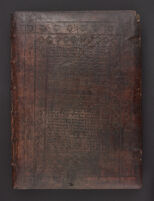
Binding: Original 15th-century binding: brown calf leather over oak boards decorated with blind-tooling and -stamps: an outer border of roundels featuring a (?) bird, an inner border of diamond-shapes featuring a (?) foliate motif, and at the centre a grid of squares featuring a dragon. Off-set and holes on the binding indicate that it once had a book chain (upper cover), two clasps, a strap and pin (lower cover), and a title plate (lower cover).
- Custodial History:
-
Origin:
England, perhaps London or Cambridge.
Provenance:
Lewis of Caerleon (d. in or after 1495), physician and astronomer: an opera omnia of his works, perhaps a presentation copy made under his close supervision, as is indicated by self-referential Latin rubrics (‘per me Lodowycum’) and annotations throughout the manuscript, and signatures of his name in the vernacular (‘Lewys’) on pp. 32 [erased], 33, 36, 39 [rubricated], 44, 51, 52, 53, 54, 55 [rubricated], 60.
? Cambridge University Library: Lewis of Caerleon was a graduate at Cambridge University and is known to have given copies of his works to Clare College, Cambridge, and Merton College, Oxford. The texts on pp. 49 and 55 specifically refer to Cambridge (see Kidd, ‘The Macclesfield Copy’, Notes and Observations (15 March 2020) [online blog]).
Sir Henry Spelman (b. 1563/4, d. 1641), historian and antiquary, owned in 1606: his ownership inscription on f. 1r: ‘Henricj Spelmannj liber. empt: 11o Apr: 1606’; and, by inheritance, his descent. The family apparently sold his library to the London bookseller John Harding (Temple Change, Fleet Street), who listed the Lewis of Caerleon manuscript as lot 3 in his sale catalogue of Spelman's library (‘Bibliotheca Selectissima: Being the Library of the Late Sir Edmund King [...] Sir Henry S[pelman]’), auctioned on 28 November 1709; also described as lot 3 in the ‘Catalogue of the Mss. in the Library of Sir Henry Spelman, sold by Auction by John Harding who bought them, December 20, 21, & 22 A.D. 1709’ made by Humfrey Wanley (b. 1672, d. 1726)’s, Library-Keeper of the Harleian Library, now Harley MS 7055, f. 232r (see Wright, Fontes Harleiani (1972), p. 310; and Kidd, ‘The Macclesfield Copy’, Notes and Observations (15 March 2020) [online blog]).
Walter Clavell (d. by 1740), F.R.S., elected 1704, admitted to the Inner Temple in 1700: lot no. 108 in the sale of his library (see A Catalogue of the Valuable Library of Books and Manuscripts of Walter Clavell, of the Inner Temple, Esq. FRS) on 29 March 1742 and successive days (see Kidd, ‘The Macclesfield Copy’, Notes and Observations (15 March 2020) [online blog]).
? William Jones (b. c. 1675, d. 1749), mathematician and tutor of George Parker: most of the manuscripts in the scientific library of the Earls of Macclesfield were purchased from him by Parker (see Kidd, ‘The Macclesfield Copy’, Notes and Observations (15 March 2020) [online blog]).
The library of the Earls of Macclesfield at Shirburn Castle, Shirburn, Oxfordshire, formed by Thomas Parker (b. 1667, d. 1733), 1st Earl of Macclesfield, George Parker (bap. 1697, d. 1764), 2nd Earl of Macclesfield, and Thomas [‘Viscount’] Parker (b. 1723, d. 1795), 3rd Earls of Macclesfield (see Quarrie, ‘The Scientific Library’ (2006), 5-10): their engraved armorial bookplate pasted on the inside of the upper cover, containing their heraldic achievement and motto (‘Sapere aude’), a reference to the ‘North Library’ (one of the two libraries at Shirburn Castle), the date 1860, and the handwritten press-mark ‘116. G. q.’. The scientific library of the Earls of Macclesfield at Shirburn Castle was sold by Richard Timothy George Mansfield Parker (b. 1943), 9th Earl of Macclesfield, and auctioned at Sotheby’s, London, in six sales between March 2004 to November 2005, but excluding this manuscript.
Purchased by the British Library from Sam Fogg Ltd on 27 August 2020, with support from the Shaw Fund, the T. S. Blakeney Fund, the Bernard H. Breslauer Fund of the American Trust for the British Library, the British Library Collections Trust, the Friends of the National Libraries, and donors who wish to remain anonymous.
- Publications:
-
Pearl Kibre, ‘Lewis of Caerleon, Doctor of Medicine, Astronomer, and Mathematician (d. 1494?)’, Isis, 43:2 (1952), 100-08.
[Peter Kidd] ‘Lewis of Caerleon, Collected Scientific Works’, Medieval Art in England, 27 June-26 July 2019 (London: Fogg, 2019), pp. 114-16 (no. 55) [Sam Fogg Ltd exhibition catalogue].
Peter Kidd, ‘The Macclesfield Copy of the Works of Lewis Caerleon’, Notes and Observations (15 March 2020) [accessed 26 October 2020].
Paul Quarrie, ‘The Scientific Library of the Earls of Macclesfield’, Notes and Records of the Royal Society of London, 60:1 (2006), 5-24.
Keith Snedegar, ‘Caerleon, Lewis (d. in or after 1494)’, Oxford Dictionary of National Biography (23 September 2004) [accessed 27 October 2020].
Cyril Ernest Wright, Fontes Harleiani: A Study of the Sources of the Harleian Collection of Manuscripts in the British Museum (London: British Museum, 1972), p. 310.
- Material Type:
- Archives and Manuscripts
- Legal Status:
- Not Public Record(s)