Hard-coded id of currently selected item: . JSON version of its record is available from Blacklight on e.g. ??
Metadata associated with selected item should appear here...
Cotton MS Nero D IV
- Record Id:
- 040-001102725
- Hierarchy Root Ancestor Record Id:
- 032-001101582
- MDARK:
- ark:/81055/vdc_100000001246.0x0003a7
- LARK:
- SLARK:
- Format:
- ISAD(G)
- Reference (shelfmark):
- Cotton MS Nero D IV
- Title:
- Gospel-book (‘Lindisfarne Gospels’)
- Scope & Content:
-
Contents:
ff. 3r-5v: St Jerome, Epistle to Pope Damasus ('Novum opus').
ff. 5v-8r: St Jerome, prologue to the Gospels ('Plures fuisse').
ff. 8r-9r: Eusebius, letter to Carpianus.
ff. 10r–17v: Canon tables.
ff. 18v-19r: Preface to the Gospel of St Matthew.
ff. 19r-23v: Chapter lists to the Gospel of St Matthew.
f. 24r-v: List of feasts with readings from the Gospel of St Matthew.
ff. 27r-89v: Gospel of St Matthew.
f. 90r-v: Preface to the Gospel of St Mark.
ff. 91r-93r: Chapter lists to the Gospel of St Mark.
f. 93r: List of feasts with readings from the Gospel of St Mark.
ff. 95r-130r: Gospel of St Mark.
f. 130r-v: List of feasts with readings from the Gospel of St Luke.
f. 131r-v: Preface to the Gospel of St Luke.
ff. 131v-137r: Chapter lists to the Gospel of St Luke.
ff. 139r-203r: Gospel of St Luke.
ff. 203v-204r: Preface to the Gospel of St John.
ff. 204r-208r: Chapter lists to the Gospel of St John.
f. 208r-v: List of feasts with readings from the Gospel of St John.
ff. 211r-259r: Gospel of St John.
f. 259r: Colophon in Latin and Old English, added by Aldred, priest of Chester-le-Street, in the 3rd quarter of the 10th century.
Throughout the manuscript: an interlinear gloss translating the gospels into Old English, added by Aldred, priest of Chester-le-Street, in the 3rd quarter of the 10th century.
Decoration:
4 Evangelist portraits: St Matthew (f. 25v); St Mark (f. 93v); St Luke (f. 137v); St John (f. 209v).
5 carpet pages: ‘Novum opus’ (f. 2v); St Matthew (f. 26v); St Mark (f. 94v); St Luke (f. 138v); St John (f. 210v).
5 incipit pages: ‘Novum opus’ (f. 3r); St Matthew (f. 27r); St Mark (f. 95r); St Luke (f. 139r); St John (f. 211r).
Chi-rho page (f. 29r).
Canon tables (ff. 10r–17v).
Numerous decorated initials throughout.
- Collection Area:
- Western Manuscripts
- Project / Collection:
- Cotton Collection
- Hierarchy Record Ids:
- 032-001101582
040-001102725 - Is part of:
- Cotton MS : Cotton Manuscripts
Cotton MS Nero D IV : Gospel-book (‘Lindisfarne Gospels’) - Hierarchy:
- 032-001101582[1367]/040-001102725
- Container:
- View / search within Archive / Collection: Cotton MS
- Record Type (Level):
- File
- Extent:
- 1 volume
- Digitised Content:
- https://iiif.bl.uk/uv/#?manifest=https://bl.digirati.io/iiif/ark:/81055/man_10000006.0x000001 (opens in a new tab)
- Thumbnail:
-
- Languages:
- English, Old
Latin - Scripts:
- Latin
- Start Date:
- 0695
- End Date:
- 0705
- Date Range:
- c 700
- Era:
- CE
- Access:
- Restrictions to access apply please consult British Library staff
-
Please request the physical items you need using the online collection item request form.
Digitised items can be viewed online by clicking the thumbnail image or digitised content link.
Readers who have registered or renewed their pass since 21 March 2024 can request physical items prior to visiting the Library by completing
this request form.
Please enter the Reference (shelfmark) above on the request form.If your Reader Pass was issued before this date, you will need to visit the Library in London or Yorkshire to renew it before you can request items online. All manuscripts and archives must be consulted at the Library in London.
This catalogue record may describe a collection of items which cannot all be requested together. Please use the hierarchy viewer to navigate to individual items. Some items may be in use or restricted for other reasons. If you would like to check the availability, contact our Reference Services team, quoting the Reference (shelfmark) above.
- Physical Characteristics:
-
Condition: intact.
Materials: parchment.
Dimensions: approximately 365 × 275 mm.
Foliation: ff. 259 (+ 5 unfoliated parchment flyleaves: 2 modern flyleaves at the beginning (ff. [i-ii]), 1 early modern flyleaf (f. [iii]), and 2 modern flyleaves at the end; f. 1 is an early modern flyleaf).
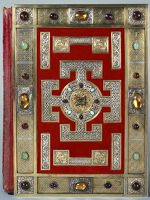
Binding: Messrs Smith, Nicholson and Co. of Lincoln’s Inn, London, 1853.
- Custodial History:
-
Origin:
England (probably the monastery of Lindisfarne).
Eadfrith (d. 722?), bishop of Lindisfarne was identified in the 10th century as the manuscript's original scribe (see below for colophon on f. 259r).
The manuscript was probably written at Lindisfarne by Eadfrith (d. 722?), bishop of Lindisfarne: identified in the added 10th-century colophon (f. 259r, set out below). Most scholars conclude that the manuscript was written at the monastery of Lindisfarne, although other sites have also been suggested, such as Monkwearmouth-Jarrow.
Provenance:
Aldred (fl. c. 970), provost of Chester-le-Street and glossator: added interlinear Old English glosses throughout the book. A colophon on f. 259r reads: 'Eadfrið biscop lindisfearnensis aecclesiae he ðis boc aurat aet fruma gode & sancte cuðberhte & allum ðaem halgum [gimaenelice]. ða. ðe in eolonde sint. & Eðiluald lindisfearneolondinga [bisc'] hit uta giðryde & gibelde sua he uel cuðae. & billfirið se oncrae he gismioðade ða gihrino ða ðe utan on sint & hit gihrinade mið golde & mið gimmum aec mið sulfre of' gylded faconleas feh; & Aldred presbyter indignus & misserrimus. mið godes fultumae & sancti cuðberhtes hit of' gloesade on englisc. & hine gihamadi mið ðaem ðriim daelu'. Matheus dael gode & sancte cuðberhti. Marci dael ðaem bisc'. & lucas dael ðaem hiorode & aehtu ora seoulfres mið to inlade. & sancti iohannis dael f'hine seolfne [id est f'e his saule] & feouer ora seoulfnes mið gode & sancti cuðberti. þ'te. he habbe ondfong ðerh godes milsae on heofnu'. uisdom & snyttro ðerh sancti cuðberhtes earnunga; Eadfrið. oeðiluald. billfrið. Aldred. hoc euangelium deo & cuðberhto construxerunt; & ornauerunt' (words in brackets have been added above the line; see Kendrick and others, Codex Lindisfarnensis (1956), pp. 5-10. (‘Eadrith, bishop of the Church of Lindisfarne, he, in the beginning, wrote this book for God and St Cuthbert and – generally – for all the saints who are on the island. And Ethiluald [Æthelwald, Oethilwald], bishop of the Lindisfarne-islanders [acceded by 731, died in 737 or 740], bound and covered it without, as he well knew how to do. And Billfrith the anchorite [fl. 750 x 800], he forged the ornaments which are on the outside and bedecked it with gold and with gems and also with gilded silver – pure wealth. And I, Aldred, unworthy and most wretched priest [born of Alfred, Aldred I am called; the outstanding son of a good woman I speak], with the help of God and St Cuthbert wrote a gloss above it in English', trans. by Gameson, From Holy Island (2013), p. 93.)
Durham Cathedral Priory, 12th century: described by Symeon of Durham (d. c. 1128) in his Libellus de exordio atque procursu istius hoc est Dunhelmensis ecclesie.
? Thomas Turner: inscribed 'Thomas Turner semel' in a 16th-century hand (f. 211r; no longer visible, see Codex Lindisfarnensis (1956), p. 25); inscribed 'Thys byk hys ussys per hyly' (f. 9r).
? William Bowyer (d. 1569/70), Keeper of the Records in the Tower, antiquary, father of Robert Bowyer (see below): probable owner (see Codex Lindisfarnensis (1956), p. 26).
Robert Bowyer (b. c. 1560, d. 1621), parliamentary official and politician: inscribed with his signature (f. 2v; visible under ultra-violet light; see Codex Lindisfarnensis (1956), p. 26).
Sir Robert Bruce Cotton (b. 1571, d. 1631), 1st baronet, antiquary and politician. Cotton’s collection was augmented by his son, Sir Thomas Cotton (b. 1594, d. 1662), 2nd baronet, and his grandson, Sir John Cotton.
Sir John Cotton (b. 1621, d. 1702), 3rd baronet: bequeathed the entire Cotton collection of books and manuscripts to trustees ‘for Publick Use and Advantage’, 12 and 13 William III, c. 7. Formed one of the foundation collections of the British Museum in 1753.
Exhibited:
The manuscript has been exhibited on a regular basis at the British Museum and at the Sir John Ritblat Gallery: Treasures of the British Library, as well as on the following occasions:
Treasures from Trinity College Dublin (London, The Royal Academy of Arts, 1961).
St Cuthbert and his Heritage (Durham Cathedral, 1987).
The Making of England: Anglo-Saxon Art and Culture, AD 600-900 (London, The British Museum, 1991-92).
Treasures of the Lost Kingdom of Northumbria (Newcastle-upon-Tyne, Laing Art Gallery, 1996).
The Lindisfarne Gospels (Newcastle-upon-Tyne, Laing Art Gallery, 2000-01).
Painted Labyrinth: The World of the Lindisfarne Gospels (London, The British Library, 2003).
Lindisfarne Gospels Durham (Durham, Palace Green Library, 2013).
Anglo-Saxon Kingdoms: Art, Word, War (London, The British Library, 2018-19).
Writing (London, The British Library, 2019).
The Lindisfarne Gospels (Newcastle-upon-Tyne, Laing Art Gallery, 2022).
- Information About Copies:
-
Codex Lindisfarnensis, Kendrick, T. D., and others, facsimile edn., 2 vols (Olten & Lausanne: Urs Graf, 1956–1960).
Das Buch von Lindisfarne: The Lindisfarne Gospels, Brown, Michelle P., facsimile edn., 2 vols (Lucerne: Faksimile-Verlag, 2002).
- Publications:
-
Alexander, Jonathan J. G., Insular Manuscripts: 6th to the 9th Century, A Survey of Manuscripts Illuminated in the British Isles, 1 (London: Harvey Miller, 1978), no. 9.
Alexander, Jonathan J. G., The Decorated Letter (London: Thames and Hudson, 1978), p. 40, pl. 1.
Alexander, Jonathan J. G., Medieval Illuminators and their Methods of Work (New Haven: Yale University Press, 1992), pp. 6, 72-73, 77, fig. 119.
Anglo-Saxon Kingdoms: Art, Word, War, ed. by Claire Breay and Joanna Story (London: The British Library, 2018), no. 30 [exhibition catalogue].
Backhouse, Janet, The Illuminated Manuscript (Oxford: Phaidon, 1979), p. 10, fig. 1.
Backhouse, Janet, The Lindisfarne Gospels (Oxford: Phaidon, 1981).
Backhouse, Janet, 'Birds, beasts and initials in Lindisfarne's Gospel books', in St Cuthbert, His Cult and His Community to AD 1200, ed. by Gerald Bonner, David Rollason and Clare Stancliffe (Woodbridge: Boydell, 1989), pp. 165–74.
Backhouse, Janet, The Lindisfarne Gospels: A Masterpiece of Book Painting (London: Phaidon, 1995).
Backhouse, Janet, The Illuminated Page: Ten Centuries of Manuscript Painting in the British Library (London: British Library, 1997), no. 1.
The Relics of St Cuthbert, ed. by C. F. Battiscombe (Durham: The Dean and Chapter of Durham Cathedral, 1956).
Birch, Walter de Gray, and Henry Jenner, Early Drawings and Illuminations: An Introduction to the Study of Illustrated Manuscripts (London: Bagster and Sons, 1879), p. 3.
Biblical Commentaries from the Canterbury School of Theodore and Hadrian, ed. by Bernhard Bischoff and Michael Lapidge, Cambridge Studies in Anglo-Saxon England, 10 (Cambridge: Cambridge University Press, 1994), pp. 155–58, 160n, 520, 527.
Boyd, William J. P., Aldred's Marginalia. Explanatory comments in the Lindisfarne Gospels (Exeter: University of Exeter, 1975).
The St Cuthbert Gospel: Studies on the Insular Manuscript of the Gospel of John, ed. by Claire Breay and Bernard Meehan (London: British Library, 2015), pp. 4, 13, 20–21, 34–36, 38, 70, 75–76, 78–80, 83, 102, 110, 123, 130, 134, 137–38, 142, 175–83.
Brown, Katherine L., and Robin J. Clark, 'The Lindisfarne Gospels and two other 8th-century Anglo-Saxon/Insular manuscripts: pigment identification by Raman microscopy,' Journal of Raman Spectroscopy, 35 (2004), 4–12.
Brown, Michelle P., A Guide to Western Historical Scripts from Antiquity to 1600 (London: British Library, 1990), no. 16.
Brown, Michelle P., 'Sir Robert Cotton, collector and connoisseur?', in Illuminating the Book: Makers and Interpreters, ed. by Michelle P. Brown and Scot McKendrick (London: British Library, 1998), pp. 281–98 (pp. 281–82, fig. 164).
Brown, Michelle P., and Patricia Lovett, The Historical Source Book for Scribes (London: British Library, 1999), pls on pp. 23, 54.
Brown, Michelle P., 'In the Beginning was the Word': Books and Faith in the Age of Bede, Jarrow Lecture 2000 (Newcastle-upon-Tyne: St Paul's Parish Church Council, 2000).
Brown, Michelle P., Commentary, in Das Buch von Lindisfarne: The Lindisfarne Gospels, Vol. I (Lucerne: Faksimile-Verlag, 2002). [facsimile]
Brown, Michelle P., The Lindisfarne Gospels: Society, Spirituality and the Scribe (London: British Library, 2003).
Brown, Michelle P., Painted Labyrinth: The World of the Lindisfarne Gospels (London: British Library, 2003).
Brown, Michelle P., Preaching with the Pen: the Contribution of Insular Scribes to the Transmission of Sacred Text, from the 6th to 9th Centuries, University of London Annual Palaeography Lecture, January 2004, School of Advanced Study, Institute of English Studies, University of London, Centre for Manuscript and Print Studies, Courses & Events, [accessed 3 April 2006].
Brown, Michelle P., ed., In the Beginning: Bibles before the Year 1000 (Washington: Freer Gallery of Art & Arthur M. Sackler Gallery, 2006), pp. 297–98.
Brown, Michelle P., Manuscripts from the Anglo-Saxon Age (London: British Library, 2007), p. 44 (plate).
Brown, T. Julian, 'Northumbria and the Book of Kells', Anglo-Saxon England, 1 (1972), pp. 219–46.
Bruce-Mitford, Rupert L. S., 'The reception by the Anglo-Saxons of Mediterranean art following their conversion from Ireland and Rome', Settimane di studio del Centro italiano di studi sull’alto medioevo Spoleto, 14 (1967), pp. 816–18.
Bruce-Mitford, Rupert L. S., 'The Lindisfarne Gospels', The Great Books of Ireland (Thomas Davis lectures) (1967), pp. 26–37.
Bruce-Mitford, Rupert L. S., 'The art of the Codex Amiatinus', Journal of the Archaeological Association, 32 (1969), 1–25.
Calkins, Robert G., Illuminated Books of the Middle Ages (London: Thames & Hudson, 1983), pp. 63–78, pls 26–32.
Chapman, John, Notes on the Early History of the Vulgate Gospels (Oxford: Clarendon Press, 1908), pp. 4, 7, 8–14, 24–25, 52 ff., 111–12, 120, 280.
Dodwell, C. R., Painting in Europe: 800 to 1200 (London: Penguin Books, 1971), pp. 3, 106–08.
Dodwell, C. R., Anglo-Saxon Art: A New Perspective (Manchester: Manchester University Press, 1982), pp. 11, 39, 51, 55, 97–98, 202, pl. 7.
Dumville, David N., A Palaeographer's Review, Sources and Materials Series, 20, 2 vols (Osaka: Institute of Oriental and Occidental Studies, Kansai University, 1999–2007), I, pp. 62, 64–65, 76–81, 94, 98.
Farr, Carol, 'Graphic divine: preaching with the pen in the Lindisfarne Gospels', Journal of St Bride Library, 4 (2008), 4–7.
The Old English Gloss to the Lindisfarne Gospels: Language, Author and Context, ed. by Julia Fernández Cuesta and Sara Pons-Sanz, Anglia Book Series, 51 (Berlin: De Gruyter Mouton, 2016).
Gameson, Richard, 'Why did Eadfrith write the Lindisfarne Gospels?', in Belief and Culture in the Middle Ages: Studies presented to Henry Mayr-Harting, ed. by Richard Gameson and Henrietta Leyser (Oxford: Oxford University Press, 2001), pp. 45–58.
Gameson, Richard, Manuscript Treasures of Durham Cathedral (London: Third Millennium, 2010), pp. 12, 28, 33, 38, 43, 90.
Gameson, Richard, From Holy Island to Durham: The Contexts and Meanings of the Lindisfarne Gospels (London: Third Millennium, 2013).
Gibson, Margaret T., The Bible in the Latin West, The Medieval Book, 1 (Notre Dame: University of Notre Dame Press, 1993), no. 4.
Gneuss, Helmut, 'A preliminary list of manuscripts written or owned in England up to 1100', Anglo-Saxon England, 9 (1981), no. 343.
Gneuss, Helmut, Handlist of Anglo-Saxon Manuscripts: A List of Manuscripts and Manuscript Fragments Written or Owned in England up to 1100 (Tempe, AZ: Arizona Center for Medieval and Renaissance Studies, 2001), no. 343.
Gullick, Michael, Calligraphy (London: Studio Editions, 1990), pls 4–5.
Henderson, George, Studies in English Bible Illustration, 2 vols (London: Pindar Press, 1985), pp. 1–2, 4, 7, 12, 19–20, 29, 32–33, 51.
Herbert, J. A., Illuminated Manuscripts (London: Methuen, 1911), p. 73, pl. viii.
Higgitt, John, The Murthly Hours: Devotion, Literacy and Luxury in Paris, England and the Gaelic West (London: British Library, 2000), p. 98, n. 4.
Hughes-Hughes, Augustus, Catalogue of Manuscript Music in the British Museum, 3 vols (London: British Museum, 1906–09), III, p. 371.
Karkow, Catherine E., 'Evangelist portraits and book production in late Anglo-Saxon England', in The Cambridge Illuminations: The Conference Papers, ed. by Stella Panayotova (London: Harvey Miller, 2007), pp. 55–63 (p. 55).
Kendrick, T. D., Anglo-Saxon Art to A.D. 900 (London: Methuen, 1938), pp. 34, 95, 103, 105 ff.
Kendrick, T. D., and others, Evangeliorum Quattuor Codex Lindisfarnensis: Musei Britannici Codex Cottonianus Nero D.IV, 2 vols (1956–60) [full facsimile with commentary].
Ker, Neil R., Catalogue of Manuscripts containing Anglo-Saxon (Oxford: Clarendon Press, 1957; repr. 1990), no. 165.
Medieval Libraries of Great Britain: A List of Surviving Books, ed. by Neil R. Ker, 2nd edn, Royal Historical Society Guides and Handbooks, 3 (London: Royal Historical Society, 1964), pp. 73, 119.
Medieval Libraries of Great Britain: A List of Surviving Books, ed. by Neil R. Ker, Supplement to the Second Edition, ed. by Andrew G. Watson, Royal Historical Society Guides and Handbooks, 15 (London: The Royal Historical Society, 1987), p. 30.
Kitzinger, Ernst, Early Medieval Art with Illustrations from the British Museum Collection (Bloomington: Indiana University Press, 1940), pls 16–17.
Klauser,Theodor, Das römische capitulare evangeliorum: Texte und Untersuchungen zu seiner ältesten Geschichte, Liturgiegeschichtliche Quellen und Forschungen, 28 (Munster: Aschendorffschen, 1935), p. XXXII, no. 12.
Laffitte, Marie-Pierre, and Charlotte Denoël, Trésors carolingiens: Livres manuscrits de Charlemagne à Charles le Chauve (Paris: Bibliothèque nationale de France, 2007), p. 69.
Lawrence-Mathers, Anne Manuscripts in Northumbria in the Eleventh and Twelfth Centuries (Woodbridge: Brewer, 2003), pp. 20, 25, 31.
Codices Latini Antiquiores, ed. by E. A. Lowe, 11 vols (Oxford: Clarendon Press, 1934–66), II: Great Britain and Ireland (1935), no. 187.
McGurk, Patrick, 'The canon tables in the Book of Lindisfarne and the Codex Fuldensis of Victor of Capua', Journal of Theological Studies, 6 (1955), 192–98.
McGurk, Patrick, Latin Gospel Books from A.D. 400 to A.D. 800 (Paris: Érasme, 1961), no. 22.
McGurk, Patrick, 'The disposition of numbers in Latin Eusebian canon tables', in Philologia Sacra: Biblische und patristische Studien für Hermann J. Frede und Walter Thele zu ihrem siebzigsten Geburtstag, ed. by Roger Gryson (Freiburg: Herder, 1993), pp. 242–58 (p. 243).
McGurk, Patrick, ‘The canon tables in the Book of Lindisfarne and in the Codex Fuldensis of St. Victor of Capua’, in Gospel Books and Early Latin Manuscripts, by Patrick McGurk, Variorum collected studies series, CS606 (Aldershot: Ashgate, 1998), essay III.
McKendrick, Scot, and Kathleen Doyle, Bible Manuscripts: 1400 Years of Scribes and Scripture (London: British Library, 2007), no. 13.
McKendrick, Scot, and Kathleen Doyle, The Art of the Bible: Illuminated Manuscripts from the Medieval World (London: British Library, 2016), no. 2.
McKitterick, Rosamond, ‘Anglo-Saxon links with Rome and the Franks in the light of the Würzburg book-list’, in Manuscripts in the Anglo-Saxon Kingdoms: Cultures and Connections, ed. by Claire Breay and Joanna Story with Eleanor Jackson (Dublin: Four Courts, 2021), pp. 86-97 (p. 94).
Marsden, Richard, 'Ask what I am called: the Anglo-Saxons and their Bibles', in The Bible as Book: The Manuscript Tradition, ed. by John L. Sharpe III and Kimberly Van Kampen (London: British Library, 1998), pp. 145–76 (p. 172).
Marx, Susanne, 'The miserable beasts – animal art in the Gospels of Lindisfarne, Lichfield and St Gallen 51', Peritia, 9 (1995), 234–45.
Masai, François, Essai sur les origines de la miniature dite Irlandaise (Brussels: Éditions 'Erasme', 1939), pp. 49 ff., 52 ff., 71, 97 ff., 126 ff.
Meehan, Bernard, ‘The Royal-Otho-Corpus / Cambridge-London / Parker-Cotton-Wolsey Gospels’, in Manuscripts in the Anglo-Saxon Kingdoms: Cultures and Connections, ed. by Claire Breay and Joanna Story with Eleanor Jackson (Dublin: Four Courts, 2021), pp. 16-27 (pp. 14-15, 26-7).
Micheli, Geneviève L., L’enluminure du haut moyen age et les influences irlandaises (Brussels: Editions de la connaissance, 1939), pp. 8–9, 15–18, 28–29, 62, 85.
Millar, E. G., The Lindisfarne Gospels (1923).
Mynors, R. A. B., Durham Cathedral Manuscripts to the End of the Twelfth Century (Durham: Printed for the Dean and Chapter of Durham Cathedral at the University Press, 1939), no. 5.
Nees, Lawrence, Early Medieval Art (Oxford: Oxford University Press, 2002), pp. 157–59, pl. 90.
Nees, Lawrence, 'Reading Aldred’s colophon for the Lindisfarne Gospels', Speculum: A Journal of Medieval Studies, 78 (2003), 333–77.
Nees, Lawrence, ‘The European context of manuscript illumination in the Anglo-Saxon kingdoms, 600–900’, in Manuscripts in the Anglo-Saxon Kingdoms: Cultures and Connections, ed. by Claire Breay and Joanna Story with Eleanor Jackson (Dublin: Four Courts, 2021), pp. 45-65 (p. 43, 56, 58).
Nordenfalk, Carl, Die spätantiken Kanontafeln (Göteborg: Oscar Isacson, 1938), pp. 208 ff.
Nordenfalk, Carl, 'Eastern style elements in the Book of Lindisfarne', Acta Archaeologia, 13 (1942), 157–74 (pp. 157–64).
Nordenfalk, Carl, and André Grabar, Early Medieval Painting from the Fourth to the Eleventh Century (Lausanne: Skira, 1957), pp. 109 ff., 121–22, 126.
Nordenfalk, Carl, Codex Caesareus Upsaliensis: An Echternach Gospel-Book of the Eleventh Century, 2 vols (Stockholm: Almquist & Wiksell, 1971), commentary volume, p. 47 [with facsimile volume].
Nordenfalk, Carl, Book Illumination: Early Middle Ages (Geneva: Editions d'art Albert Skira, 1995), originally printed as Early Medieval Painting (New York: Skira, 1957), pls on pp. 34–35.
Ó Cróinín, Dáibhí, 'Pride and prejudice', Peritia, 1 (1982), 352–62.
Ó Cróinín, Dáibhí, 'Rath Maelsigi, Willibrord and the earliest Echternach manuscripts', Peritia, 3 (1984), 17–49.
O'Sullivan, William, 'The palaeographical background to the Book of Kells', in The Book of Kells, ed. by F. O'Mahony, Proceedings of a Conference at Trinity College Dublin, 6–9 September 1992 (Aldershot: Scolar Press, 1994), pp. 175–82.
Pächt, Otto, C. R. Dodwell and Francis Wormald, The St. Albans Psalter (Albani Psalter) (London: Warburg Institute, 1960), p. 105.
Rickert, Margaret, Painting in Britain: the Middle Ages, 2nd edn (London: Penguin Books, 1965), pp. 9–32.
Rischpler, Susanne, Biblia Sacra figuris expressa: Mnemotechnische Bilderbibeln des 15. Jahrhunderts, ed. by Horst Brunner and others, Wissensliteratur im Mittelalter 36 (Wiesbaden: Reichert, 2001), p. 200.
Roberts, Jane, Guide to Scripts used in English Writings up to 1500 (London: British Library, 2005), no. 5, p. 17.
Rudolf, Winfried, ‘On the Italian provenance of the Vercelli Book’, in Manuscripts in the Anglo-Saxon Kingdoms: Cultures and Connections, ed. by Claire Breay and Joanna Story with Eleanor Jackson (Dublin: Four Courts, 2021), pp. 154-167 (p. 161 n. 55).
Sacred: Judaism, Christianity, and Islam and their Sacred Texts (London: British Library, 2007), p. 110 [exhibition catalogue].
Schools of Illumination: Reproductions from Manuscripts in the British Museum, 6 vols (London: British Museum, 1914–30), I: Hiberno-Saxon and Early English Schools A.D. 700–1100, pls 1–5.
Schapiro, Meyer, The Language of Form: Lectures on Insular Manuscript Art, with an introduction by Jane E. Rosenthal (New York: Pierpont Morgan Library, 2005), pp. 20–24, 29–41, 53, 65, 75–76, 78, 80, 87, 130–31, 154–55, 169, figs. 14 and 15, 20–25, 51–52, 61, 139, 153.
Scrivener, Frederick Henry Ambrose, A Plain Introduction to the Criticism of the New Testament, ed. by Edward Miller, 4th edn, 2 vols (London: George Bell & Sons, 1894), II, p. 76.
Temple, Elżbieta, Anglo-Saxon Manuscripts 900–1066, A Survey of Manuscripts Illuminated in the British Isles, 2 (London: Harvey Miller, 1976), pp. 20, 36, 40, 50, 69, 91–92.
Thompson, E. Maunde, Wycliffe Exhibition in the King’s Library (London: Clowes and Sons, 1884), no. 1.
[Thompson, E. Maunde and G. F. Warner], Catalogue of Ancient Manuscripts in the British Museum, 2 vols (London: British Museum, 1881-1884), II: Latin, pp. 15–18.
Tilghman, Benjamin C., 'Pattern, Process, and the Creation of Meaning in the Lindisfarne Gospels', West 86th: A Journal of Decorative Arts, Design History, and Material Culture, 24 (2017), 3-28.
Tinti, Francesca, ‘Anglo-Saxon travellers and their books’, in Manuscripts in the Anglo-Saxon Kingdoms: Cultures and Connections, ed. by Claire Breay and Joanna Story with Eleanor Jackson (Dublin: Four Courts, 2021), pp. 168-178 (p. 173).
Tymms, W. R., and M. D. Wyatt, The Art of Illuminating as Practised in Europe from the Earliest Times (London: Day and Sons, 1860), p. 16, pl. VII.4.
Watson, Andrew G., Catalogue of Dated and Datable Manuscripts c. 700–1600 in The Department of Manuscripts: The British Library, 2 vols (London: British Library, 1979), no. 544.
The Making of England: Anglo-Saxon Art and Culture AD 600–900, ed. by Leslie Webster and Janet Backhouse (London: British Museum, 1991), no. 80 [exhibition catalogue].
Westwood, J. O., Facsimiles of the Miniatures and Ornaments of Anglo-Saxon and Irish Manuscripts (London: B. Quaritch, 1868), pp. 33-39.
Wormald, Francis, An Early Breton Gospel Book: a ninth-century manuscript from the Collection of H. L. Bradfer-Lawrence, 1887-1965, ed. by Jonathan Alexander (Cambridge: Roxburghe Club, 1977), p. 7.
Zimmermann, E. H., Vorkarolingische Miniaturen (Berlin: Im Selbstverlage des Deutschen Vereins für Kunstwissenschaft, 1916), pp. 22–23, 25, 31–32, 34, 112–16, 139, 262–69.
- Material Type:
- Archives and Manuscripts
- Legal Status:
- Not Public Record(s)