Hard-coded id of currently selected item: . JSON version of its record is available from Blacklight on e.g. ??
Metadata associated with selected item should appear here...
Cotton MS Otho E XIII
- Record Id:
- 040-001102921
- Hierarchy Root Ancestor Record Id:
- 032-001101582
- MDARK:
- ark:/81055/vdc_100000001273.0x00021d
- LARK:
- ark:/81055/vdc_100064372236.0x000001
- SLARK:
- Format:
- ISAD(G)
- Reference (shelfmark):
- Cotton MS Otho E XIII
- Title:
-
A collection of predominantly canon law and penitential texts, including: Liber ex Lege Moysi; two recensions of Collectio Canonum Hibernensis; St Patrick, Epistola ad Episcopos in Campo Hai; Excerpta de Libris Romanorum et Francorum; Pseudo-Adomnán, Canones Adomnani; Passio Septem Dormientium; Canones Theodori
- Scope & Content:
-
This late 9th- or early 10th-century manuscript consists mostly of canon law and penitential texts. Several of these texts are of Irish origin; most notably the anonymous compilation known as Collectio Canonum Hibernensis (The Irish Collection of Canon law). The use of Insular versions of common abbreviations throughout, even though the script used is Continental (Caroline minuscule), is indicative of the close connections between the Insular world and Breton scribes, and perhaps also reflects an Irish exemplar. There are also several Old Breton glosses in the text of the Collectio Canonum Hibernensis.
The manuscript was damaged in the Ashburnham House fire of 1731 and the leaves are illegible in some parts, especially at the beginning and the end. Extracts copied from this manuscript before it was damaged in the 1731 fire survive in two manuscripts: one is a notebook of Archbishop James Ussher (b. 1581, d. 1656), now Dublin, Trinity College Library, MS 780 (previously D. 3. 10); Ussher also referenced his use of the manuscript in his Brittannicarum Ecclesiarum Antiquitates, published in 1639; the other is a notebook of historian Sir James Ware (b. 1594, d. 1666), now Oxford, Bodleian Library, MS Rawlinson B. 479.
Contents:
ff. 3v-11r: A condensed recension of Liber ex Lege Moysi (The Book from the Law of Moses), a selection of prescriptions from the books of Exodus, Leviticus, Numbers, and Deuteronomy, beginning: ‘Ego sum Dominus Deus tuus qui eduxi te’.
ff. 11v-128r: Recension A of Collectio Canonum Hibernensis, augmented with excerpts from recension B, imperfect at the beginning. There are 18 Old Breton glosses throughout the text, edited by Stokes, Old Breton Glosses, pp. iv–v, 2, 17–20.
ff. 128v-130v: An unidentified text on canon law, imperfect at the beginning.
ff. 131r-131v: Proceedings of the Synod of Rome, 721, imperfect at the beginning. The first legible sentence begins: ‘Post hanc omnium consonam responsionem’. The synod referred to is clear from the specific canons and the mention of Pope Gregory II (r. 715-731), despite textual losses. The text includes various prohibitions regarding marriage, ending with a prohibition against clerics letting their hair grow.
ff. 131v-132v: An unidentified text on canon law, beginning: ‘Sinodus romana qui in die dominico’.
ff. 132v-133r: Possibly by St Patrick (fl. second half of the 5th century), Epistola ad episcopos in Campo Hai (Letter to the Bishops in 'Campo Hai'), imperfect. Beginning: ‘In libris Patrici .ii. episcopi Cethianus et Conallus in campo hai’. Discussed by Grosjean, ‘Notes sur les documents anciens concernant S. Patrice’ (1944), pp. 44-45.
ff. 133r-136r: Further penitential material discussing Old Testament law and prohibitions, beginning: ‘De his qui contempnunt principem Dathan et Abiron et Corœ’.
f. 136r: Short prologue to Collectio canonum Hibernensis, beginning: ‘De nomine sinodi in libris’.
ff. 136v-139r: An unidentified text on canon law, imperfect at the beginning.
ff. 139r-141v: Excerpta de libris Romanorum et Francorum (Excerpts from books of the Romans and Franks), recension A, beginning: ‘Si quis homicidium comisseri voluerit.’ This text is also known as Canones Wallici (The Welsh Canons). Printed and translated by Bieler, ed., The Irish Penitentials (1963), pp. 136-49.
ff. 141v-143r: Pseudo-Adomnán, Canones Adomnani (The Canons of Adomnan), regarding clean and unclean foods, beginning: ‘Maritima animalia ad litora deleta’. This short text tends to be transmitted under the name of St Adomnán of Iona (d. 704), but there is little other evidence supporting that attribution. Printed and translated by Bieler, ed., The Irish Penitentials (1963), pp. 176-81.
ff. 146v-150r: Passio septem dormientium (The Legend of the Seven Sleepers), imperfect at the end. Beginning: ‘In illo tempore regnabat Decius’.
ff. 150r-179v: Recension B of Collectio canonum Hibernensis, now imperfect, beginning: ‘De eo quod in ministerium’.
ff. 151r-151v: Imperfect fragment of Canones Theodori (Canons of Theodore), also known as Paenitentiale Theodori (The Penitential of Theodore), interrupting recension B of Collectio canonum Hibernensis. The beginning is lacking and the folio is damaged.
The manuscript contains later additions:
ff. 2v-3v: A preface and list of contents for the collection, added at Canterbury in the 13th century.
f. 1r: A list of contents probably added by the librarian of Sir Robert Cotton, Richard James (b. 1592, d. 1638) (see Tite, The Early Records (2003), p. 250), now mostly lost or illegible, ending: ‘7 dormientibus’.
[ff. 1v, 108r, 108v are blank].
Decoration:
The first word of the new text on f. 3v consists of one full-page initial and two medium initials in red with ink outline, decorated with interlace as well as foliate motifs. Large to medium initials (the upper parts of which are lost due to damage) in red with ink outline and interlace and zoomorphic motifs, marking the start of texts (ff. 2v, 11v, 15v). Throughout ff. 8-147 the minor initials are highlighted in red or with simple interlace or foliage decoration, marking the start of the separate canons and other sections of the texts. As of f. 150r the minor initials are no longer highlighted in red. Rubrics and certain important words in the text are in red or highlighted in red.
- Collection Area:
- Western Manuscripts
- Project / Collection:
- Cotton Collection
England and France 700-1200 Project - Hierarchy Record Ids:
- 032-001101582
040-001102921 - Is part of:
- Cotton MS : Cotton Manuscripts
Cotton MS Otho E XIII : A collection of predominantly canon law and penitential texts, including: Liber ex Lege Moysi; two recensions of… - Hierarchy:
- 032-001101582[0789]/040-001102921
- Container:
- View / search within Archive / Collection: Cotton MS
- Record Type (Level):
- File
- Extent:
- A parchment codex
- Digitised Content:
- https://iiif.bl.uk/uv/#?manifest=https://bl.digirati.io/iiif/ark:/81055/vdc_100064372236.0x000001 (opens in a new tab)
- Thumbnail:
-
- Languages:
- Breton
Latin - Scripts:
- Latin
- Start Date:
- 0875
- End Date:
- 0924
- Date Range:
- 4th quarter of the 9th century-1st quarter of the 10th century
- Era:
- CE
- Access:
- Restrictions to access apply please consult British Library staff
- User Conditions:
- Letter of introduction required to view this manuscript.
Please request the physical items you need using the online collection item request form.
Digitised items can be viewed online by clicking the thumbnail image or digitised content link.
Readers who have registered or renewed their pass since 21 March 2024 can request physical items prior to visiting the Library by completing
this request form.
Please enter the Reference (shelfmark) above on the request form.If your Reader Pass was issued before this date, you will need to visit the Library in London or Yorkshire to renew it before you can request items online. All manuscripts and archives must be consulted at the Library in London.
This catalogue record may describe a collection of items which cannot all be requested together. Please use the hierarchy viewer to navigate to individual items. Some items may be in use or restricted for other reasons. If you would like to check the availability, contact our Reference Services team, quoting the Reference (shelfmark) above.
- Physical Characteristics:
-
Condition: Leaves damaged by fire in 1731; the top line(s) of text lost throughout.
Materials: Parchment..
Dimensions: c 185 x 135 mm (text space: c. 155 x 110 mm).
Foliation: ff. 180 (+ 6 unfoliated modern paper flyleaves at the beginning + 5 at the end); all leaves mounted on paper frames; the folios were seemingly assembled in the wrong order during the first restoration and binding, and subsequently refoliated in 1895 (the old foliation numbers crossed out); note by Sir Frederic Madden (b. 1801, d. 1873) was added in 1853 (f. [vi verso]); an examination note in 1895, ‘Refoliated Febr. 1895, W. B. (f. [181 recto].
Script: Caroline minuscule.
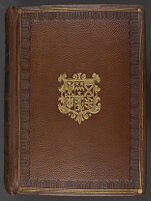
Binding: British Museum in-house, 1853: gold-tooled brown leather binding; the upper and lower covers gold-stamped with the Cotton arms; subsequently repaired along the hinges and spine; gilt fore-edge; the spine inscribed in gold at the British Museum: 'STATUTA SYNODORUM, ET CANONUM COLLECTIO. MUS. BRIT. BIBL. COTTON. OTHO E. XIII.'.
- Custodial History:
-
Origin: Western France.
Provenance:
It is likely that the manuscript reached Canterbury at some point during the reign of either King Edward the Elder (r. 899-924) or King Æthelstan (r. 925-939). During that period numerous Breton refugees displaced by Viking raids fled to England, bringing manuscripts with them. This manuscript was one of a group of manuscripts from Brittany containing texts that became crucial to the Benedictine reform movement, which began in earnest in Anglo-Saxon England in the mid-10th century (see Ambrose, ‘The Collectio Canonum Hibernensis' (2005), pp. 108-09).
The Benedictine abbey of St Augustine in Canterbury, founded in 598 during St Augustine’s mission to Anglo-Saxon England: the Abbey added a volume title (now partly reconstructed) in the13th-century on f. 2r: ‘[Statuta sy]nodorum cum. A.’; an ownership inscription and shelfmark in the late 13th or early 14th century (the latter altered at a slightly later point), ‘[Liber S.] Augustini Cantuarensis Di XV. Ga III Cum. A.’ (see Barker-Benfield, St Augustine's Abbey, Canterbury (2008), III, p. 1727).
Sir Robert Bruce Cotton (b. 1571, d. 1631), 1st baronet, antiquary and politician: included in the first catalogue of his collection (Harley MS 6018, no. 322), and the Cottonian catalogue, Add MS 36682 (see Tite, The Early Records (2003), p. 158).
Cotton’s collection was augmented by his son, Sir Thomas Cotton (b. 1594, d. 1662), 2nd baronet, and his grandson, Sir John Cotton.
Sir John Cotton (b. 1621, d. 1702), 3rd baronet: bequeathed the entire Cotton collection of books and manuscripts to trustees ‘for Publick Use and Advantage’, 12 and 13 William III, c. 7. Formed one of the foundation collections of the British Museum in 1753.
- Information About Copies:
-
Full digital coverage available for this manuscript: see Digitised Manuscripts at http://www.bl.uk.manuscripts/.
- Publications:
-
Ambrose, Shannon, ‘The Collectio Canonum Hibernensis and the Literature of the Anglo-Saxon Benedictine Reform’, Viator, 36 (2005), 107-18, (pp. 109-11).
Barker-Benfield, Bruce C., St Augustine's Abbey, Canterbury, Corpus of British medieval library catalogues, 13, 3 vols (London: British Library in association with the British Academy, 2008), I: pp. 54, 755; II: 1535; III: pp. 1727-28, 1792.
Bibliotheca Hagiographica Latina Antiquae et Mediae Aetatis, Subsidia Hagiographica, 12, Supplementi (Brussels: Société des bollandistes, 1911), p. 98 (no. 2316d).
Bibliotheca Hagiographica Latina Antiquae et Mediae Aetatis: Novum Supplementum, ed. by Henricus Fros, Subsidia Hagiographica, 70 (Brussels: Société des bollandistes, 1986), p. 267 (no. 2316).
Bieler, Ludwig, ed., The Irish Penitentials, Scriptores Latini Hiberniae, 5 (Dublin: Dublin Institute for Advanced Studies, 1963), pp. 14, 22–24.
Bernhard Bischoff, Katalog der festländischen Handschriften des neunten Jahrhunderts (mit Ausnahme der wisigotischen), 3 vols (Wiesbaden: Harrassowitz, 1998-2014), II (2004): Laon-Paderborn, ed. by Birgit Ebersperger, pp. 107-08 (no. 2423).
Bradshaw, Henry, The Early Collection of Canons Known as the Hibernensis: Two Unfinished Papers (Cambridge: Cambridge University Press, 1893), pp. 10-11.
Flechner, Roy, ‘The Making of the Canons of Theodore’, Peritia, 17-18 (2003-2004), 121-43.
Gneuss, Helmut and Michael Lapidge, Anglo-Saxon Manuscripts: A Bibliographical Handlist of Manuscripts and Manuscript Fragments Written or Owned in England up to 1100 (Toronto: University of Toronto Press, 2014), p. 283 (no. 361).
Grosjean, Paul, ‘Notes sur les documents anciens concernant S. Patrice’, Analecta Bollandiana, 62 (1944), 42-73 (pp. 44-45).
Howlett, David, ‘The Prologue to the Collectio Canonum Hibernensis’, Peritia, 17-18 (2003-2004), 144-49.
Ker, N. R., ed., Medieval Libraries of Great Britain: A List of Surviving Books, Royal Historical Society Guides and Handbooks, 3, 2nd edn (London: Royal Historical Society, 1964), p. 43.
Kéry, Lotte, Canonical Collections of the Early Middle Ages (ca. 400–1140): A Bibliographical Guide to the Manuscripts and Literature (Washington DC: Catholic University of America Press, 1999), p. 73.
Meeder, Sven, ‘The Liber ex lege Moysi: Notes and Text’, The Journal of Medieval Latin, 19 (2009), 173-218 (esp. pp. 182-85).
Stokes, Whitley, ed., Old Breton Glosses (Calcutta: The Superintendent of Government Printing, 1879), pp. iv-v, 2, 17-20.
Tite, Colin G. C., The Early Records of Sir Robert Cotton’s Library: Formation, Cataloguing, Use (London: The British Library, 2003), p. 158.
Wasserschleben, Hermann, ed., Die irische Kanonensammlung, 2nd edn (Leipzig: Tauchnitz, 1885), pp. xxxii–xxxiii.
- Material Type:
- Archives and Manuscripts
- Legal Status:
- Not Public Record(s)
- Notes:
- This manuscript is part of The Polonsky Foundation England and France Project: Manuscripts from the British Library and the Bibliothèque nationale de France, 700-1200.