Hard-coded id of currently selected item: . JSON version of its record is available from Blacklight on e.g. ??
Metadata associated with selected item should appear here...
Cotton MS Vitellius E XVIII
- Record Id:
- 040-001103106
- Hierarchy Root Ancestor Record Id:
- 032-001101582
- MDARK:
- ark:/81055/vdc_100000001273.0x000278
- LARK:
- ark:/81055/vdc_100074817411.0x000001
- SLARK:
- Format:
- ISAD(G)
- Reference (shelfmark):
- Cotton MS Vitellius E XVIII
- Title:
-
Psalter with gloss in Old English
- Scope & Content:
-
This 11th-century manuscript is one of the six Gallican Psalters with a continuous Old English that are extant from England in the period between 975 and 1075 (see Gretsch, The Intellectual Foundations of the Benedictine Reform, 2004). Four of these Psalters, including this manuscript, were produced in Winchester. It was probably written at the Benedictine abbey of New Minster or the Cathedral Priory of St Peter, St Paul, and St Swithun, also known as the Old Minster (see Ker, Medieval Libraries (1964), pp. 103, 200). Although the Easter Tables on ff. 9v-12r are designed for the years 1031 to 1145, scholars assume that the manuscript was produced circa 1060, because another Easter table on f. 13v has a cross above a column that corresponds to the years 1060-1087 and a dot by the year 1062.
Like most contemporary Psalters, this manuscript contains prefatory matter, the Book of Psalms (including Psalm 151), and the Canticles. The manuscript's Latin and Old English prefatory matter includes computistical texts, charms, medicines and recipes, prognosticative texts and secret writing. The Book of Psalms itself also features moral interpretations of the psalms (argumenta) in its margins and a continuous interlinear gloss written in Old English.
Contents:
ff. 2v-7v: Calendar, featuring verses on Egyptian Days and entries for Dog Days.
f. 8r: Verses on the limits of Easter.
f. 8r: Calculation of Advent.
f. 8r: Limits of Septuagesima.
f. 8v: An Easter table.
f. 9r: Rules for calculating Septuagesima and the lunar cycle.
f. 9r: A list of unlucky days per month (Old English).
ff. 9v-12r: Easter tables for the years 1031-1145; the Latin names of numbers on the lower half of f. 11v.
ff. 12r-13r: A list of embolismic years, a note on concurrents and epacts and rules for finding feasts of the Temporal cycle.
f. 13r: A prohibition on bloodletting on the so-called ‘Dog days’ (Old English).
f. 13v: A lunar table.
f. 14r: An Easter table.
f. 14v: The Sphere of Pythagoras.
f. 15r: Lucky days for childbirth.
ff. 15r-15v: Unlucky days for bloodletting [Egyptian Days] (Old English).
f. 15v: A charm to protect bees against theft (Old English).
f. 15v: Instructions for creating ‘Columcille’s Circle’ (A Sphere of Life and Death).
f. 15v: Medical recipes and charms for healing or protecting cattle, sheep and crops (Old English).
f. 16r: The Sphere of Apuleius (with Old English glosses).
f. 16v: A riddle (Old English), encoded in secret writing.
f. 16v: An explanation of secret writing (Old English).
ff. 18r-131r: the Book of Psalms with interlinear and marginal glosses in Old English.
ff. 131r-131v: A Psalm (Psalm 151) that is attributed to David when he fought Goliath, beginning: 'Pusillus eram inter fratres meos'.
ff. 131v-138v: Canticles.
ff. 138v-140v: Pater noster (Lord’s Prayer); Symbolum Apostolorum (Apostles’ Creed); Gloria in excelsis Deo (Angelic Hymn); Quicumque Vult (Athanasian Creed).
ff. 140v-144r: A Litany of Saints, including St Ælfheah, St Æthelwold, St Birnstan, St Dunstan, St Hedda, St Swithun bishop of Winchester; the name of St Frithestan, Bishop of Winchester (r. 909-931), has been added in a 12th- or 13th-century hand.
ff. 144v-146r: Lections.
The manuscript contains a number of additions:
f. 9r: A prayer-charm against fever, added in a (?) 12th-century hand.
f. 9r: A list of monasteries participating in a confraternity, added in a (?) 12th-century hand.
f. 17r: A prayer to God, added in a 12th-century script.
ff. 17r-17v: A litany for the Virgin Mary, added in a 12th-century script.
f. 144r: A prayer to God, added in a 12th-century script.
f. 146v: Middle English lyrics, including ‘Hwa hi se on þe rode Ihesu mi lemman’ [an excerpt from On Rode Ihesu My Lemman]; ‘Myn herte hytt synte / þat love me bynto’; ‘Wel were hym þat wyste / To wam he mytte tryste/ Bet[er] were hym þat knewe / þe false fro þe trewe’.
Decoration:
Circular diagrams in red and green on ff. 14v, 15v and 16r. 1 large initial with foliate and knot-work decoration in blue, green, red and yellow (f. 18r). Medium and small initials in blue, green, red, and yellow. Display script (rustic capitals) in blue, green, and red. Rubrics in red.
- Collection Area:
- Western Manuscripts
- Project / Collection:
- Cotton Collection
England and France 700-1200 Project - Hierarchy Record Ids:
- 032-001101582
040-001103106 - Is part of:
- Cotton MS : Cotton Manuscripts
Cotton MS Vitellius E XVIII : Psalter with gloss in Old English - Hierarchy:
- 032-001101582[0880]/040-001103106
- Container:
- View / search within Archive / Collection: Cotton MS
- Record Type (Level):
- File
- Extent:
-
A parchment codex
- Digitised Content:
- https://iiif.bl.uk/uv/#?manifest=https://bl.digirati.io/iiif/ark:/81055/vdc_100074817411.0x000001
- Thumbnail:
-
- Languages:
- English, Old
Latin - Scripts:
- Latin
- Start Date:
- 1050
- End Date:
- 1074
- Date Range:
- 3rd quarter of the 11th century
- Era:
- CE
- Access:
-
Please request the physical items you need using the online collection item request form.
Digitised items can be viewed online by clicking the thumbnail image or digitised content link.
Readers who have registered or renewed their pass since 21 March 2024 can request physical items prior to visiting the Library by completing
this request form.
Please enter the Reference (shelfmark) above on the request form.If your Reader Pass was issued before this date, you will need to visit the Library in London or Yorkshire to renew it before you can request items online. All manuscripts and archives must be consulted at the Library in London.
This catalogue record may describe a collection of items which cannot all be requested together. Please use the hierarchy viewer to navigate to individual items. Some items may be in use or restricted for other reasons. If you would like to check the availability, contact our Reference Services team, quoting the Reference (shelfmark) above.
- User Conditions:
-
Letter of introduction required to view this manuscript
- Physical Characteristics:
-
Condition: Leaves damaged by fire in 1731.
Materials: Parchment.
Dimensions: approximately 210 x 130 mm (text space: approximately 205 x 120 mm).
Foliation: ff. 146 ( + 4 unfoliated modern paper flyleaves at the beginning + 2 at the end); 2 paper pastedowns (bibliographical notes) on f. [ii]recto; f. [iii]recto is a notice of the manuscript’s new foliation after its rebinding in 1954; f. [iv]recto is a notice of misplaced parchment fragments; f. 1 is a 17th-century parchment endleaf; 1 paper (note of foliation) mounted on f. [147]; all parchment leaves have been mounted on paper frames.
Script: Protogothic.
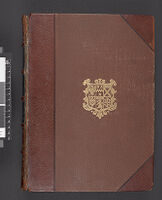
Binding: British Museum/British Library in-house: brown half leather binding (re-bound on 21 May 1954); Cotton’s bookplate gold-stamped on the upper and lower covers, the spine inscribed in gold at the British Museum: ‘PSALTERIUM CUM VERS. INTERLIN. ANGLO-SAXONICA.’; gilt fore-edge.
- Custodial History:
-
Origin: Winchester, Southwestern England.
Provenance:
The Benedictine abbey of New Minster in Winchester, founded in 901, or the Benedictine Cathedral Priory of St Peter, St Paul, and St Swithun, established in 964: the Calendar is similar to manuscripts from New Minster, but the Litany of Saints suggests the Cathedral Priory. A list of houses in confraternity with this monastery has been added to the lower margin of f. 9r. An encoded inscription on f. 16v identifies Ælfwine, abbot of New Minster (between 1031 and 1032) as the author of an item on secret writing: ‘Ælfuuine me uurat. ræde ðu ðe cenne’ [‘Ælxxnf1 1≡ fxxm-rt· d11ræ c ð·= ðx11nxxn’] (‘Ælfwine wrote me. Read you who might be able’). Ælfwine is known to have worked as a scribe, since he participated in the production of Cotton MS Titus D XXVI and Cotton MS Titus D XXVII. However, it seems unlikely that he copied the prefatory matter himself, since the lunar table on f. 13v appears to have been composed in or after 1060. Another scribe, who added a litany for the Virgin Mary on ff. 17r-17v identifies himself on f. 17v as a monk named Stephanus: ‘Stefanus ede monacus’ [‘St:f·n:·:s :d: mxxxxnxcxxxxxs’] (see Pulsiano, ‘The Prefatory Matter’ (1998), pp. 85-116). A scribe of this monastery also added a scribal inscription (rubricated), featuring a date (‘Anno domini [...]’), on f. 144r (now erased).
?John Dee (b. 1527, d. 1609), mathematician, astrologer, and antiquary: manuscript ‘Fr 133’ in his catalogue (1583) is identifiable with Cotton MS Vitellius E XVIII or Cotton MS Julius A VI (see Montague Rhodes James, Lists of Manuscripts (1921), p. 28 (‘Fr. 133’)).
Robert Bowyer (b. c. 1560, d. 1621), parliamentary official and politician: owned the manuscript in 1590 according to a note in a transcript of portions of the manuscript made by Francis Tate (see Cotton MS Julius C II, f. 68v: ii Junij 1590. ex libro nostri R. Boyeij ante psalmos davides. Saxonice & Latine conscripto').
?William Lambarde (b. 1536, d. 1601), antiquary and lawyer: this manuscript may be identifiable with a manuscript that Robert Cotton notes he received from him (Tite, The Early Records (2003), p. 51 (no. 49. 35), although Tite (The Early Records (2003), p. 170) considers it more likely that this was Cotton MS Tiberius C VI.
Sir Robert Bruce Cotton (b. 1571, d. 1631), 1st baronet, antiquary and politician: his bookplates gold-stamped on the upper and lower covers; his pressmark on f. 1r; the manuscript is listed in his catalogues (see Tite, The Early Records (2003), p. 170).
Cotton’s collection was augmented by his son, Sir Thomas Cotton (b. 1594, d. 1662), 2nd baronet, and his grandson, Sir John Cotton.
Sir John Cotton (b. 1621, d. 1702), 3rd baronet: bequeathed the entire Cotton collection of books and manuscripts to trustees ‘for Publick Use and Advantage’, 12 and 13 William III, c. 7. Formed one of the foundation collections of the British Museum in 1753.
- Information About Copies:
-
Full digital coverage available for this manuscript: see Digitised Manuscripts at http://www.bl.uk.manuscripts/.
- Publications:
-
A Catalogue of the Manuscripts in the Cottonian Library Deposited in the British Museum (London: British Museum, 1802), p. 431.
Anglo-Saxon Manuscripts in Microfiche Facsimile, 23 vols (Binghamton, NY: Arizona Center for Medieval and Renaissance Studies, 1994-2014), II (1994): Psalters I, ed. by Phillip Pulsiano, Medieval & Renaissance Texts & Studies, 137, pp. 50-56 (no. 258).
Bestul, ‘British Library, MS Arundel 60, and the Anselmian Apocrypha’, Scriptorium, 35:2 (1981), 271-75 (p. 272).
Chardonnens, László Sándor, Anglo-Saxon Prognostics, 900-1100: Study and Texts, Brill’s Studies in Intellectual History, 153; Brill’s Texts and Sources in Intellectual History, 3 (Leiden: Brill, 2007), pp. 23, 26 n. 4, 29 n, 30 n., 34 n. 47, 36, 37-38, 39, 55, 62, 67 n. 6, 70, 76, 87, 88, 91, 127, 134, 155, 169, 181 n. 1, 182, 183, 195-97, 215-16, 229, 230, 232 n. 10, 234, 270, 277, 280 n. 55, 281, 289, 336, 341, 347, 348, 353, 368, 371, 387, 437, 439, 353, 368, 371, 387, 437, 439, 486, 487-88, 505 n. 16, 506, 511 n. 45, 525-28, 533 n. 161, 552.
Chardonnens, Laszlo Sándor, ‘Context, Language, Date and Origin of Anglo-Saxon Prognostics’, in Foundations of Learning: The Transfer of Encyclopaedic Knowledge in the Early Middle Ages, ed. by Rolf H. Bremmer Jr and Kees Dekker, Storehouses of Wholesome Learning, 1 (Leuven: Peeters, 2007), pp. 317-40 (pp. 321 n. 8, 322 n. 13, 329, 339).
Chardonnens, Laszlo Sándor, ‘Appropriating Prognostics in Late Anglo-Saxon England: a Preliminary Source Study’, in Practice in Learning: The Transfer of Encyclopaedic Knowledge in the Early Middle Ages, ed. by Rolf H. Bremmer Jr and Kees Dekker, Storehouses of Wholesome Learning, 2 (Paris: Peeters, 2010), pp. 203-55 (pp. 229 n. 10, 233 n. 117, 237 n. 139, 239 n. 150, 241 n. 162, 250).
Chardonnens, László Sándor, 'Ælfric and the Authorship of the Old English De diebus malis', in Limits to Learning: The Transfer of Encyclopaedic Knowledge in the Early Middle Ages, ed. by Concetta Giliberto and Loredana Teresi, Storehouses of Wholesome Learning, 3 (Leuven: Peeters, 2013), pp. 124-53 (pp. 125, 149).
Dumville, David N., Liturgy and the Ecclesiastical History of Late Anglo-Saxon England: Four Studies, Studies in Anglo-Saxon History, 5 (Woodbridge: Boydell, 1992), pp. 22, 25, 50, 52, 57, 110, 125, 129.
Förster, Max, 'Ein altengisches Prosa-Rätsel', Archiv für das Studium der neueren Sprachen und Literaturen, 116 (1905), 367-71.
Förster, Max, ‘Die altenglischen Verzeichnisse von Glücks- und Unglückstagen’, in Studies in English Philology: A Miscellany in Honour of Frederick Klaeber, ed. by Kemp Malone and Martin B. Ruud (Minneapolis: University of Minnesota Press, 1929), pp. 258-77.
Gameson, Richard, ‘English Manuscript Art in the Mid-Eleventh Century: The Decorative Tradition’, The Antiquaries Journal, 71 (1991), 64-122 (p. 81).
Gameson, Richard, The Scribe Speaks? Colophons in Early English Manuscripts, H. M. Chadwick Memorial Lectures, 12 (Cambridge: Cambridge University Press, 2002), pp. 6-7 (no. 35), 24, 26, and 47.
Gameson, Richard, ‘Book Decoration in England, c. 871-c. 1100’, in The Cambridge History of the Book in Britain, Volume I: c. 400-1100, ed. by Richard Gameson (Cambridge: Cambridge University Press, 2012), pp. 249-93 (p. 269).
Gasquet, Francis Aidan, and Edmund Bishop, The Bosworth Psalter: An Account of a Manuscript Formerly Belonging to O. Turville-Petre Esq. of Bosworth Hall Now Addit. MS 37527 at the British Museum (London: Bell, 1908), passim.
Gerchow, Jan, Die Gedenküberlieferung der Angelsachsen: Mit einem Katalog der Libri Vitae und Nekrologien, Arbeiten zur Frühmittelalterforschung, 20 (Berlin: De Gruyter, 1988), pp. 230-31 (no. 15).
Gneuss, Helmut, ‘Liturgical Books in Anglo-Saxon England and Their Old English Terminology’, in Learning and Literature in Anglo-Saxon England: Studies Presented to Peter Clemoes on the Occasion of His Sixty-Fifth Birthday, ed. by Michael Lapidge and Helmut Gneuss (Cambridge: Cambridge University Press, 1991), pp. 91-141 (p. 115).
Gneuss, Helmut, and Michael Lapidge, Handlist of Anglo-Saxon Manuscripts: A List of Manuscripts and Manuscript Fragments Written or Owned in England up to 1100, Medieval and Renaissance Texts and Studies, 241 (Tempe: Arizona Center for Medieval and Renaissance Studies, 2014), pp. 334-35 (no. 407).
Gretsch, Mechthild, The Intellectual Foundations of the English Benedictine Reform, Cambridge Studies in Anglo-Saxon England, 25 (Cambridge: Cambridge University Press, 1999), pp. 19 (as ‘H’), 26, 27, 39, 64, 90, 93, 97, 196 n. 23, 268.
James, Montague Rhodes, Lists of Manuscripts formerly owned by Dr. John Dee, Supplement to the Bibliographical Society’s Transactions, 1 (Oxford: The Bibliographical Society, 1921), p. 28 (‘Fr. 133’).
Keefer, Sarah Larratt, The Old English Metrical Psalter: An Annotated Set of Collation Lists with the Psalter Glosses (New York: Garland, 1979), pp. xi (as ‘G’).
Ker, Neil Ripley, Catalogue of Manuscripts Containing Anglo-Saxon (Oxford: Clarendon Press, 1957; repr. 1990), no. 224.
Keynes, Simon, The Liber Vitae of the New Minster and Hyde Abbey Winchester, British Library Stowe 944, together with Leaves from British Library Cotton Vespasian A. VIII and British Library Cotton Titus D. XXVII, Early English Manuscripts in Facsimile, 26 (Copenhagen: Rosenkilde and Bagger, 1996), pp. 66-68, 115.
Lindelöf, Uno, ‘Studien zu altenglischen Psalterglossen’, Bonner Beiträge zur Anglistik, 13 (1904), 1-123 (as ‘G’).
Liuzza, Roy M., 'The Sphere of Life and Death: Time, Medicine, and the Visual Imagination', in Latin Learning and English Lore: Studies in Anglo-Saxon Literature for Michael Lapidge, ed. by Katherine O'Brien O'Keeffe and Andy Orchard, 2 vols (Toronto: University of Toronto Press, 2005), II, pp. 28-52 (pp. 30, 38-45).
Liuzza, Roy Michael, Anglo-Saxon Prognostics: An Edition and Translation of Texts from London, British Library, MS Cotton Tiberius A.iii, Anglo-Saxon Texts, 8 (Woodbridge: Brewer, 2011), pp. 14-15.
Medieval Libraries of Great Britain: A List of Surviving Books, ed. by Neil Ripley Ker, 2nd edn, Royal Historical Society Guides and Handbooks, 3 (London: Royal Historical Society, 1964), pp. 103, 200.
Morgan, Nigel, ‘Notes on the Post-Conquest Calendar, Litany and Martyrology of the Cathedral Priory of Winchester, with a Consideration of Winchester Diocese Calendars of the Pre-Sarum Period’, in The Vanishing Past: Medieval Studies Presented to Christopher Hohler, ed. by Alan Borg and Andrew Martindale, British Archaeological Reports International Series, 111 (Oxford: British Archaeological Reports, 1981), pp. 133-71 (p. 431).
Old English Glossed Psalters: Psalms 1-50, ed. by Phillip Pulsiano, Toronto Old English Series, 11 (Toronto: University of Toronto Press, 2001), p. xxiii (as ‘G’).
Pulsiano, Phillip, 'The Old English Introductions in the Vitellius Psalter', Studia Neuphilologica, 63 (1991), 13-35.
Pulsiano, Phillip, ‘New Old English Glosses in the Vitellius Psalter’, ANQ: A Quarterly Journal of Short Articles, Notes and Reviews, n.s. 6:4 (1993), 180-82.
Pulsiano, Phillip, ‘New Old English Glosses in the Vitellius Psalter (II)’, ANQ: A Quarterly Journal of Short Articles, Notes and Reviews, n.s. 7:1 (1994), 3-5.
Pulsiano, Phillip, ‘Abbot Ælfwine and the Date of the Vitellius Psalter’, ANQ: A Quarterly Journal of Short Articles, Notes and Reviews, n.s. 11:2 (1998), 3-12.
Pulsiano, Phillip, ‘The Prefatory Matter of London, British Library, Cotton Vitellius E. xviii’, in Anglo-Saxon Manuscripts and Their Heritage, ed. by Phillip Pulsiano and Elaine M. Treharne (Aldershot, 1998), pp. 85-116.
Rushforth, Rebecca, Saints in English Kalendars before A.D. 1100, Henry Bradshaw Society, 117 (Woodbridge: Boydell, 2008), pp. 48-49 (no. 23).
Rust, Martha Dana, ‘The Art of Beekeeping Meets the Arts of Grammar: a Gloss of “Columcille’s Circle”’, Philological Quarterly, 78 (1999), 359-87.
Salvador-Bello, Mercedes, Isidorean Perceptions of Order: The Exeter Book Riddles and Medieval Latin Enigmata (Morgantown: West Virginia University Press, 2015), pp. 43, 55, 420.
Scragg, Donald, A Conspectus of Scribal Hands Writing English, 960-1100, Publications of the Manchester Centre for Anglo-Saxon Studies, 11 (Cambridge: Brewer, 2012), p. 52.
Sisam, Cecilia, and Kenneth Sisam, The Salisbury Psalter: Edited from Salisbury Cathedral MS. 150 (Oxford: Oxford University Press, 1959), esp. pp. 58-75 (as ‘G’).
Storms, Godfrid, Anglo-Saxon Magic (The Hague: Nijhoff, 1948), pp. 309, 311.
Temple, Elzbieta, Anglo-Saxon Manuscripts 900-1066, Survey of Manuscripts Illuminated in the British Isles, 2 (London: Miller, 1976), pp. 64 and 117.
The Eadwine Psalter: Text, Image, and Monastic Culture in Twelfth-Century Canterbury, ed. by Margaret Templeton Gibson, Thomas Alexander Heslop, and Richard William Pfaff, Publications of the Modern Humanities Research Association, Modern Humanities Research Association, 14 (Cambridge: Modern Humanities Research Association, 1992), pp. 64 n. 8, 66 n. 12, 70, 74, 75, 91 n. 12, 102 n. 39, 105.
The Vitellius Psalter: Edited from British Museum MS Cotton Vitellius E. xviii, ed. by Rosier, James L, Cornell Studies in English, 42 (Ithaca, New York: Cornell University Press, 1962), passim.
Tite, Colin G. C., The Early Records of Sir Robert Cotton’s Library: Formation, Cataloguing, Use (London: The British Library, 2003), p. 170.
Wildhagen, Karl, ‘Das Kalendarium der Handschrift Vitellius E XVIII (Brit. Mus): Ein Beitrag zur Chronologie und Hagiologie Altenglands’, in Texte und Forschungen zur Englischen Kulturgeschichte, ed. Heinrich Boehmer (Halle: Niemeyer, 1921), pp. 68-118.
Wormald, Francis, English Kalendars before A.D. 1100, Henry Bradshaw Society, 72 (Woodbridge: Boydell, 1934; repr. 1988), pp. 155-67.
- Material Type:
- Archives and Manuscripts
- Legal Status:
- Not Public Record(s)
- Notes:
-
This manuscript is part of The Polonsky Foundation England and France Project: Manuscripts from the British Library and the Bibliothèque nationale de France, 700-1200.