Hard-coded id of currently selected item: . JSON version of its record is available from Blacklight on e.g. ??
Metadata associated with selected item should appear here...
Cotton MS Titus D XXVII
- Record Id:
- 040-001103600
- Hierarchy Root Ancestor Record Id:
- 032-001101582
- MDARK:
- ark:/81055/vdc_100000001273.0x0003a5
- LARK:
- ark:/81055/vdc_100058107969.0x000001
- SLARK:
- Format:
- ISAD(G)
- Reference (shelfmark):
- Cotton MS Titus D XXVII
- Title:
- Liturgical and computistical collection (‘Ælfwine’s Prayerbook’), including a calendar and an Easter-table chronicle
- Scope & Content:
-
Cotton MS Titus D XXVII and Cotton MS Titus D XXVI originally formed one manuscript which began with Cotton MS D XVII and was followed by Cotton MS D XVI (see Henel, De temporibus anni (1942)). This volume includes Ælfric's De temporibus anni; an alphabetical prognostic; miscellaneous notes; offices; devotions and prayers. Cotton MS Titus D XXVII and Cotton MS Titus D XXVI are the second largest collection of Latin prognostics in extant manuscripts (see: S. Chardonnens, Anglo-Saxon Prognostics (2007), p. 58).
Contents:
ff. 2r-8v: A lunar calendar for bloodletting and calendar on the Egyptian days (ff. 3r-8v) and Dog days (ff. 3r-8v). Some slightly later additions of obituary entries, beginning: ‘Ad sanguinem minuendam’, beginning of the text: ‘Luna i tota die bona est’.
ff. 9r-10r: A lunar calendar.
ff. 10v-13r: A computus.
f. 13v: De epacta (On the epact), a rule for determining the numbers of epacts (relating the lunar calendar to the solar calendar). Beginning: ‘Si vis scire quota epacta erit in omni anno’. At the bottom of the folio, the coded colophon by Aelsinus (see Provenance).
f. 14r: The seven sleepers, beginning: ‘Haec sunt nomina septem dormientium qui .ccc. lxxiii. annos dormierunt: Maximianus, Malchus, Martinianus, Dionisius, Iohannes, Serapion, Constantinus’.
ff. 14v-21r: A computus, with additions of obituary entries in a later hand until f. 18v.
f. 21v: A circular diagram (likely incomplete) representing the four winds often linked to the four cardinals directions: subsolanus, auster, favonius, septemtrio.
ff. 22r-23r: Prognostics, verses on Egyptian days with prose commentary, beginning: ‘Iani prima dies septima sine timetur. Periculosum est flebotomari in principio mensis Ianuarii’. Followed by a caveat against some lunar days (the three critical Mondays, Canicular days etc.): ‘Super omnes hos sunt etiam isti observabiles’.
ff. 23r-25r: A Latin computus notes mainly on lunar movement, beginning: ‘Dominus noster Ihesus Christus ter carnaliter huic mundo ortus est. Prima incarnatio quando in utero Sanctae Mariae virginis’.
ff. 25r-v: The Revelatio Esdrae (Revelation of Esdras), a short text offering predictions for the year: weather, agriculture etc. according to the kalend of January, beginning: ‘Kl. Ianuarius. Si fuerit in prima feria hiems bona erit’.
f. 25v: A short note in Old English about the length of the year in days, weeks, hours, beginning: ’Đis is full ger twelf monþas fulle’.
ff. 26r-27r: A prayer, beginning: ‘Oratio sacerdotali. Ante oculos tuos Domine culpas quas fecimus et plagas quas excepimus comferimus’.
ff. 27r-29v: A collective lunarium with year prognosis, beginning: ‘Argumentum lunare ad requirendum quomodo vel qualiter observetur. Luna .i. hec dies ad omnia agenda utilis est.’.
ff. 30r-54r: Ælfric, De temporibus anni (On the time of the year), beginning: ‘De primo die seculi, sive de equinoctio vernali’. Text: ‘Þone forman dæg þissere worulde we magon afíndan’. First section (ff. 50v-54r): ‘Beda se snotera lareow gesette’.
f. 54v: A short note on an indulgence, beginning: ‘Cantatio unius misse potest .xii. dies redimere ...’, followed on the same folio by a rule for calculating Christian feasts: ‘On Ianuarius .ofer XVI kƚ febr’.
f. 55r: A note on concurrents and epacts: ‘Gif þu nyte hwyle concurrentes beo on geare’.
ff. 55v-56v: Added, 1st half of the 12th century, Anglo-Saxon alphabetical prognostics, beginning: ‘A. He gangeð 7 biþ siðfæ gesund’ (f. 56v) ends with a verse of doxology.
f. 56v: A note in English (nine lines): ‘Hér is seo endebyrdnes monangonges .7 sæflodes’.
f. 56v: Notes on the age of the Virgin (six lines): ‘Sancta Maria wæs on þreo 7 syxti wintra’.
ff. 57r-64v: A prayer, beginning ‘Passio Domini Nostri Ihesu Christi secundum Iohannem. In illo tempore egressus Ihesus cum discipulis suis’.
f. 64v: Prayers for the Holy Cross, beginning : ‘Ave alma crux que mundi precium postati, que vexilla regis eterni ferebas, in te enim Christus triumphavit’.
ff. 66r-73v: Offices of the Holy Cross, beginning ‘Si vis orare ad crucifixum, hos Psalmos canta’. The series of offices ends (f. 73v): ‘ indulgeat mihi dominus universa delicta mea. Amen’.
f. 74r: Added, 1st half of the 12th century, a woman's prayer (twelve lines): ‘Credo quod sis angelus sanctus a Deo omnipotente ad custodiam mei deputatus, propterea peto et per illum que te ad hoc ordinavit humiliter imploro ut me miseram fragilem atque indignam semper et ubique in hac vita custodias, protegas a malis omnibus atque defendas ...’.
ff. 76r-80v: Offices of the Holy Trinity, beginning: 'Deus in adiutorium meum intende’.
ff. 80v-81v: Prayers to the Cross: ‘Deus cui cuncte obediunt creature et omnia in verbo tuo fecisti sapientia supplices...’.
ff. 81v-93v: Various prayers dedicated to: the Virgin Mary (ff. 81v-85v), the Father (f. 86r), the Son (ff. 86r-v), the Holy Ghost (ff. 86v-87r), Christ (ff. 87r-88r), St Peter (ff. 88r-v), the Cross (ff. 89r-v), St Benedict (ff. 89v-91r), St Gregory (f. 91r), St Augustine (f. 91r-v), St Cecilia (ff. 91v-92r), other saints (ff. 92v-93v).
Decoration:
Titles in red in rustic capitals. Numerous plain initials in red, blue, green and purple.
The computus is situated within full-leaf columned porticos red and blue (ff. 10v-12r), followed by a full-leaf red frames with red circular diagrams (ff. 12v-13r).
Two full-pages drawings of the Crucifixion (f. 65v) and the Trinity, including the Virgin Mary and a small hellmouth (f. 75v).
- Collection Area:
- Western Manuscripts
- Project / Collection:
- Cotton Collection
- Hierarchy Record Ids:
- 032-001101582
040-001103600 - Is part of:
- Cotton MS : Cotton Manuscripts
Cotton MS Titus D XXVII : Liturgical and computistical collection (‘Ælfwine’s Prayerbook’), including a calendar and an Easter-table chronicle - Hierarchy:
- 032-001101582[1117]/040-001103600
- Container:
- View / search within Archive / Collection: Cotton MS
- Record Type (Level):
- File
- Extent:
- A parchment codex
- Digitised Content:
- https://iiif.bl.uk/uv/#?manifest=https://bl.digirati.io/iiif/ark:/81055/vdc_100058107969.0x000001 (opens in a new tab)
- Thumbnail:
-
- Languages:
- English, Old
Latin - Scripts:
- Latin
- Start Date:
- 1000
- End Date:
- 1099
- Date Range:
- 3rd decade of the 11th century
- Era:
- CE
- Access:
- User Conditions:
- Letter of introduction required to view this manuscript
Please request the physical items you need using the online collection item request form.
Digitised items can be viewed online by clicking the thumbnail image or digitised content link.
Readers who have registered or renewed their pass since 21 March 2024 can request physical items prior to visiting the Library by completing
this request form.
Please enter the Reference (shelfmark) above on the request form.If your Reader Pass was issued before this date, you will need to visit the Library in London or Yorkshire to renew it before you can request items online. All manuscripts and archives must be consulted at the Library in London.
This catalogue record may describe a collection of items which cannot all be requested together. Please use the hierarchy viewer to navigate to individual items. Some items may be in use or restricted for other reasons. If you would like to check the availability, contact our Reference Services team, quoting the Reference (shelfmark) above.
- Physical Characteristics:
-
Materials: parchment.
Dimensions: 130 × 90 mm (text space: 100 x 60 mm).
Foliation: ff. 93 (+ 1 unfoliated paper flyleaf and 1 unfoliated parchment flyleaf at the beginning; + 3 unfoliated parchment flyleaves at the end); 2 unfoliated parchment flyleaves between f. 1 and f. 2.
Script: Anglo-Caroline minuscule, English vernacular minuscule.
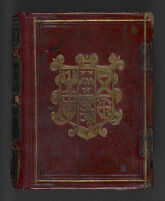
Binding: Post-1600. Cottonian 17th century. Gold-stamped binding with Cotton's arms on both sides of the cover. Claps marks. On the spine: golden title in black cartouche.
- Custodial History:
-
Origin: Winchester, Southeastern England.
Provenance:
New Minster, Winchester: Probably compiled for Ælfwine, before he became abbot of the New Minster in 1031 or 1032. The bulk of this manuscript has traditionally been attributed to two scribes, one of whom identified himself as Aelsinus, monk of New Minster in an encrypted colophon (Cotton MS Titus D XXVII, f. 13v; see Ælfwine’s Prayerbook (1993)). Aelsinus's code of replacing vowels by the consonant which follows, when decoded (Cotton MS Titus D XXVII, f. 13v): 'Frater humillimus et monachus Aelsinus me scripsit, sit illi longa salus. Amen. Aelfwino/us monacho/us aeque decano/us compotum istum possideo/ me possidet. Amen' (see Gameson, 'Aelsinus' (2004)). Up to seven hands have been identified in the manuscript by Peter Stokes in the 11th-century text and additions (Stokes, English Vernacular (2014), p. 86). Aelsinus is also the scribe of the Liber vitae (Stowe MS 944) and computistical and calendar works (Cambridge, Trinity College, ms. R.15.32, 13-36); added, 11th century, directions for devotion, Latin formula and rules of Confraternity, written by different scribes (ff. 2r-v, 16v, 17r-v).
Ælfwine (d. 1057): his ownership is acknowledged in an encoded inscription, where some vowels were replaced by the consonant which follows it (f. 13v). 'Ælfƿknp (l us) mpnbchp (l us) aeqxf dfcbnp (l us) cpmpptxm kstxm ppsskdfp t mf ppsskdst Bmfn' = 'Ælfwino/us monacho/us aeque decano/us compotum istum possideo/ me possidet amen' (see Gameson, 'Aelsinus' (2004)). Cotton MS Titus D XXVI and Cotton MS Titus D XXVII may have constituted Ælfwine's prayerbook and show a number of internal references to Ælfwine: a prayer with his name (Cotton MS Titus D XXVI, f. 61v), the obits of his mother (named Wulfynn who died in 1029), his father, his brother and sisters in the calendar (Cotton MS Titus D XXVII, ff. 4r, 7v, 8r, 16v) and a blessing in his name within the full-page miniature showing Christ's crucifixion: 'Hec crux consignet Aelfwinum corpore mente' (Cotton MS Titus D XXVII, f. 65v).
The Benedictine abbey of New Minster, Winchester: the text includes obits of bishops in the calendar and the Easter tables (ff. 3r-8v; 14v-21r); rules of the confraternity between the abbot of New Minster and other abbots and bishops (Cotton MS Titus D XXVI, ff. 17v-18r).
Added, 12th-century prayer to a guardian angel (f. 74r).
?The Benedictine abbey of St Mary, Winchester (Nunnaminster): added, 12th-century feminine prayer in brown ink, in Cotton MS Titus D XXVII (f. 74r); in both manuscript a 12th-century hand has added feminine endings to numerous prayers (e. g., Cotton MS Titus D XXVI, ff. 61v; 67v). These additions could suggest a female owner, perhaps in the Nunnaminster community during the first half of the twelfth century (see Wilmart, Auteurs spirituels (1932), p. 543 and N. Ker, Catalogue of manuscripts containing Anglo-Saxon (1957), no 202 and Robinson, 'A Twelfth-Century Scriptrix' (1997), p. 90).
Sir Robert Bruce Cotton (b. 1571, d. 1631), 1st baronet, antiquary and politician: table of content in the hand of Richard James (f. 1r), Cotton's librarian; cited in catalogues (see Tite, The Early Records (2003), p. 201).
Cotton’s collection was augmented by his son, Sir Thomas Cotton (b. 1594, d. 1662), 2nd baronet, and his grandson, Sir John Cotton.Sir John Cotton (b. 1621, d. 1702), 3rd baronet: bequeathed the entire Cotton collection of books and manuscripts to trustees ‘for Publick Use and Advantage’, 12 and 13 William III, c. 7. Formed one of the foundation collections of the British Museum in 1753.
- Information About Copies:
- Full digital coverage available for this manuscript: see Digitised Manuscripts at http://www.bl.uk.manuscripts.
- Publications:
-
Ælfwine’s Prayerbook (London, British Library, Cotton Titus D. xxvi + xxvii), ed. by Beate Günzel, Henry Bradshaw Society, 108 (London: Henry Bradshaw Society, 1993).
Anglo-Saxon Kingdoms: Art, Word, War, ed. by Claire Breay and Joanna Story (London: The British Library, 2018), no. 121 [exhibition catalogue].
Anglo-Saxon Litanies of the Saints, ed. by Michael Lapidge, Henry Bradshaw Society, 106 (London: Henry Bradshaw Society, 1991), no. 21.
Birch, Walter De Gray and Jenner Henry, Early Drawings and Illuminations: An Introduction to the Study of Illustrated Manuscripts (London: Bagster and Sons, 1879), p. 4.
Birch, Walter de Gray, Liber Vitae: Register and Martyrology of New Minster Abbey, Winchester (London: Simpkin and Co, 1892), pp. 269-83.
British Museum Reproductions from Illuminated Manuscripts, ed. by Eric G. Millar, 4th ser. (London: British Museum, 1928), pl. 6.
Brown, Michelle, 'Female Book-Ownership and Production in Anglo-Saxon England: The Evidence of the Ninth-Century Prayerbooks', in Lexis and Texts in Early English: Studies Presented to Jane Roberts, ed. by Christian J. Kay and Louise M. Sylvester, Costerus New Series, 133 (Amsterdam: Rodopi, 2001), pp. 45-68 (p. 59).
Chardonnens, Làszlò S., Anglo-Saxon prognostics: 900-110. Study and texts, Brill's Studies in Intellectual History, 153 (Leiden: Brill, 2007), pp. 179-80, 255-56, 519-23 passim.
Dodwell, Charles R., Anglo-Saxon Art: A New Perspective (Manchester: Manchester University Press, 1982), p. 58, pl. 9.
Doyle, Kathleen and Charlotte Denoël, Medieval Illumination: Manuscript Art in England and France 700-1200 (London: British Library, 2018), also published as Enluminures Médiévales: Chefs-d'oeuvre de la Bibliothèque nationale de France et de la British Library, 700-1200 (Paris : BnF Éditions, 2018), p. 61.
Fulton, Rachel, From Judgment to Passion: Devotion to Christ and the Virgin Mary, 800-1200 (New York: Columbia University Press, 2002), pp. 495 n. 99, 514 n.33, 540 n. 70, 541 n. 90.
Gameson, Richard, 'Aelsinus', Oxford Dictionary of National Biography (Oxford: Oxford University Press, 2004) [http://www.oxforddnb.com/view/article/202 accessed 26 April 2017].
Gameson, Richard, Manuscript Treasures of Durham Cathedral (London: Third Millennium, 2010), pp. 42-43.
Gneuss, Helmut, Handlist of Anglo-Saxon Manuscripts: A List of Manuscripts and Manuscript Fragments Written or Owned in England up to 1100 (Tempe, AZ: Arizona Center for Medieval and Renaissance Studies, 2001), no. 380.
Hamburger, Jeffrey F., and Nigel Palmer, The Prayer Book of Ursula Begerin, 2 vols (Zurich: Urs Graf Verlag, 2015), I, p. 412.
Henel, H., Aelfric, De Temporibus Annis, EETS vol. 213 (London: Early English Text Society, 1942), pp. xx-xxi.
Heslop, T. A., 'The Production of De Luxe Manuscripts and the Patronage of King Cnut and Queen Emma', in Anglo-Saxon England, 19, ed. by Michael Lapidge and others (Cambridge: Cambridge University Press, 1990), 151-98 (p. 153).
Ker, Neil R., Catalogue of Manuscripts containing Anglo-Saxon (Oxford: Clarendon Press, 1957; repr. 1990), no. 202.
Liuzza, Roy M., Anglo-Saxon prognostics: An edition and translation of texts from London, British Library, MS. Cotton Tiberius A.iii. (Cambridge: D. S Brewer, 2010), pp. 13-14.
Liuzza, Roy M., 'Anglo-Saxon prognostics in context: A survey and handlist of manuscripts', Anglo-Saxon England, 30 (2001), 219–21.
Medieval Libraries of Great Britain: A List of Surviving Books, ed. by Neil R. Ker, Royal Historical Society Guides and Handbooks, 3, 2nd edn (London: Royal Historical Society, 1964), p. 103.
The Monastic Breviary of Hyde Abbey, Winchester: MSS. Rawlinson Liturg. e. 1*, and Gough Liturg. 8, in the Bodleian Library, Oxford, ed. by J.B.L. Tolhurst, Henry Bradshaw Society, 69-71, 76, 78, 80, 6 vols (London: Henry Bradshaw Society, 1932-42), 6, p. 240.
Priebsch, Robert, The Heliand Manuscript, Cotton Caligula A. VII in the British Museum: A Study (Oxford: Clarendon Press, 1925), p. 27.
Rice, David T., English Art, 871-1100, Oxford History of English Art, 2 (Oxford: The Clarendon Press, 1952), pp. 165, 213n., 213, pl. 82.
Rickert, Margaret, Painting in Britain: the Middle Ages, 2nd edn (London: Penguin Books, 1965), pp. 42-43, 227n, pl. 37b.
Robinson, P.R., 'A Twelfth-Century Scriptrix from Nunnaminster', in Of the Making of Books: Medieval Manuscripts, their Scribes and Readers: Essays presented to M. B. Parkes, ed. by P. R. Robinson and Rivkah Zim (Aldershot: Scholar Press, 1997), 73-93.
Rushforth, Rebecca, An Atlas of Saints in Anglo-Saxon Calendars (Cambridge: University of Cambridge, Department of Anglo-Saxon, Norse and Celtic, 2002), no. 14.
Sharpe, Richard and Willoughby, James, Medieval Libraries of Great Britain (Oxford: The Bodleian Libraries, 2015) [accessed 19 January 2017].
Stafford, Pauline, 'Emma: The Powers of the Queen in the Eleventh Century', in Queens and Queenship in Medieval Europe, ed. by Anne J. Duggan (Woodbridge: Boydell Press, 1997), pp. 3-26 (pl. 3).
Stokes, Peter, English Vernacular Minuscule from Æthelred to Cnut circa 990-1035 (D.S. Brewer: Cambridge, 2014), 13, 35, 37, 42-43, 48, 49, 51-52, 60, 73, 83-84, 86-87, 91, 192.
Temple, Elzbieta, Anglo-Saxon Manuscripts 900-1066, Survey of Manuscripts Illuminated in the British Isles, 2 (London: Harvey Miller, 1976), no. 77.
Thomas, Kate, Late Anglo-Saxon Prayer in Practice: Before the Books of Hours (Berlin: De Gruyter and Medieval Institute Publications, 2020).
Tite, C., The Early Records of Sir Robert Cotton's Library (London: The British Library, 2003), p. 201.
Watson, Andrew G., Catalogue of Dated and Datable Manuscripts c. 700-1600 in The Department of Manuscripts, The British Library, 2 vols (London: British Museum, 1979), no. 561.
Wilmart, A., Auteurs spirituels et textes dévots du Moyen Age latin: Etudes d'Histoire Littéraire (Turnhout: Brepols, 1971), p. 135.
Wormald, Francis, English Kalendars before A.D. 1100, Henry Bradshaw Society, 72 (London: Harrison and Sons Ltd, 1934), pp. 113-25.
- Exhibitions:
- Anglo-Saxon Kingdoms: Art, Word, War, British Library, London, 19 October 2018 - 19 February 2019
- Material Type:
- Archives and Manuscripts
- Legal Status:
- Not Public Record(s)