Hard-coded id of currently selected item: . JSON version of its record is available from Blacklight on e.g. ??
Metadata associated with selected item should appear here...
Cotton MS Faustina A V
- Record Id:
- 040-001103844
- Hierarchy Root Ancestor Record Id:
- 032-001101582
- MDARK:
- ark:/81055/vdc_100000001273.0x00004f
- LARK:
- ark:/81055/vdc_100063638724.0x000001
- SLARK:
- Format:
- ISAD(G)
- Reference (shelfmark):
- Cotton MS Faustina A V
- Title:
-
Letters of the Chancellor of the University of Oxford and the archbishop of Canterbury; petitions of the clergy of the province of Canterbury; a letter of Pope John XXII; sermons on the Seven Deadly Sins, the Ascension (macaronic), and All Saints; Richard Rolle, Emendatio Vitae; Simeon of Durham, De Exordio Ecclesiae Dunelmensis; Pseudo-Jerome, De Quindecim Signis ante Diem Iudicii; Liber de Antichristo; sermons on the Assumption of Mary and Luke 12.12 (partially macaronic)
- Scope & Content:
-
This composite manuscript contains five parts that were written in England during the 12th and 14th centuries (ff. 3-12; 13-24; 25-98; 99-102; 103-106). The larger part of the manuscript (ff. 25r-97r), copied in the first quarter of the 12th century, contains the De Exordio Ecclesiae Dunelmensis (Concerning the Beginning of the Church of Durham), including 'Bede's Death Song' in Old English. that Simeon of Durham (fl. c. 1090–c. 1128), Benedictine monk and historian of Durham Priory, wrote between 1104 and 1109. This manuscript and Durham, Cathedral Priory, Cosin V. II. 6 are the earliest witnesses of this work.
It has been suggested that Cotton MS Faustina A V, ff. 25r-97r may have been produced at Durham Priory for Ranulf Flambard (b. c. 1060, d. 1128), Bishop of Durham (see Gullick, ‘The Two Earliest Manuscripts’ (1996), p. 119 n. 34). However, ownership inscriptions indicate that this part was at the Cistercian monastery of Fountains Abbey in North Yorkshire around the year 1200. It is here that the manuscript may have been combined with its other parts: a 14th- or 15th-century inscription concerning the Libellus (‘Lege et perlege de exordio dunelmensis Ecc[les]ie’ c[hathe]dralis’) on f. 106v indicates that the manuscript's final part (ff. 103-106) had been bound together with ff. 25-98 by that time.
The manuscript was then still at Fountains Abbey, and may have remained there until the monastery's dissolution in 1539, as it contains a memorandum (f. 98r) concerning the entry of six lay brothers in 1512. 14th-century ownership inscription of Fountains Abbey on f. 13r also suggests that ff. 13-24 may have been part of this manuscript at this time. It is unknown, however, whether these parts were produced at Fountains Abbey as well. Gullick suggests that the manuscript’s copy of De Quindecim Signis ante Diem Iudicii (On The Fifteen Signs before the Day of Judgement) on ff. 99r-99v may have been written in Winchester (see Lucas, ‘Bede’s Death Song’ (1997), p. 43).
The manuscript originally contained an additional section, now Dublin, Trinity College, MS 114. This section was removed by Henry Savile the Elder (b. 1547, d. 1622) when he donated the manuscript to Thomas Allen (b. 1542, d. 1632) in 1589.
Contents:
ff. 3r-4v: Letters of the Chancellor of the University of Oxford and the archbishop of Canterbury.
ff. 4v-6r: Petitions of the clergy of the province of Canterbury.
f. 6r: A letter of Pope John XXII (r. 1316–1334).
ff. 6v-12v: Sermons on the Seven Deadly Sins, the Ascension, and All Saints; the sermon on the Ascension (ff. 10r-10v) is macaronic (Middle English-Latin).
ff. 13r-24v: Richard Rolle (b. 1305x10, d. 1349), Emendatio vitae (The changing of one's own life).
ff. 24r-97r: Simeon of Durham, De Exordio Ecclesiae Dunelmensis, including 'Bede's Death Song' in Old English.
ff. 99r-99v: Pseudo-Jerome [here attributed], De Quindecim Signis ante Diem Iudicii (On The Fifteen Signs before the Day of Judgement).
ff. 99v-102r: Anonymous, Liber de Antichristo (Book of the Antichrist), beginning: ‘De antichristo scire volentibus primo dicemus quare sic vocatur’ [Patrologia Latina, 40 cols 1131-1134].
ff. 103r-106v: Anonymous, sermons; including a macaronic (Middle English-Latin) section on ff. 105v-106r concerning the Raising of Lazarus.
The manuscript contains a number of additions:
f. 97v: A short history of the bishops of Durham, from Aidan (r. 635-651) to Wilgred (r. c. 925-? 942), entitled ‘Episcopi dunhelmenses’, added in the (?) 15th-century.
f. 98r: A memorandum for the year 1512, concerning the entrance of six lay brothers at Fountains Abbey, added in the early 16th century.
f. 1r: The inscription ‘Textus Evangelij – 106’, in an early modern script.
f. 2 r: A table of contents, added by Richard James (b. 1592, d. 1638), librarian for Sir Robert Bruce Cotton (b. 1571, d. 1631).
f. 107v: an index for this manuscript (?) with references to (?) page numbers, added in the 17th century.
[ff. 1v, 2v, 102v are blank].
Decoration:
See the separate descriptions for Cotton MS Faustina A V, ff. 3–12, ff. 13–24, ff. 25–98, ff. 99–102, and ff. 103–106.
- Collection Area:
- Western Manuscripts
- Project / Collection:
- Cotton Collection
England and France 700-1200 Project - Hierarchy Record Ids:
- 032-001101582
040-001103844 - Is part of:
- Cotton MS : Cotton Manuscripts
Cotton MS Faustina A V : Letters of the Chancellor of the University of Oxford and the archbishop of Canterbury; petitions of the clergy of… - Contains:
- Cotton MS Faustina A V, ff 3–12 : Letters of the Chancellor of the University of Oxford and the archbishop of Canterbury; petitions of the clergy…
Cotton MS Faustina A V, ff 13–24 : Richard Rolle, Emendatio Vitae
Cotton MS Faustina A V, ff 25–98 : Simeon of Durham, De Exordio Ecclesiae Dunelmensis
Cotton MS Faustina A V, ff 99–102 : Pseudo-Jerome, De Quindecim Signis ante Diem Iudicii; Liber de Antichristo
Cotton MS Faustina A V, ff 103–106 : Sermons on the Assumption of Mary and Luke 12.12 (partially macaronic)
Click here to View / search full list of parts of Cotton MS Faustina A V - Hierarchy:
- 032-001101582[1231]/040-001103844
- Container:
- View / search within Archive / Collection: Cotton MS
- Record Type (Level):
- File
- Extent:
-
A parchment codex
- Digitised Content:
- https://iiif.bl.uk/uv/#?manifest=https://bl.digirati.io/iiif/ark:/81055/vdc_100063638724.0x000001
- Thumbnail:
-
- Languages:
- English, Middle
English, Old
Latin - Scripts:
- Latin
- Start Date:
- 1100
- End Date:
- 1399
- Date Range:
- 1st quarter of the 12th century-2nd half of the 14th century
- Era:
- CE
- Access:
-
Please request the physical items you need using the online collection item request form.
Digitised items can be viewed online by clicking the thumbnail image or digitised content link.
Readers who have registered or renewed their pass since 21 March 2024 can request physical items prior to visiting the Library by completing
this request form.
Please enter the Reference (shelfmark) above on the request form.If your Reader Pass was issued before this date, you will need to visit the Library in London or Yorkshire to renew it before you can request items online. All manuscripts and archives must be consulted at the Library in London.
This catalogue record may describe a collection of items which cannot all be requested together. Please use the hierarchy viewer to navigate to individual items. Some items may be in use or restricted for other reasons. If you would like to check the availability, contact our Reference Services team, quoting the Reference (shelfmark) above.
- User Conditions:
-
Letter of introduction required to view this manuscript
- Physical Characteristics:
-
Materials: Parchment.
Dimensions: 240 x 180 mm (text space: 195 x 140 mm [ff. 3r-24v]; 195 x 110 mm [ff. 25r-97r]; 170 x 115 mm [ff. 99r-102r]; 210 x 125 mm [ff. 103r-106v]).
Script: Protogothic (ff. 25r-102r); Gothic cursive (ff. 3r-24v; 103r-106r).
Foliation: ff. 107 ( + 1 unfoliated modern paper flyleaf at the beginning + 1 unfoliated early modern and 1 unfoliated modern paper flyleaf at the end); 3 unfoliated early modern paper flyleaves between f. 106 and f. 107 (ff. [106a]-[106c]); ff. 1-2, [106a]-[106c], and 107 are early modern paper leaves; paper stubs between each of the 5 different parts of this manuscript; 2 unfoliated parchment stubs between f. 24 and f. 25; a paper pastedown on f. [i]recto (bibliographical notes); the off-set of a book-chain on ff. 99r-102v; 17th-century pagination (‘1-208’) and foliation (‘2-105’) have been crossed out.
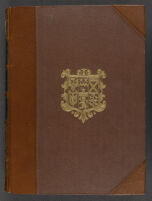
Binding: British Museum/British Library in-house: brown half leather binding; Cotton’s bookplate gold-stamped on the upper and lower covers, the spine inscribed in gold at the British Museum: ‘SIMEON OF DURHAM HISTORIA DUNELMENSIS ECCLESIAE, ETC.’.
- Custodial History:
-
Provenance:
The Cistercian abbey of St Mary the Virgin, Fountains Abbey, North Yorkshire, founded in 1132, perhaps joined the manuscript’s different parts together and owned it until its dissolution in 1538: its 12th-century ownership inscriptions on f. 25r: ‘Liber sancte marie de fontibus’; and f. 97v: ‘Liber Sancte Marie de ffonte ex dono Will[elm]i de Coutton quondam monachi de ffontibus’; its 14th-century ownership inscription on f. 13r; perhaps the abbey’s (?) 15th-century pressmark (? C T B) on f. 98v; perhaps their (erased) inscription on f. 102v.
Henry Savile of Banke (b. 1568, d. 1617), collector of manuscripts: owned by him according to an inscription on f. 1r: ‘Ex Dono Magistri Henrici Savelli’ (see Watson, Henry Savile (1969), p. 33 [no. 76]); separated a section from the manuscript, now Dublin, Trinity College, MS 114.
Thomas Allen (1540?-1632), mathematician and antiquary: the number ‘65’ on f. 3r refers to his catalogue; his name inscribed on f. 1r and 25r (see Watson, ‘Allen of Oxford’ (1978), pp. 290, 300, 309).
?‘Matthew Pattenson’ (fl. 1623): his name inscribed on f. 107v.
Sir Robert Bruce Cotton (b. 1571, d. 1631), 1st baronet, antiquary and politician: his bookplates gold-stamped on the upper and lower covers; his pressmark inscribed on f. 1r; f. 2r contains a table of contents by his librarian Richard James (b. 1592, d. 1638); the manuscript is listed in one of his catalogues; (see Tite, The Early Records (2003), p. 218).
Cotton’s collection was augmented by his son, Sir Thomas Cotton (b. 1594, d. 1662), 2nd baronet, and his grandson, Sir John Cotton.
Sir John Cotton (b. 1621, d. 1702), 3rd baronet: bequeathed the entire Cotton collection of books and manuscripts to trustees ‘for Publick Use and Advantage’, 12 and 13 William III, c. 7. Formed one of the foundation collections of the British Museum in 1753.
- Information About Copies:
- Full digital coverage available for this manuscript: see Digitised Manuscripts at http://www.bl.uk.manuscripts/.
- Publications:
-
A Catalogue of the Manuscripts in the Cottonian Library Deposited in the British Museum (London: British Museum, 1802), p. 602.
Allen, Hope Emily, Writings Ascribed to Richard Rolle, Hermit of Hampole and Materials for his Biography, The Modern Language Association of America Monograph Series, 3 (New York: Heath, 1927), p. 235.
Dobbie, Elliott Van Kirk, The Manuscripts of Cædmon's Hymn and Bede's Death Song: With a Critical Text of the Epistola Cuthberti de Obitu Bedæ, Colombia University Studies in English and Comparative Literature, 128 (New York: Columbia University Press, 1937), esp. p. 84.
Fletcher, Alan John, Late Medieval Popular Preaching in Britain and Ireland: Texts, Studies, and Interpretations (Turnhout: Brepols, 2009), pp. 18-19.
Gameson, Richard, Manuscript Treasures of Durham Cathedral (London: Third Millennium, 2010), p. 99 (no. 380).
Gneuss, Helmut, and Michael Lapidge, Handlist of Anglo-Saxon Manuscripts: A List of Manuscripts and Manuscript Fragments Written or Owned in England up to 1100 (Tempe, Arizona: Arizona Center for Medieval and Renaissance Studies, 2001), p. 254 (no. 330.5) [on ff. 99-102].
Gullick, Michael, ‘The Two Earliest Manuscripts of the Libellus de exordio’, in Symeon of Durham: Historian of Durham and the North, ed. by David Rollason (Stamford: Watkins, 1996), pp. 106–19 (pp. 109-112), 358–59.
Ker, N. R., Catalogue of Manuscripts containing Anglo-Saxon (Oxford: Clarendon Press, 1957), pp. 189-90 (no. 152).
Lawrence-Mathers, Anne, Manuscripts in Northumbria in the Eleventh and Twelfth Centuries (Woodbridge: Brewer, 2003), pp. 87, 208 n. 67, 213.
Lucas, Peter J., ‘London, British Library, Cotton Faustina A. v. “Bede’s Death Song”’, in Latin Manuscripts with Anglo-Saxon Glosses, ed. by Phillip Pulsiano, Anglo-Saxon Manuscripts in Microfiche Facsimile, 5, Medieval & Renaissance Texts & Studies, 175 (Tempe: Pegasus Press for Arizona Center for Medieval and Renaissance Studies, 1997), pp. 42-47 (no. 191).
Medieval Libraries of Great Britain: A List of Surviving Books, ed. by N.R. Ker, Royal Historical Society Guides and Handbooks, 3, 2nd edn (London: Royal Historical Society, 1964), p. 88.
Mynors, Roger Aubrey Baskerville, Durham Cathedral Manuscripts to the End of the Twelfth Century (Oxford: Oxford University Press, 1939), p. 61.
Parkes, Malcolm Beckwith, Scribes, Scripts and Readers: Studies in the Communication, Presentation and Dissemination of Medieval Texts (London: Hambledon Press, 1991), pp. 194 n. 32, 196 n. 36.
Symeon of Durham, Libellus de Exordio atque Procursu istius, hoc est Dunhelmensis, Ecclesie. Tract on the Origins and Progress of this the Church of Durham, ed. by David Rollason (Oxford: Clarendon Press, 2000), pp. xxii–xxiii (as 'F'), l–lviii.
Tite, Colin G. C., The Early Records of Sir Robert Cotton’s Library: Formation, Cataloguing, Use (London: The British Library, 2003), p. 218.
Watson, Andrew G., The Manuscripts of Henry Savile of Banke (London: The Bibliographical Society, 1969), p. 33 (no. 76).
Watson, Andrew G., ‘Thomas Allen of Oxford and His Manuscripts’, in Medieval Scribes, Manuscripts and Libraries: Essays Presented to N. R. Ker, ed. by Malcolm B. Parkes and Andrew G. Watson (London: Scolar Press, 1978), pp. 279-314 (pp. 300, 309).
- Material Type:
- Archives and Manuscripts
- Legal Status:
- Not Public Record(s)
- Notes:
-
This manuscript is part of The Polonsky Foundation England and France Project: Manuscripts from the British Library and the Bibliothèque nationale de France, 700-1200.