Hard-coded id of currently selected item: . JSON version of its record is available from Blacklight on e.g. ??
Metadata associated with selected item should appear here...
Zweig MS 138
- Record Id:
- 040-001945896
- Hierarchy Root Ancestor Record Id:
- 032-001945746
- MDARK:
- ark:/81055/vdc_100000000195.0x0002a7
- LARK:
- ark:/81055/vdc_100139609651.0x000001
- SLARK:
- Format:
- ISAD(G)
- Reference (shelfmark):
- Zweig MS 138
- Title:
- George Gordon, 6th Baron Byron: 'Note to the lines where Capel Lofft is mentioned'
- Scope & Content:
-
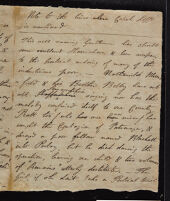
Autograph fair copy. The prose note explains the allusion to Capel Lofft in Byron's 'Hints from Horace' (published 1811), lines 693-696: 'Hark to those notes, narcotically soft! / The cobber-laureats sing to Capel Lofft! /Till, lo! that modern Midas, as he hears, / Adds an ell-growth to his egregious ears!' Byron upbraids men such as Capel Lofft and Josiah Pratt who give patronage to poor poets and encourage the publication of work lacking in merit, so that such poets are ridiculed posthumously.
Begins: 'This well meaning Gentleman has spoilt some excellent Shoemakers, & been accessory to the poetical undoing of many of the industrious poor.'
Ends: 'There is a child, a book, and a dedication: send the girl to her Grace, the volumes to the Grocer & the Dedication to the D-v-l.'
On f. 1, 'Staffordshire' was written originally but is struck through with 'Somersetshire' substituted above. At the end, the words 'Lord Byron's autograph' are in his own hand.
Stefan Zweig described the present manuscript as 'Diese ungemein geistreiche und glühend agressive Prosastelle' (Add. MS 73168, f. 4. He also noted 'Manuskripte Lord Byrons und besonders in sich vollständige wie dieses gehören heute schon zu den allergrössten Seltenheiten und sind fast unauffindbar geworden'. He was particularly pleased to acquire this item because ‘anderseits in England die Pietät den grossen Dichtern gegenüber es fast gänzlich unmöglich macht, ein Gedicht von Byron oder Shelley zu erwerben.’(Die Autographensammlung). By contrast in America ‘Stevenson wird drüben teurer bezahlt als Lord Byron, eine aktuelle Größe ungemein höher als ein Genius der Vergangenheit.’ (Überschätzung der Lebenden). He wrote more than once to Anton Kippenberg encouraging him to promote Byron’s works in Germany, and indeed an edition of the poems appeared in 1921 in the Bibliotheca Mundi published by Insel Verlag in Leipzig.
The Sotheby catalogue of the sale on 1 May 1914 lists as part of Lot 352 a two-page autograph letter with portrait of Teresa, Contessa Guiccioli (b.1800, d.1873), Lord Byron’s mistress in Ravenna. This letter, dated Paris, 6 March 1837, is not now with the Zweig MS 138 and has not been traced as ever having been in Zweig's collection. There is no evidence that the letter related to the manuscript, or that the manuscript was ever in the Contessa's possession. The manuscripts which Byron entrusted to her in 1823 when he left Italy for Greece were taken to England with her in 1832 and were eventually sold by Sotheran in 1900 to John Pierpont Morgan.
- Collection Area:
- Western Manuscripts
- Project / Collection:
- Stefan Zweig Collection
- Hierarchy Record Ids:
- 032-001945746
036-001945888
040-001945896 - Is part of:
- Zweig MS 1-218 : Stefan Zweig Collection: Music, literary and historical manuscripts
Zweig MS 132-200 : Stefan Zweig Collection: Literary and historical manuscripts
Zweig MS 138 : George Gordon, 6th Baron Byron: 'Note to the lines where Capel Lofft is mentioned' - Hierarchy:
- 032-001945746[0002]/036-001945888[0005]/040-001945896
- Container:
- View / search within Archive / Collection: Zweig MS 1-218
- Record Type (Level):
- File
- Extent:
- 1 item
- Digitised Content:
- https://iiif.bl.uk/uv/#?manifest=https://bl.digirati.io/iiif/ark:/81055/vdc_100139609651.0x000001
- Thumbnail:
-
- Languages:
- English
- Scripts:
- Latin
- Start Date:
- 1806
- End Date:
- 1816
- Date Range:
- c 1811
- Era:
- CE
- Access:
-
Please request the physical items you need using the online collection item request form.
Digitised items can be viewed online by clicking the thumbnail image or digitised content link.
Readers who have registered or renewed their pass since 21 March 2024 can request physical items prior to visiting the Library by completing
this request form.
Please enter the Reference (shelfmark) above on the request form.If your Reader Pass was issued before this date, you will need to visit the Library in London or Yorkshire to renew it before you can request items online. All manuscripts and archives must be consulted at the Library in London.
This catalogue record may describe a collection of items which cannot all be requested together. Please use the hierarchy viewer to navigate to individual items. Some items may be in use or restricted for other reasons. If you would like to check the availability, contact our Reference Services team, quoting the Reference (shelfmark) above.
- User Conditions:
- Letter of introduction required to view this manuscript
- Physical Characteristics:
-
207 x 165 mm.
ff. 2. A bifolium, mounted unfolded.
The writing fills the whole space at 16 or 17 lines per page.
Written in black ink on white wove paper.
No watermark.
- Custodial History:
-
Before 1914, the manuscript was owned by Admiral Julian Alleyne Baker of Malvern Wells (b.1845, d.1922), nephew of Sir Samuel White Baker, the explorer. It was sold at Sotheby’s on 1 May 1914, as lot 352 and purchased by Zweig. The copy of the sale catalogue in the British Library Department of Manuscripts is annoted '£36' in the left margin and 'Zweig' in the right margin.
Zweig’s record card is Add. MS 73168, f. 4; see also Add. MS 73174, ff. 35-37 and an index card in Add MS 73182 - Publications:
-
For the detailed publication history of ‘Hints from Horace’, see Jerome J. McGann (ed.), Lord Byron. The Complete Poetical Works, (Oxford: Clarendon Press, 1980), pp. 426-427. Byron made abortive plans to publish in 1811 and 1820-1822, each time with corrections and revisions, and it was not until after his death that incomplete versions began to appear in print.
R. C. Dallas, Recollections of the Life of Lord Byron, (London: Charles Knight, 1824), pp. 104-113 provided the first publication of any part of ‘Hints from Horace’ (lines 1-210). The text was based on Egerton MS 2029. The Capel Lofft lines and the Note were not included, but the example of Joseph Blackett the shoemaker and his publisher Pratt is developed on pages 92-101.
Thomas Moore (ed.), Letters and Journals of Lord Byron, vol. I, (London: Murray, 1830). Extracts from the poem, including lines 671-694, are published on pp. 263-269, with the shorter version of the Note as in Zweig MS 138 on p. 268. This appears to be the first publication of the Note.
The Works of Lord Byron, (London: Murray, 1831), vol. V, pp. 273-327, The first publication of the complete text of ‘Hints from Horace’, thought to have been printed from MS T or a proof made from it. The additional paragraph beginning 'I beg Nathaniel's pardon' is printed first on pp. 318-319, as the gloss on 'cobbler laureats', followed by the main Note as gloss on 'Capel Lofft'.
The Complete Works of Lord Byron, (Paris: Galignani, 1831). Page 727 (in the one volume edition) prints the Note as in Zweig MS 138, without the additional paragraph.
Jerome J. McGann (ed.), Lord Byron. The Complete Poetical Works, vol. 1, (Oxford: Clarendon Press, 1980). This edition is based partly on Proof M and partly on MS T to reflect Byron’s last revisions. The Note and the additional paragraph are printed in the Commentary to line 694 on pp. 441-442.
Variants:
Zweig MS 138 appears to be the only source in which ‘Staffordshire’ was first written in error and amended as the location of the Bloomfield brothers. All the printed editions have followed the corrected reading of ‘Somersetshire’. The Zweig MS is close to McGann’s 1980 text of the Note except for some variant capitalisation and the lack of the additional paragraph.
Digitised copy available on British Library Digitised Manuscripts: http://www.bl.uk/manuscripts/FullDisplay.aspx?index=128&ref=Zweig_MS_138
- Material Type:
- Archives and Manuscripts
- Legal Status:
- Not Public Record(s)