Hard-coded id of currently selected item: . JSON version of its record is available from Blacklight on e.g. ??
Metadata associated with selected item should appear here...
Zweig MS 160
- Record Id:
- 040-001945920
- Hierarchy Root Ancestor Record Id:
- 032-001945746
- MDARK:
- ark:/81055/vdc_100000000195.0x0002bd
- LARK:
- ark:/81055/vdc_100139607554.0x000001
- SLARK:
- Format:
- ISAD(G)
- Reference (shelfmark):
- Zweig MS 160
- Title:
- Johann Christian Friedrich Hölderlin: Poem 'Stuttgart' [1800-1801]
- Scope & Content:
-
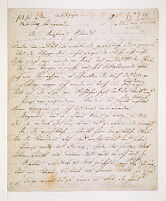
Autograph fair copy in Kurrentschrift. Folio 1 annotated by other hands as described above.
An elegy of six stanzas with the title spelled ‘Stutgard’. Each strophe is formed of nine distiches in groups of three. The poem reflects the celebration of autumn in a landscape through which the wanderer and a companion pass, considering the role of the gods. They come to his birthplace which evokes memories of the past and its heroes, and a vision of Stuttgart as priestess. The wanderer appeals to the town and the spirits of the land, recognising that celebrations will end and life is short.
Begins: ‘Wieder ein Glük ist erlebt. Die gefährliche Dürre geneset,’
Ends: ‘Aber die größere Lust sparen dem Enkel wir auf.’
Below the title is the autograph dedication 'An Siegfried Schmidt'. Folio 1 bears annotations in various hands which have been identified and interpreted by Autenrieth and Kelletat (Johanna Autenrieth and Alfred Kelletat, Katalog der Hölderlin-Handschriften, (Stuttgart: Kohlhammer, 1961), no.443. Cf. the same annotators in the Württembergische Landesbibliothek MS, no. 5). According to their findings, the deletion of the autograph title and the insertion (top centre in ink) of the alternative ‘Herbstfeyer’ are in the hand of the poet Justinus Kerner (Zweig thought the alternative title was in the hand of Hölderlin’s friend Isaac von Sinclair (see record card at Add. MS 73168, f. 1). However he was not confident of his opinion as he also suggested and deleted the names of Seckendorf or Mörike). Kerner also wrote ‘steht schon in der Samlung’ at the top left in ink and ‘(in Sekendorfs Musenalm. gedrukt.)’ at the top right in ink. Two annotations in red crayon, ‘p.99’ at top left and ‘Creutze zu vergleichen’ at top right are thought to be by Fritz Breunlin, Hölderlin’s nephew. Also at the top right are the figures ‘41/99’ in ink and ‘Nr. 98’ in pencil written by Karl Gok, Hölderlin’s step-brother, the latter overwritten with the figure 5 in ink. At the bottom of the page are ‘8 C’ over W on the left in pencil, possibly a dealer’s mark, and on the right ‘Hölderlin’ in very faint pencil, attributed tentatively to Carl Künzel.
Sattler believes that Hölderlin started writing the present poem in Stuttgart in September 1800 at the earliest. The composition may have continued through the winter and even into the New Year of 1801. On 3 February Siegfried Schmid wrote a letter of thanks to Hölderlin, but not necessarily relating to this poem (see Beissner 2.2 p.584). Philipp Siegfried Schmid (b.1774, d.1859), was a writer and a cadet in the Imperial army. He first met Hölderlin in Frankfurt in 1797 and they became part of the same circle of friends in Homburg. Hölderlin dedicated ‘Stuttgart’ to him to welcome him back from the war, but Zweig MS 160 may not be the copy he sent to his friend. Hölderlin was able to make amendments to the Homburg manuscript, possibly in spring 1804, but when the time came for publication in the Musenalmanach he was already insane, and his friends Isaac von Sinclair and Leo Freiherr von Seckendorf saw it into print (Sattler, p. 181). It is not clear who made the decision to change the title to ‘Herbstfeier’.
In his essay ‘Handschriften als schöpferische Dokumente’, Stefan Zweig gave as an example of a manuscript which sparked his schoolboy interest in collecting ‘ein Wahnsinnsgedicht Hölderlins mit seinem wirr durcheinander fahrenden Zeilen’. He was sufficiently fascinated by the poet to include him in the second volume of his Baumeister der Welt series, alongside Kleist and Nietsche, under the title Der Kampf mit dem Dämon, (Leipzig, Insel Verlag, 1925), pp. 23-151. He wrote here of Hölderlin’s perfecting lyrical form and creating heroic rhythm, and of his habit of excessive revision, creating new versions of poems in several layers on the same manuscript (as evidenced by the Homburg MS). He spoke of thousands of pages destroyed and of lack of recognition from a whole generation, but concluded that despite his weakness as an artist and incompetence for life, Hölderlin triumphed through singleness of purpose and the music of his words.
Zweig published articles about Hölderlin including: ‘Die Heilige Schar. Vorklang zu einem Hölderlin-Bildnis’, in Die Horen, Heft I, (Berlin, 1924); ‘Phaeton oder die Begeisterung’, in Die Literatur, 27 Jahrgang, Heft 3, (Berlin, 1924); ‘Hölderlins Untergang’, in Neue Freie Presse, (Vienna, 11 Nov. 1924).
Zweig also owned the following autograph manuscripts of Hölderlin:
‘Burg Tübingen’, acquired in 1929 and now in the Bodmer Foundation, Geneva.
‘Der Frühling’, acquired in 1927 and now in the Bodmer Foundation, Geneva.
‘Der Herbst’, acquired in 1926 and now in the Bodmer Foundation, Geneva.
Three fragments of ‘Hyperion’, acquired in 1925 and 1931 and now in the Bodmer Foundation, Geneva.
‘Lied der Freundschaft’, acquired in 1929 and now in the Bodmer Foundation, Geneva (Facsimile in Martin Bircher, Musik und Dichtung,[catalogue of an exhibition at the Bodmer Foundation], (Munich: Saur, 2002), pp. 195-198).
Three poems, ‘Die Kürze’, ‘Ehemals und jetzt’, ‘Lebenslauf’, acquired in 1921 and now in the Bodmer Foundation, Geneva.
‘Patmos’, date of acquisition unknown, now in the Bodmer Foundation, Geneva.
Two poems, ‘Dem Sonnengott’, ‘Der Mensch’, acquired in 1926 and now in the Bodmer Foundation, Geneva.
‘Stimme des Volkes’, acquired before 1930 and now in the Bodmer Foundation, Geneva.
‘Der Winter’, acquired in 1909, and now in the Bodmer Foundation, Geneva.
Seven pieces of Pindar fragments, date of acquisition unknown, now in the Bodmer Foundation, Geneva
- Collection Area:
- Western Manuscripts
- Project / Collection:
- Stefan Zweig Collection
- Hierarchy Record Ids:
- 032-001945746
036-001945888
037-001945919
040-001945920 - Is part of:
- Zweig MS 1-218 : Stefan Zweig Collection: Music, literary and historical manuscripts
Zweig MS 132-200 : Stefan Zweig Collection: Literary and historical manuscripts
Zweig MS 160-161 : STEFAN ZWEIG COLLECTION. Vols. CLX, CLXI. Friedrich Hölderlin: manuscripts of poems; circa 1798-1800. Two volumes.
Zweig MS 160 : Johann Christian Friedrich Hölderlin: Poem 'Stuttgart' [1800-1801] - Hierarchy:
- 032-001945746[0002]/036-001945888[0024]/037-001945919[0001]/040-001945920
- Container:
- View / search within Archive / Collection: Zweig MS 1-218
- Record Type (Level):
- File
- Extent:
- 1 item
- Digitised Content:
- https://iiif.bl.uk/uv/#?manifest=https://bl.digirati.io/iiif/ark:/81055/vdc_100139607554.0x000001 (opens in a new tab)
- Thumbnail:
-
- Languages:
- German
- Scripts:
- Latin
- Start Date:
- 1795
- End Date:
- 1805
- Date Range:
- c 1800
- Era:
- CE
- Access:
- Restrictions to access apply please consult British Library staff
- User Conditions:
- Letter of introduction required to view this manuscript
Please request the physical items you need using the online collection item request form.
Digitised items can be viewed online by clicking the thumbnail image or digitised content link.
Readers who have registered or renewed their pass since 21 March 2024 can request physical items prior to visiting the Library by completing
this request form.
Please enter the Reference (shelfmark) above on the request form.If your Reader Pass was issued before this date, you will need to visit the Library in London or Yorkshire to renew it before you can request items online. All manuscripts and archives must be consulted at the Library in London.
This catalogue record may describe a collection of items which cannot all be requested together. Please use the hierarchy viewer to navigate to individual items. Some items may be in use or restricted for other reasons. If you would like to check the availability, contact our Reference Services team, quoting the Reference (shelfmark) above.
- Physical Characteristics:
-
247 x 204mm.
ff. 3. Two bifolia, originally interleaved but now separated. The second half of the outer bifolium is blank on recto and verso.
One stanza per page occupying the whole width, with longer lines running on at the right hand edge of the line below.
Watermark: J WHATMAN 1794
Written in black ink on white wove paper.
(See Add. MS 73174, f. 110 for the draft physical description prepared by Dr Friedenthal in 1947 for Beissner’s edition of the works. - Custodial History:
-
The Hölderlin-Gesellschaft facsimile publication states that this manuscript was apparently amongst Hölderlin’s papers when the first collection of his poems was made about 1820. It may subsequently have belonged to Carl Künzel, the autograph collector (b.1808, d.1877) whose hand has possibly been detected on f. 1, and then to his nephew Wilhelm Künzel (d. 1896).
On 1 March 1898 the manuscript was sold by Leo Liepmannssohn of Berlin, auction 22, lot 446. It was offered again by Liepmannssohn on 21 October 1926, auction 48, lot 437, and purchased by Zweig through Heinrich Rosenberg. Zweig’s record card in Add. MS 73168, f. 31 notes ‘Prachtstück ersten Ranges! Nie gelangte ein Gedicht Hölderlins von [deletion] ähnlichem Umfang zum Verkauf’.
The Zweig Provenance Papers in Add. MS 73174, ff. 107-112 include two letters from the Hölderlin Archiv in Stuttgart to Dr M. Altmann (ff. 108, 109) relating to the inclusion of the poems in Beissner’s edition (April and August 1947), and a draft physical description (f. 110) prepared by Dr Friedenthal for the same edition.
- Publications:
-
First published
Leo Freiherr von Seckendorf (ed.), Musenalmanach für das Jahr 1807, (Regensburg: Montag- und Weißischen Buchhandlung, 1807), pp 3-12. Title ‘Die Herbstfeier’. Based on the Homburg text or a derivative (Online at http://www.textkritik.de/hoelderlin/hoelderlin_drucke.htm from this page click on 1807, then on each double opening).
Franz Zinkernagel (ed.), Friedrich Hölderlin Gedichte, (Leipzig: Insel, 1922), pp. 291-296.
Friedrich Beissner (ed.), Hölderlin. Sämtliche Werke, (Stuttgart, Kohlhammer, 1951),text vol. 2.1, Gedichte nach 1800, pp. 86-89, commentary vol. 2.2, pp. 584-591. The Stuttgarter Ausgabe.
Günter Mieth (ed.), Friedrich Hölderlin. Sämtliche Werke und Briefe, (Darmstadt: Wissenschaftliche Buchgesellschaft, 1970), vol. 1, text, pp. 305-308, notes, pp. 1025-1029.
D. E. Sattler (ed.), Friedrich Hölderlin. Sämtliche Werke, (Frankfurt am Main: Roter Stern, 1976-2008), Vol. 6. Elegien und Epigramme. Includes text and facsimile of H3, text of the 1807 printing, and a reconstructed text, pp. 181-201, and text and facsimile of the five lines of H1. The Frankfurter Ausgabe.
Variants
There are few variants between the three fair copy manuscripts, mainly in punctuation. Beissner’s Stuttgarter Ausgabe (2.2 pp. 585-588) has a full critical apparatus, and the Hölderlin-Gesellschaft facsimile of Zweig MS 160 lists the readings that are different in these two sources as well as the minor Schreibfehler corrected in the Zweig manuscript. The only unique wording in the present manuscript is at line 91 ‘Genien des Landes!’ where the other sources all have ‘Engel des Vaterlandes!’
Reproduced:
Christian Waas, Siegfried Schmid aus Friedberg in der Wetterau, der Freund Hölderlins, in Hessische Volksbücher, Bd 66-69 (Darmstadt, 1928), following p. 310. A facsimile Zweig MS 160, f. 1 but not showing the annotations at the top of the leaf.
Hölderlin Stutgard. ‘Originalgetreue Wiedergabe der Londoner Handschrift. Erläuterungen von Cyrus Hamlin’. Schriften der Hölderlin-Gesellschaft, Bd 8. (Tübingen, 1970). Full facsimile, text and variants of Zweig MS 160, with introduction, notes and structural analysis.
Bibliography:
Stefan Zweig, Der Kampf mit dem Dämon, ‘Baumeister der Welt’, Vol. 2, (Leipzig, Insel Verlag, 1925), pp. 23-151.
Stefan Zweig, ‘Meine Autographen-Sammlung’, in Philobiblon (Vienna), 3. Jahrgang, Heft 7, Sept. 1930, pp. 279 ff. Reprinted in Matuschek pp. 128-132.
Wilhelm Frels, Deutsche Dichterhandschriften von 1400 bis 1900, (Leipzig: Hiersemann, 1934), pp. 134-135. Bibliographical Publications Germanic Section Modern Language Association of America Vol. II.
Listed in the brochure for the British Library exhibition 75 Musical and Literary Autographs from the Stefan Zweig Collection (1986) and in the programme book for the Stefan Zweig Series of Concerts, Lectures and Exhibitions April - May 1987.
Catalogue of Additions to the Manuscripts 1986-1990, (London: British Library, 1993), Part I, p. 72.
Oliver Matuschek, Ich kenne den Zauber der Schrift, (Vienna: Inlibris, 2005), p. 243.
- Material Type:
- Archives and Manuscripts
- Legal Status:
- Not Public Record(s)