Hard-coded id of currently selected item: . JSON version of its record is available from Blacklight on e.g. ??
Metadata associated with selected item should appear here...
Zweig MS 163
- Record Id:
- 040-001945923
- Hierarchy Root Ancestor Record Id:
- 032-001945746
- MDARK:
- ark:/81055/vdc_100000000195.0x0002c0
- LARK:
- ark:/81055/vdc_100139607576.0x000001
- SLARK:
- Format:
- ISAD(G)
- Reference (shelfmark):
- Zweig MS 163
- Title:
- John Keats: Fragment of poem 'I stood tip-toe upon a little hill'
- Scope & Content:
-
Autograph first draft.
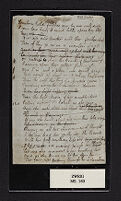
Fifty-seven lines (including deletions) from the 4th leaf of the poem. The whole work consists of 242 lines in rhyming couplets, drafted on ten leaves. Lines 87-106 of the final version are drafted on the recto, and lines 123-150 on the verso of this fragment. The gap between is accounted for by fragments at Harvard and in New York Public Library (see below under Related Manuscripts).
Begins: ‘Sometimes Gold-finches one by one will drop’
Ends: ‘To bow for gratitude before Jove's Throne.’
The complete poem reflects, partly through observation and partly in visions, the power of nature to inspire the poet. At the end Keats’s first use of the Endymion theme emerges. The recto of the present fragment describes a real flight of goldfinches evoking the vision of a maiden moving through a field; the verso marks the opening of an extended address to the moon.
The heading 'John Keates' is written in another hand.
The rough draft is characterised by the deletion of ten lines or part lines and displays its hasty composition in the alterations, flowing script and lack of punctuation. Line numbers are confused: lines 120, 136, 150 are numbered in the margin, but the first does not correspond to the published editions. There are pen trials in the left-hand margin of the recto.
Stefan Zweig felt a particular affinity with Keats, naming him in his explanation of how autographs enable us to connect through our memories with the creative writer:
‘Ein Gedichtblatt Keats’ bleibt solange nichts als ein armes Blatt Papier, sofern in uns nicht schon bei der bloßen Anrufung dieses Namens ehrfürchtige Erinnerung aufklingt an heilig schöne Verse, die wir von ihm gelesen haben und die unserer Seele so wirklich und gegenwärtig sind wie jedes Haus dieser Stadt und der Himmel darüber und die Wolken und das Meer.’ (from ‘Sinn und Schönheit der Autographen’, in Philobiblon (Vienna) 8. Jahrgang, Heft 4, April 1935).
On his record card (Add MS 73168, f. 32), he noted that this fragment ‘[Geh]ört zu den allergrössten Seltenheiten der Welliteratur [sic]. Durch die Schönheit des Gedichtes noch kostbarer’. On 11 March 1924, he wrote to the Paris manuscript dealer Simon Kra that he wanted to keep this Keats manuscript, acquired the previous month, as it was quite expensive and he did not expect to see another for sale, except in America where they were bought for hundreds of dollars (Add MS 74269, ff. 10-11v).
- Collection Area:
- Western Manuscripts
- Project / Collection:
- Stefan Zweig Collection
- Hierarchy Record Ids:
- 032-001945746
036-001945888
040-001945923 - Is part of:
- Zweig MS 1-218 : Stefan Zweig Collection: Music, literary and historical manuscripts
Zweig MS 132-200 : Stefan Zweig Collection: Literary and historical manuscripts
Zweig MS 163 : John Keats: Fragment of poem 'I stood tip-toe upon a little hill' - Hierarchy:
- 032-001945746[0002]/036-001945888[0026]/040-001945923
- Container:
- View / search within Archive / Collection: Zweig MS 1-218
- Record Type (Level):
- File
- Extent:
- 1 item
- Digitised Content:
- https://iiif.bl.uk/uv/#?manifest=https://bl.digirati.io/iiif/ark:/81055/vdc_100139607576.0x000001
- Thumbnail:
-
- Languages:
- English
- Scripts:
- Latin
- Start Date:
- 1816
- End Date:
- 1816
- Date Range:
- [1816]
- Era:
- CE
- Access:
- Restrictions to access apply please consult British Library staff
Please request the physical items you need using the online collection item request form.
Digitised items can be viewed online by clicking the thumbnail image or digitised content link.
Readers who have registered or renewed their pass since 21 March 2024 can request physical items prior to visiting the Library by completing
this request form.
Please enter the Reference (shelfmark) above on the request form.If your Reader Pass was issued before this date, you will need to visit the Library in London or Yorkshire to renew it before you can request items online. All manuscripts and archives must be consulted at the Library in London.
This catalogue record may describe a collection of items which cannot all be requested together. Please use the hierarchy viewer to navigate to individual items. Some items may be in use or restricted for other reasons. If you would like to check the availability, contact our Reference Services team, quoting the Reference (shelfmark) above.
- User Conditions:
- Letter of introduction required to view this manuscript
- Physical Characteristics:
-
194 x 121mm.
f. 1 (one complete leaf of the original ten).
Chain lines. No watermark.
Written in black ink on brown laid paper. - Custodial History:
-
Keats gave the draft manuscript to Charles Cowden Clarke in 1816 who cut up and dispersed it as described above.
Zweig purchased the fragment in February 1924 from Leo Liepmannssohn in Berlin, noting that it came 'Aus grosser deutscher Privatsammlung' (record card Add MS. 73168, f. 32). The German collector has not been identified. By the early 20th century, Americans were the principal purchasers of Keats manuscripts (Hebron, p. 28).
The history is confused by a further statement on the record card ‘Hinweis auf den Erwerb in beiliegenden Ausschnitt aus amerik. Kat.’ but this has been deleted and must be presumed erroneous. See also the correspondence, invoice and related papers in Add MS. 73175, ff 4-14. The cutting here which refers to a letter and poem as Lot 90 does not relate to the present manuscript. - Publications:
-
First published, prepared by Keats himself, in Poems, (London: printed for Charles and James Ollier, 1817). The first poem in the collection, following the dedication to Leigh Hunt.
Maurice Buxton Forman, Letter to the editor of The Times Literary Supplement, 27 August 1938, pp. 555-556 (copy in Add MS 73175, f. 12). Responding to correspondence in previous issues (6 and 14 August) relating to the manuscript given to Cowden Clarke, Forman draws attention to the fragment owned Stefan Zweig. He quotes in full the lines contained in this fragment, not from the manuscript but from the 1817 edition, and he notes the variants.
H. W. Garrod (ed.) The Poetical Works of John Keats, 2nd edition (Oxford: Clarendon Press, 1958), pp. 3-11 (text with variants in footnotes) and Introduction pp. lxxxiv-lxxxviii for a note on the first version of this poem.
Jack Stillinger (ed.), The Poems of John Keats (London: Heinemann, 1978), pp. 79-88 text and apparatus, 556-559 notes and reconstruction.
Jack Stillinger (ed.), John Keats Complete Poems (Cambridge, Mass. and London: Harvard University Press, 1982), pp. 47-53, with notes 425-426.
Corrections and variants in wording and capitalisation between draft, fair copy and print are fully noted by Garrod and Stillinger in the critical apparatus. Garrod (p. lxxxvii) notes that the line numbering123-150 on the verso of the Zweig fragment is the same as the 1817 edition, but on the recto (published lines 87-106), Keats has written 120 against line 98. The discrepancy may be attributed to the rejection or transfer of 21 lines earlier in the poem, or to the order in which the lines were written on separate scraps of paper. Lines 137 and 138 which are deleted in Zweig 163 are reinstated in the editions.
- Material Type:
- Archives and Manuscripts
- Legal Status:
- Not Public Record(s)