Hard-coded id of currently selected item: . JSON version of its record is available from Blacklight on e.g. ??
Metadata associated with selected item should appear here...
Zweig MS 188
- Record Id:
- 040-001945951
- Hierarchy Root Ancestor Record Id:
- 032-001945746
- MDARK:
- ark:/81055/vdc_100000000195.0x0002d9
- LARK:
- ark:/81055/vdc_100139608208.0x000001
- SLARK:
- Format:
- ISAD(G)
- Reference (shelfmark):
- Zweig MS 188
- Title:
- Percy Bysshe Shelley: ‘Lines to —’, a sonnet to Lord Byron: autograph fair copy; headed ‘Jan 22.’ [composed 1821 or 1822]
- Scope & Content:
-
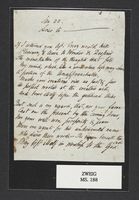
Begins: ‘If I esteemed you less, Envy would kill / Pleasure’.Ends: ‘The worm beneath the sod / May lift itself in worship to the God’.
A sonnet of fourteen lines, divided into two stanzas of eight and six lines. The addressee or subject of the sonnet was first publicly identified as Lord Byron by Thomas Medwin in 1833. This poem should be distinguished from another entitled ‘Lord Byron’.The poem acknowledges Byron’s genius and reflects Shelley’s own sense of inferiority. The introductory prose line ‘I am afraid these verses will not please you, but’, which appears before Shelley’s rough draft in Bodleian MS Shelley adds. e. 17, is lacking in the present fair copy, which suggests that Shelley did not intend it to be included in the final version. The number ‘200’ is written on the verso.
The date of composition of the sonnet is disputed. Zweig noted January 1822 on his record card (Add MS 73168, f. 61), and the evidence of Mary Shelley’s headnote and social events in Italy at the start of the year would support this. From the jottings in the Hellas notebook, and the association of the autograph draft with the Charles the First manuscript, Robinson argues that it might have been begun in November 1821 and finalised in the following January. If Crook’s theory about the matching paper is correct, there is no need for a long gestation, as the fair copy could have been written immediately after the draft, on one of the following pages of the notebook which was then torn out.
In Thomas Medwin’s Life of Shelley, as revised by H. Buxton Forman in 1913, there is a reconstruction, possibly imagined, of the circumstances in which this sonnet was composed when both Shelley and Byron were staying in Pisa. It is suggested that Shelley was inspired by reading Byron’s Corsair, and wrote the poem the very next day. Crook and Reiman demonstrate from other sources that Byron’s work was familiar to the circle at Pisa at the start of 1822. Medwin claimed that Byron himself never saw the poem, though, if true, it is not clear whether the reason was Shelley’s premature death by drowning in July, or because friends advised him that the tone was too self-effacing.
Zweig described this maunscript on his record card as ‘eines der wichtigsten Documente aus der Heroenzeit der englischen Literatur’.
- Collection Area:
- Western Manuscripts
- Project / Collection:
- Stefan Zweig Collection
- Hierarchy Record Ids:
- 032-001945746
036-001945888
040-001945951 - Is part of:
- Zweig MS 1-218 : Stefan Zweig Collection: Music, literary and historical manuscripts
Zweig MS 132-200 : Stefan Zweig Collection: Literary and historical manuscripts
Zweig MS 188 : Percy Bysshe Shelley: ‘Lines to —’, a sonnet to Lord Byron: autograph fair copy; headed ‘Jan 22.’ [composed 1821 or 1822] - Hierarchy:
- 032-001945746[0002]/036-001945888[0048]/040-001945951
- Container:
- View / search within Archive / Collection: Zweig MS 1-218
- Record Type (Level):
- File
- Extent:
- 1 item (1 folio; f. 1v blank)
- Digitised Content:
- https://iiif.bl.uk/uv/#?manifest=https://bl.digirati.io/iiif/ark:/81055/vdc_100139608208.0x000001
- Thumbnail:
-
- Languages:
- English
- Scripts:
- Latin
- Start Date:
- 1821
- End Date:
- 1822
- Date Range:
- c 1821-1822
- Era:
- CE
- Access:
- Available for research unless otherwise stated
Please request the physical items you need using the online collection item request form.
Digitised items can be viewed online by clicking the thumbnail image or digitised content link.
Readers who have registered or renewed their pass since 21 March 2024 can request physical items prior to visiting the Library by completing
this request form.
Please enter the Reference (shelfmark) above on the request form.If your Reader Pass was issued before this date, you will need to visit the Library in London or Yorkshire to renew it before you can request items online. All manuscripts and archives must be consulted at the Library in London.
This catalogue record may describe a collection of items which cannot all be requested together. Please use the hierarchy viewer to navigate to individual items. Some items may be in use or restricted for other reasons. If you would like to check the availability, contact our Reference Services team, quoting the Reference (shelfmark) above.
- User Conditions:
- Letter of introduction required to view this manuscript
- Physical Characteristics:
- 165 x 122mm.Black ink on wove paper.No watermark.
- Custodial History:
- The present manuscript was owned by Mary Shelley who, after copying, gave it to her acquaintance Charlotte Murchison sometime between 1831 and 1833; sold at Sotheby’s in 1931 as the property of Sir Kenneth Murchison, of Hargrave Hall, Huntingdonshire, from the collection of Sir Roderick Murchison; purchased by Zweig at Sotheby’s sale, 16 December 1931, lot 713, through Maggs; BL 1986.
- Administrative Context:
- Exhibited: Paris, Bibliothèque nationale de France, Le Livre Anglais, 1951–2, catalogue no. 192 (see indemnity form in Add MS 73175, f. 13 and envelope at Add MS 73175, f. 111).
- Information About Copies:
- Reproduced: Sotheby’s sale catalogue (1931), facing p. 93, and Reiman and O’Neill (1997), p. 250; reproduced from Sotheby’s catalogue in The ‘Charles the First’ Draft Notebook. A facsimile of Bodleian MS Shelley adds. e. 17., The Bodleian Shelley Manuscripts, 12, ed. Nora Crook (New York; London: Garland, 1991), p. 132.
- Publications:
-
Published: First published by Thomas Medwin, Shelley’s cousin, seven lines only, in his ‘Memoir of Shelley’ in the Athenaeum (London: J. Francis), Issue 248, 28 July 1832, p. 489; Medwin reprinted the lines unchanged in The Shelley Papers (London: Whittaker, Treacher & Co., 1833), p. 37, and with corrections and four additional lines in The Life of Percy Bysshe Shelley, ii (London: Thomas Cautley Newby, 1847), pp. 35 and 162; The Poetical Works of Percy Bysshe Shelley, ii, ed. William Michael Rossetti (London: E. Moxon, 1870), p. 362, note p. 585, fourteen lines published, with the first printing of the introductory prose line; The Life of Percy Bysshe Shelley by Thomas Medwin, ed. H. Buxton Forman, amended and extended ed. (London: Humphrey Milford / Oxford University Press, 1913), where a version of the poem in twelve lines from Medwin’s 1847 Life is on p. 258; Sotheby’s sale catalogue, 16 December 1931, lot 713, p. 93, the fourteen lines of Zweig MS 188 quoted; Fair-Copy Manuscripts of Shelley’s Poems in European and American Libraries. The Manuscripts of the Younger Romantics. Percy Bysshe Shelley, 7, ed. Donald H. Reiman and Michael O’Neill (New York; London: Garland, 1997), containing a thorough physical and textual analysis of Zweig MS 188, with reference to the publication history and related manuscripts, pp. 246–53.
Bibliography: William J. Burling, ‘New light on Shelley’s ‘Lines to —’, Keats–Shelley Journal (New York: Keats–Shelley Association of America, 1986), 35, pp. 20–3; BL Programme Book, 1987; Catalogue of Additions, p. 76; Matuschek, p. 327.
- Exhibitions:
- Where Great Writers Gather: Treasures of the British Library, Shanghai Library, Shanghai, 15 March 2018 - 15 April 2018
- Material Type:
- Archives and Manuscripts
- Legal Status:
- Not Public Record(s)