Hard-coded id of currently selected item: . JSON version of its record is available from Blacklight on e.g. ??
Metadata associated with selected item should appear here...
R.M.20.e.8
- Record Id:
- 040-001948667
- Hierarchy Root Ancestor Record Id:
- 032-001948397
- MDARK:
- ark:/81055/vdc_100000000293.0x00039d
- LARK:
- ark:/81055/vdc_100156352798.0x000001
- SLARK:
- Format:
- ISAD(G)
- Reference (shelfmark):
- R.M.20.e.8
- Title:
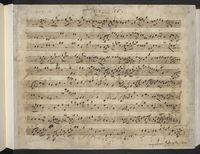
- George Frideric Handel: Hercules (a ‘musical drama’ by Thomas Broughton, after texts by Sophocles and Ovidius), HWV 60. Autograph
- Scope & Content:
-
The MS. (cf. the Preface to H-G.) contains the divisions into acts and scenes of the Libretto, but not the directions as to Ripieni, etc., in H-G. Between ff. 57 and 58 is inserted a leaf, ruled with staves but otherwise blank, foliated as f. 57a; ff. 83v, 98v, 133v are ruled with staves but otherwise blank.
Points of note:
1. f. 1. ‘angefangen July 19. [here is the astrological symbol for Thursday]. 1744’.
2. f. 4. At the end of the Overture: ‘Act I, scene 1, A Royal Apartment. Dejanira Lychas and the Chorus of Trachinians. NB. Lychas acc: and Aria. poi segue’. ‘O Hercules’ (H-G., p. 15) follows.
3. f. 4v. ‘The world, when day’s career’ down to the end of H-G., p. 16.
4. f. 5. ‘Act I, scene 1. A Royal Apartment. Dejanira Lychas, etc. (ut supra). ‘See, with what sad dejection’ (H-G., p. 10) in the Alto clef.
5. f. 6. ‘No longer, Fate’ (H-G., p. 11). The original words began: ‘On great Alcides, Jove, look down’. At the end (f. 8v): ‘poi segue Dejanira accomp. O Hercules! why art thou absent from me’.
6. f. 9. The end of ‘the world, when day’s career’ – from H-G., p. 17.
7. f. 10v. The part of Hyllus is written in the Tenor clef.
8. f. 13. At the end of Hyllus’ recitative (‘…his toils recount’): ‘the Song ex G’.
9. f. 13v. ‘There in myrtle shades’ (H-G., p. 25). In E major; much shortened (in ink).
10. f. 25v. End of ‘Begone, my fears’.
11. ff. 26-27. ‘The smiling hours’ (H-G., p. 52). The second part (H-G., p. 55, line 1, from end of bar 7) has a Violin accompaniment, crossed out in pencil.
12. f. 28. Recitatives (H-G., p. 51). At the end: ‘segue l’Aria of Lichas the smiling Hours’. The recitatives of Lichas have originally been written in the Tenor clef and altered to Alto.
13. f. 28v. ‘Let none despair’ (H-G., p. 56).
14. f. 33v. ‘Daughter of gods’ (H-G., p. 66). The whole air is full of alterations and cuts (in ink).
15. f. 36v. ‘Marche’. The repeat marks at the double bar are crossed out and ‘NB’ written in (pencil).
16. f. 47. (End of ‘Crown with festal pomp’) ‘geendiget dies 1 Ackt July 30 [here is the astrological symbol for Monday] 1744’.
17. ff. 47v-48. The ‘Symfonie’ (H-G., pp. 101-102) has repeats marked at the double bars, but crossed out in pencil.
18. ff. 50v-51. The recitatives for Iole and Dejanira (H-G., pp. 109-110) are much longer, but shortened in ink.
19. f. 55. ‘As star that rise’. Marked (in pencil) ‘ex F’ ‘Hyllus’.
20. f. 58v. ‘Jealousy, infernal pest’. Seven bars have been crossed out (both in ink and pencil) after H-G., p. 128, line 2, bar 3.
21. ff. 79v-81v. From ‘…love and constancy’ (H-G., p. 168) to the end of ‘Cease, ruler of the day’ (H-G., p. 171) is cut (in pencil).
22. f. 82. Begins ‘…force and see, the herald’ (H-G., p. 172, line 5). ‘Constant lovers has a Violin accompaniment (printed in H-G.) crossed out in pencil.
23. f. 83. Ends: ‘the torture of my bleeding heart’ (H-G., p. 175).
24. f. 84. ‘Some kinder Pow’r’ (H-G., p. 172). The recitative from ‘prove it’s magic force’ originally ended differently. This ending is crossed out, with a reference to f. 82. Two sets of notes are written to much of the recitative and not crossed out.
25. f. 84v. ‘Forgive me, Princess…paternal throne’ (H-G., p. 175). Two sets of notes for Dejanira’s part.
26. ff. 85-89. ‘Joys of freedom’ (H-G., p. 176). Much shortened (in ink) from the original setting.
27. f. 94v. (End of ‘Love and Hymen’) ‘Fine dell’Atto 2do Agost 11. 1744. [here is the astrological symbol for Saturday]’.
28. f. 95v. The repeats at the double bars (H-G., p. 193) are crossed out in pencil.
29. f. 98. (End of ‘O scene of unexampled woe), ‘Segue 1 Tr Recit: O fatal Jelausy’ [sic].
30. f. 99. Begins: ‘robe, by cursed art’ (H-G., p. 194, last line). After ‘vaulted roof returns’ (p. 195): ‘NB Aria Lichas’. ‘O fatal Jealousy’ (p. 197) follows.
31. f. 121. The recitatives on H-G., p. 238 down to ‘lights a moment’.
32. f. 122. ‘He, who for Atlas’ (H-G., p. 240). ‘Aria for Mrs Cibber. Lichas or Priest’. At the end: ‘Segue Dejanira Words are too faint to speak’.
33. f. 124. Continues the recitatives from f. 121. After ‘deities to dwell’ (H-G., p. 239): ‘Aria for the Priest, followed by ‘Words are too faint’, etc. (p. 244).
34. f. 128v. ‘To him your grateful notes’. All is cut (in pencil) before H-G., p. 261, line 1, beginning of bar 6.
35. f. 133. ‘Fine. London. Agost: 17. ♀ [Friday]. 1744. völlig geendiget…’ The end has been cut by the binder.
Sophocles: Publius Ovidius Naso, Roman poet: Thomas Broughton, librettist: Handel's 'Hercules' (HWV60) to a libretto by Thomas Broughton, after texts by Sophocles and Publius Ovidius Naso: 18th cent.
- Collection Area:
- Music Collections
- Project / Collection:
- Royal Music Library Manuscripts
- Hierarchy Record Ids:
- 032-001948397
040-001948667 - Is part of:
- R.M. : Royal Music Library Manuscripts
R.M.20.e.8 : George Frideric Handel: Hercules (a ‘musical drama’ by Thomas Broughton, after texts by Sophocles and Ovidius), HWV 60. Autograph - Hierarchy:
- 032-001948397[0233]/040-001948667
- Container:
- View / search within Archive / Collection: R.M.
- Record Type (Level):
- File
- Extent:
- 1 volume (133 folios)
- Digitised Content:
- https://iiif.bl.uk/uv/#?manifest=https://bl.digirati.io/iiif/ark:/81055/vdc_100156352798.0x000001 (opens in a new tab)
- Thumbnail:
-
- Languages:
- English
- Scripts:
- Latin
- Start Date:
- 1744
- End Date:
- 1744
- Date Range:
- 1744
- Era:
- CE
- Access:
- Restrictions to access apply please consult British Library staff
-
Please request the physical items you need using the online collection item request form.
Digitised items can be viewed online by clicking the thumbnail image or digitised content link.
Readers who have registered or renewed their pass since 21 March 2024 can request physical items prior to visiting the Library by completing
this request form.
Please enter the Reference (shelfmark) above on the request form.If your Reader Pass was issued before this date, you will need to visit the Library in London or Yorkshire to renew it before you can request items online. All manuscripts and archives must be consulted at the Library in London.
This catalogue record may describe a collection of items which cannot all be requested together. Please use the hierarchy viewer to navigate to individual items. Some items may be in use or restricted for other reasons. If you would like to check the availability, contact our Reference Services team, quoting the Reference (shelfmark) above.
- Physical Characteristics:
- 9.25 x 11.75in.
- Information About Copies:
- Digitised copy available on British Library Digitised Manuscripts: http://www.bl.uk/manuscripts/FullDisplay.aspx?ref=R.M.20.e.8
- Publications:
- Händel-Gesellschaft IV. See also Donald Burrows and Martha J. Ronish, A Catalogue of Handel’s Musical Autographs (Oxford: Clarendon, 1994), pp. 121-123.
- Material Type:
- Archives and Manuscripts
- Legal Status:
- Not Public Record(s)