Hard-coded id of currently selected item: . JSON version of its record is available from Blacklight on e.g. ??
Metadata associated with selected item should appear here...
Stowe MS 56
- Record Id:
- 040-001952837
- Hierarchy Root Ancestor Record Id:
- 032-001952775
- MDARK:
- ark:/81055/vdc_100000000493.0x00024e
- LARK:
- ark:/81055/vdc_100062974606.0x000001
- SLARK:
- Format:
- ISAD(G)
- Reference (shelfmark):
- Stowe MS 56
- Title:
- Baudri de Bourgueil, Historia Hierosolymitana; Historia Danica; Pseudo-Cornelius Nepos, Pseudo-Dares Phrygius, De Excidio Troiae Historia; Historia Apollonii Regis Tyri; Historia Alexandri Magni; Pseudo-Alexander, Epistola Alexandri ad Aristotelem; Collatio Alexandri et Dindimi; Geoffrey of Monmouth, Historia Regum Britanniae
- Scope & Content:
-
Contents:
ff. 2r-59r: Baudri de Bourgueil (b. c. 1046, d. 1130), Historia Hierosolymitana (The History of Jerusalem).
ff. 59r-63v: Historia Danica (The Danish History).
ff. 64r-75r: De Excidio Troiae Historia (The History of the Fall of Troy), authorship attributed to Dares Phrygius and translation to Cornelius Nepos (b. c. 110 BC, d. c. 25 BC).
ff. 75r-87v: Historia Apollonii Regis Tyri (The History of Apollonius King of Tyre).
ff. 87v-99v: Historia Alexandri Magni (The History of Alexander the Great).
ff. 99v-106v: Pseudo-Alexander, Epistola Alexandri ad Aristotelem (The Letter of Alexander the Great to Aristotle).
ff. 106v-112r: Collatio Alexandri et Dindimi (The Letters of Alexander the Great and Dindimus King Of The Brahmans).
ff. 112r-185v: Geoffrey of Monmouth (d. 1154), Historia Regum Britanniae (The History of the Kings of Britain).
The manuscript contains a number of additions:
ff. 186r: various verses and notes in English in a 16th-century hand.
[f. 186v is blank].
Decoration:
Numerous large initials in green or blue with red penwork decoration, or in red with green penwork decoration. Numerous large and small initials in red, green, or brown, some with penwork decoration, several extending into the margin. Highlighting of letters in red. Line-fillers in red.
- Collection Area:
- Western Manuscripts
- Project / Collection:
- England and France 700-1200 Project
Stowe Collection - Hierarchy Record Ids:
- 032-001952775
036-001952833
037-001952834
040-001952837 - Is part of:
- Stowe Ms 1-1085 : Stowe Manuscripts
Stowe MS 54-310 : CLASS IV.HISTORY.
Stowe MS 54-57 : SECT. I. — GENERAL AND MISCELLANEOUS.
Stowe MS 56 : Baudri de Bourgueil, Historia Hierosolymitana; Historia Danica; Pseudo-Cornelius Nepos, Pseudo-Dares Phrygius, De Excidio… - Hierarchy:
- 032-001952775[0004]/036-001952833[0001]/037-001952834[0003]/040-001952837
- Container:
- View / search within Archive / Collection: Stowe Ms 1-1085
- Record Type (Level):
- File
- Extent:
-
1 volume
- Digitised Content:
- https://iiif.bl.uk/uv/#?manifest=https://bl.digirati.io/iiif/ark:/81055/vdc_100062974606.0x000001 (opens in a new tab)
- Thumbnail:
-
- Languages:
- Latin
- Scripts:
- Latin
- Start Date:
- 1200
- End Date:
- 1224
- Date Range:
- 1st quarter of the 13th century
- Era:
- CE
- Access:
- User Conditions:
- Letter of introduction required to view this manuscript
Please request the physical items you need using the online collection item request form.
Digitised items can be viewed online by clicking the thumbnail image or digitised content link.
Readers who have registered or renewed their pass since 21 March 2024 can request physical items prior to visiting the Library by completing
this request form.
Please enter the Reference (shelfmark) above on the request form.If your Reader Pass was issued before this date, you will need to visit the Library in London or Yorkshire to renew it before you can request items online. All manuscripts and archives must be consulted at the Library in London.
This catalogue record may describe a collection of items which cannot all be requested together. Please use the hierarchy viewer to navigate to individual items. Some items may be in use or restricted for other reasons. If you would like to check the availability, contact our Reference Services team, quoting the Reference (shelfmark) above.
- Physical Characteristics:
-
Materials: Parchment.
Dimensions: 280 x 210 mm (text space: 225 x 160 mm, in two columns).
Foliation: ff. 186 (+ 5 unfoliated paper flyleaves and 1 parchment flyleaf at the beginning + 4 unfoliated paper flyleaves at the end); 1 parchment and 1 paper stub before [f. i] and 2 parchment stubs before f. 186; ff. [iii], [iv], [185a] and [185b] are 16th-century paper leaves with watermarks (see Charles Moïse Briquet, Les Filigranes: Dictionnaire Historique des Marques du Papier dès leur Apparition vers 1282 jusqu'en 1600, 4 vols (London: Quaritch, 1907), II, p. 640) that suggest an origin in Northern France; the modern paper pastedowns include fragments of medieval pastedowns.
Script: Gothic, written above top line.
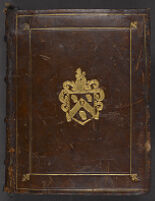
Binding: Post-1600. Brown leather, gold-tooled, stamped with the arms of Sir James Ley; red fore-edges. 1 bookmark made of green ribbons attached to leather.
- Custodial History:
-
Origin: England or Northern France.
Provenance:
An unknown 15th-century owner: added marginal notes to the text of Geoffrey of Monmouth’s Historia Regum Britanniae in a 15th-century hand.
An unknown 16th-century owner: added a table of contents in a 16th-century hand and decoration in red and green (f. 1r).
James Ley (b. 1550, d. 1629), 1st earl of Marlborough, judge and politician: his arms gold-stamped in the centre of the upper and lower covers.
Richard Temple-Nugent-Brydges-Chandos-Grenville (b. 1776, d. 1839), 1st duke of Buckingham and Chandos, of Stowe House, near Buckingham.
Richard Temple-Nugent-Brydges-Chandos-Grenville (b. 1797, d. 1861), 2nd duke of Buckingham and Chandos: sold in 1849 to Lord Ashburnham.
Bertram Ashburnham (b. 1797, d. 1878), 4th earl of Ashburnham, of Ashburnham Place, Sussex.
Bertram Ashburnham (b. 1840, d. 1913), 5th earl of Ashburnham: purchased by the British Museum from him together with 1084 other Stowe manuscripts in 1883.
- Information About Copies:
-
Full digital coverage available for this manuscript: see Digitised Manuscripts at http://www.bl.uk.manuscripts/.
Select digital coverage available for this manuscript; see the Catalogue of Illuminated Manuscripts, https://bl.uk/catalogues/illuminatedmanuscripts/.
- Publications:
-
Catalogue of the Stowe Manuscripts in the British Museum, 2 vols (London: British Museum, 1895-1896), I (1895), pp. 33-36 (no. 56).
Birger Munk Olsen, L’Étude des Auteurs Classiques Latins aux XIe et XIIe Siècles, 3 vols (Paris: Centre national de la Recherche Scientifique, 1982-1989), I, p. 372 (no. C.24).
Historia Apollonii Regis Tyri, ed. by G. A. A. Kortekaas, Mediaevalia Groningana, 3 (Groningen: Bouma's Boekhuis, 1984), p. 18.
Julia C. Crick, The Historia Regum Britannie of Geoffrey of Monmouth, 5 vols (Cambridge: Brewer, 1985-1991), III (1989): A Summary Catalogue of the Manuscripts, p. 100 (no. 117); IV (1991): Dissemination and Reception in the Later Middle Ages, pp. 31-32, 34, 36 (n. 80), 42, 46, 50, 59, 67-68, 71-73, 96, 99, 103, 105-106, 111, 132 (n. 27), 149 (n. 63), 152, 162 (n. 23), 163, 170, 188.
The Historia Ierosolimitana of Baldric of Bourgueil, ed. by Steven J. Biddlecombe (Rochester, NY: Boydell, 2014), pp. lxxxii-lxxxiii.
- Material Type:
- Archives and Manuscripts
- Legal Status:
- Not Public Record(s)
- Notes:
- This manuscript is part of The Polonsky Foundation England and France Project: Manuscripts from the British Library and the Bibliothèque nationale de France, 700-1200.