Hard-coded id of currently selected item: . JSON version of its record is available from Blacklight on e.g. ??
Metadata associated with selected item should appear here...
Stowe MS 62
- Record Id:
- 040-001952844
- Hierarchy Root Ancestor Record Id:
- 032-001952775
- MDARK:
- ark:/81055/vdc_100000000493.0x000254
- LARK:
- ark:/81055/vdc_100059476336.0x000001
- SLARK:
- Format:
- ISAD(G)
- Reference (shelfmark):
- Stowe MS 62
- Title:
- William of Newburgh, Historia rerum Anglicarum; Sermons
- Scope & Content:
-
This manuscript from c. 1200 originates from the Augustinian priory of St Mary, Newburgh, in North Yorkshire. It contains the works of the abbey’s most prolific author: the Historia rerum Anglicarum (History of English Affairs) by William of Newburgh (b. 1135/6, d. in or after 1198). The Historia, which William dedicated to Ernald, abbot of the Cistercian abbey of Rievaulx (1189-99), covers the period from 1066 to 1198 in five books; it may have been written during the last years of William’s life and some of the notes that have been added to the manuscript may have been written by him. The manuscript’s initials in three colours and motifs are characteristic of initial decoration at Yorkshire’s Cistercian monasteries (see Lawrence-Mathers, Manuscripts in Northumbria (2003), pp. 187-88). Both the manuscript’s contents (the Historia's dedication to Abbot Ernald) and decoration are testament to the influence of Cistercian houses on Newburgh Priory, and Yorkshire's Augustinian priories in general.
Contents:
ff. 2r-158r: William of Newburgh, Historia Rerum Anglicarum (Books I-V), preceded by the author's dedicatory letter and a table of contents.
ff. 159r-172r: William of Newburgh, Sermon on Luke 11:27; the Trinity; and St Alban (the latter two sermons are imperfect due to the loss of a quire between f. 166 and f. 167).
The manuscript contains a number of additions:
ff. 173v-174r: Latin notes in 13th- and 15th-century scripts: ‘Partibus faminie [sic] quidem vir nobilis et decurio in partibus australibus in oriente et occidente’; 'Dum sumus in mundo vivamus corde jocundo'; a Latin alphabet; ‘Chronica [William] canon de Novo burgo’; two memoranda referring to the death of William, Archbishop of York, one attributed to Roger of Howden [Hoveden] (d. 1201/02), chronicler from Howden in North Yorkshire.
ff. 68r-81v, 101r-102v: passages from the Historia, added in the 17th century to replace damaged or lost folios, copied from Lambeth Library MS 73 (written in a Gothic script).
[ff. 1r [pasted to the inside upper cover], 1v, 2r, 158v, 172v, 173r, 173v, 174r, 174v are blank].
Decoration:
6 large initials in red, blue, or green with penwork foliate decoration in the other colours, characterised by Lawrence as 'split-petal' and 'three-lobed-bud' motifs at the beginning of the prologue and of books (ff. 3r, 3v, 29r, 59r, 93v, 130v). Medium initials in red or green, usually with penwork decoration and pen-flourishing in green, red, or blue, or sometimes in two colours. Small simple initials in red or green. Two drawings of a harp (large and small) in brown ink on f. 174r.
- Collection Area:
- Western Manuscripts
- Project / Collection:
- England and France 700-1200 Project
Stowe Collection - Hierarchy Record Ids:
- 032-001952775
036-001952833
037-001952839
040-001952844 - Is part of:
- Stowe Ms 1-1085 : Stowe Manuscripts
Stowe MS 54-310 : CLASS IV.HISTORY.
Stowe MS 58-83 : SECT. II. — ENGLISH.
Stowe MS 62 : William of Newburgh, Historia rerum Anglicarum; Sermons - Hierarchy:
- 032-001952775[0004]/036-001952833[0002]/037-001952839[0005]/040-001952844
- Container:
- View / search within Archive / Collection: Stowe Ms 1-1085
- Record Type (Level):
- File
- Extent:
-
1 volume
- Digitised Content:
- https://iiif.bl.uk/uv/#?manifest=https://bl.digirati.io/iiif/ark:/81055/vdc_100059476336.0x000001
- Thumbnail:
-
- Languages:
- Latin
- Scripts:
- Latin
- Start Date:
- 1200
- End Date:
- 1224
- Date Range:
- 1st quarter of the 13th century
- Era:
- CE
- Access:
-
Please request the physical items you need using the online collection item request form.
Digitised items can be viewed online by clicking the thumbnail image or digitised content link.
Readers who have registered or renewed their pass since 21 March 2024 can request physical items prior to visiting the Library by completing
this request form.
Please enter the Reference (shelfmark) above on the request form.If your Reader Pass was issued before this date, you will need to visit the Library in London or Yorkshire to renew it before you can request items online. All manuscripts and archives must be consulted at the Library in London.
This catalogue record may describe a collection of items which cannot all be requested together. Please use the hierarchy viewer to navigate to individual items. Some items may be in use or restricted for other reasons. If you would like to check the availability, contact our Reference Services team, quoting the Reference (shelfmark) above.
- User Conditions:
- Letter of introduction required to view this manuscript
- Physical Characteristics:
-
Materials: Parchment.
Dimensions: 270 x 175 mm (text space: 200 x 135 mm, in 2 columns).
Foliation: ff. 174 ( + 11 unfoliated parchment flyleaves at the end); f. 1 is pasted to the inside cover; ff. 1, 173 and 174 originally were flyleaves; 1 parchment stub between f. 67 and f. 68; f. 80 and f. 81; 2 between f. 158 and f. 159; ff. 68-81, 101-102 were added in the 17th century, probably to replace lost or damaged folios.
Script: Protogothic; Gothic (ff. 68-81, 101-102).
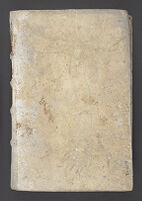
Binding: Pre-1600. White leather over pasteboard, the spine inscribed in gold at the British Museum: ‘GULIELMI DE NOVO BURGO CHRONICON SERMONES DE TRINITATE DE SCO: ALBANO &c.’; a red star (possibly from the manuscript’s spine) pasted on f. 126v.
- Custodial History:
-
Origin: Newburgh Priory, Northern England.
Provenance:
The Augustinian priory of St Mary, Newburgh: its 13th-century ownership inscription on f. 2v and 3r: 'Liber sancte Marie de Novo Burgo'; its table of contents (f. 2v); reference to St Godric of Finchale, who was visited by William of Newburgh in his old age (f. 1v: ‘[...] hanc librum [...] sanctum Go[d]ericu[m] in sen[ec]tute agentem [...]’)
? John Clerk (d. 1541), bishop of Bath and Wells (1523-1541): perhaps his ownership inscription on f. 2r (‘John Wells’); the antiquary John Leland (b. c. 1503, d. 1552) reported that he could not find a copy of William of Newburgh’s Historia at Newburgh Priory in c. 1536-40, but knew of a copy at Wells (see The Libraries of the Augustinian Canons, ed by Webber and Watson (1988), p. 401 (A23)).
? Sir Henry Spelman (b. 1563/4, d. 1641), historian and antiquary: inscription '16 Aug. 1633, precium 16s' (f. 2v).
Sir Roger Twysden, (b. 1597, d. 1672), 2nd baronet, antiquary: his signature (f. 1v) affixed to inside upper cover; chapters 5-15 of book 3 and 10-12 of book 4 supplied by him on parchment copied from Lambeth Library MS 73 (ff. 68-81 and 101-102).
Sir Thomas Sebright (d. 1736): the manuscript owned by him at the time of the edition of the text by Thomas Hearne (see Guilielmi Neubrigensis, ed. by Hearne (1719)).
Richard Temple-Nugent-Brydges-Chandos-Grenville (b. 1776, d. 1839), 1st duke of Buckingham and Chandos, of Stowe House, near Buckingham.
Richard Temple-Nugent-Brydges-Chandos-Grenville (b. 1797, d. 1861), 2nd duke of Buckingham and Chandos: sold in 1849 to Lord Ashburnham.
Bertram Ashburnham (b. 1797, d. 1878), 4th earl of Ashburnham, of Ashburnham Place, Sussex.
Bertram Ashburnham (b. 1840, d. 1913), 5th earl of Ashburnham: purchased by the British Museum from him together with 1084 other Stowe manuscripts in 1883.
- Information About Copies:
-
Full digital coverage available for this manuscript; see Digitised Manuscripts, https://bl.uk/manuscripts/.
Select digital coverage available for this manuscript; see the Catalogue of Illuminated Manuscripts, https://bl.uk/catalogues/illuminatedmanuscripts/
- Publications:
-
Guilielmi Neubrigensis Historia Sive Chronica Rerum Anglicarum, Libris Quinque, ed. by Thomas Hearne, 3 vols (Oxford: Sheldonian Theatre, 1719), passim.
Historia Rerum Anglicarum of William of Newburgh, ed. by Richard Howlett, 4 vols, Chronicles and Memorials of Great Britain and Ireland during the Middle Ages, Rolls Series, 82 (London: Rolls Commission, 1884-1889), I, p. xi and as ‘S’ as the basis for the edition.
Catalogue of the Stowe Manuscripts in the British Museum, 2 vols (London: Longmans, 1895), I: Text, pp. 40-41.
Kate Norgate, 'The Date of Composition of William of Newburgh's History', The English Historical Review, 19:4 (1904), pp. 288-97 [on the text].
Medieval Libraries of Great Britain: A List of Surviving Books, ed. by Neil Ripley Ker, Royal Historical Society Guides and Handbooks, 3 (London: Royal Historical Society, 1941), p. 74.
Richard W. Hunt, 'The Library of the Abbey of St Albans', in Medieval Scribes, Manuscripts & Libraries: Essays Presented to N. R. Ker, ed. by Michael Beckwith Parkes and Andrew G. Watson (London: Scolar Press, 1978), pp. 251-78 (p. 265 n. 77).
Anne Lawrence-Mathers, ‘The Artistic Influence of Durham Manuscripts’, in Anglo-Norman Durham 1093-1193, ed. by David Rollason, Margaret Harvey, and Michael Prestwich (Woodbridge: Boydell, 1994), pp. 451-69 (p. 469 n. 55).
The Libraries of the Augustinian Canons, ed. by Teresa Webber and Andrew G. Watson, Corpus of British Medieval Library Catalogues, 6 (London: The British Library in association with the British Academy, 1998), p. 401 (A23).
Peter Biller, ‘William of Newburgh and the Cathar Mission to England’, in Life and Thought in the Northern Church c.1100–c.1700: Essays in Honour of Claire Cross, ed. by Diana Wood, Studies in Church History: Subsidia 12 (Woodbridge: Boydell & Brewer, 1999), pp. 11–30.
John Gillingham, ‘William of Newburgh and Emperor Henry VI’, in Auxilia Historica: Festschrift für Peter Acht zum 90. Geburtstag, ed. by Walter Koch, Alois Schmid and Wilhelm Volkert (Munich: Beck, 2001), pp. 51–71 (p. 59).
John Gillingham, 'Two Yorkshire Historians Compared: Roger of Howden and William of Newburgh', Haskins Society Journal, Studies in Medieval History, 12 (2002), 15-38 (p. 23).
Anne Lawrence-Mathers, Manuscripts in Northumbria in the Eleventh and Twelfth Centuries (Woodbridge: Brewer, 2003), pp. 187-88, fig. 68.
Andrew Brock Kraebel, The Sermons of William of Newburgh: Edited from Oxford Bodleian Library, MS Rawlinson C. 31, London, Lambeth Palace Library, MS 73, and London, British Library, MS Stowe 62 (Toronto: The Pontifical Institute of Mediaeval Studies, 2010), pp. 24-26 (S).
Stephen Gordon, ‘Social monsters and the walking dead in William of Newburgh's Historia rerum Anglicarum’, Journal of Medieval History, 41 (2015), 446-65 (p. 450).
- Material Type:
- Archives and Manuscripts
- Legal Status:
- Not Public Record(s)
- Notes:
- This manuscript is part of The Polonsky Foundation England and France Project: Manuscripts from the British Library and the Bibliothèque nationale de France, 700-1200.