Hard-coded id of currently selected item: . JSON version of its record is available from Blacklight on e.g. ??
Metadata associated with selected item should appear here...
Add MS 54229
- Record Id:
- 040-001959720
- Hierarchy Root Ancestor Record Id:
- 032-001959718
- MDARK:
- ark:/81055/vdc_100000000771.0x0001e1
- LARK:
- ark:/81055/vdc_100063640727.0x000001
- SLARK:
- Format:
- ISAD(G)
- Reference (shelfmark):
- Add MS 54229
- Title:
-
Glossed Psalter
- Scope & Content:
-
This manuscript contains a Psalter, with the marginal Gloss on the Psalms (Magna glosatura) by Peter Lombard (b. c. 1096, d. 1160). It was probably made in England in the 3rd quarter of the 12th century, making it a particularly early copy of Peter Lombard’s Gloss on the Psalms, possibly made within the author’s lifetime.
Originally, this Psalter most likely featured a programme of decoration for the ten-fold division of the 150 psalms: a combination of the liturgical division at the first psalm of Matins for each day of the week (1, 26, 38, 52, 68, 80, 97), the first psalm for Sunday Vespers (109) and the psalms of the tripartite division (at psalms 1, 51 and 101). This is suggested by the fact that the folios with the openings of the psalms at these divisions have been removed, probably by a book dealer in the modern period. Psalm 29 (‘Exaltabo te’) also appears to have been illustrated, since its opening has been removed as well. The only remaining illustration is a historiated initial on f. 3r.
The manuscript's style of decoration suggests a production in or near Canterbury (see Cahn, 'St. Albans and the Channel Style in England' (1975), p. 207 n. 60). It was owned by the Benedictine abbey of St Augustine at Canterbury at an early stage, when a monk Ralph, the uncle of Abbot Roger I (r. 1176-1216) donated this manuscript as part of a series of 21 volumes containing a nearly complete glossed Bible to St Augustine. This is the only identified volume of that gift.
Contents:
ff. 1v-2r: A glossed list of Hebrew kings, with details about their reigns and associated prophets, entitled ‘Catalogus Regum Hebrerorum’.
f. 2v: Psalm 151 (apocryphal), beginning: ‘Pusillus eram inter fratres meos et adolescentior in domo patris mei’.
ff. 3r-3v: Peter Lombard, Prologue to Gloss on the Psalms, beginning: ‘Cum omnes prophetas spiritus sancti revelatione constet esse locutos’.
ff. 4r-122r: Psalter, with Gloss on the Psalms by Peter Lombard, imperfect due to the loss of folios; the following verses are entirely lacking: Psalm 1:1-5 'peccato'; Psalm 25:6 'inter' to 26:10 'tuo'; Psalm 28:9 'revelabit' to 29:6 'matutinum lae[...]'; Psalm 38:1-8; Psalm 50:20 'ficentur muri' to 52:6 'placent'; Psalm 67:26 'pes conjuncti' to 68:9; Psalm 79:17 'increpatione' to 80:6 'exiret'; Psalm 95:13 'veritate' to 97:1 'novum'; Psalm 100.2 'ad me' to 101:2 'exaudi'; Psalm 108:19 'et sicut' to 109:2 'virgam'; Psalm 118:167 'et dilixet' to 119:3).
[f. 1r and f. 211v are empty].
Decoration:
1 large historiated zoomorphic (dragon) initial in a blue frame, featuring a bearded enthroned figure (? David or ? Peter Lombard) holding a blank scroll, approached by a ? servant or ? student (f. 3r); off-set of text and illumination on f. 2v. Two large blue initials with foliate decoration in red and blue against a gold background inside the letter, placed inside green frames with a background in light brown or red (ff. 58v [Psalm 38], 166v [Psalm 118]). Large and medium initials in blue or red (openings of Psalm commentaries) or puzzle initials in blue and red (opening of Psalms) with penwork decoration in red or blue with green fillings, sometimes highlighted with yellow. Numerous small initials in red or blue (for Psalm verses), sometimes with penwork decoration in the opposite colour and green fillers. Display script in red or blue. Rubrics in red. Paraph markers in red or blue. Quotation marks (vertical lines in the margin) in red. Underlining in red. Roman numerals (in running headers) in red. Quire numbers (last versos) in brown ink. A marginal drawing of a bearded figure, praying, has been added to f. 128r; the head of a (?) bishop to f. 180r; and a human head in brown ink to f. 211v.
- Collection Area:
- Western Manuscripts
- Project / Collection:
- Additional Manuscripts
England and France 700-1200 Project - Hierarchy Record Ids:
- 032-001959718
036-001959719
040-001959720 - Is part of:
- Add MS 54229-54323* : MILLAR BEQUEST
Add MS 54229-54246 : A. MEDIEVAL AND RENAISSANCE MANUSCRIPTS
Add MS 54229 : Glossed Psalter - Hierarchy:
- 032-001959718[0001]/036-001959719[0001]/040-001959720
- Container:
- View / search within Archive / Collection: Add MS 54229-54323*
- Record Type (Level):
- File
- Extent:
-
A parchment codex
- Digitised Content:
- https://iiif.bl.uk/uv/#?manifest=https://bl.digirati.io/iiif/ark:/81055/vdc_100063640727.0x000001 (opens in a new tab)
- Thumbnail:
-
- Languages:
- Latin
- Scripts:
- Latin
- Start Date:
- 1150
- End Date:
- 1174
- Date Range:
- 3rd quarter of the 12th century
- Era:
- CE
- Access:
- User Conditions:
- Letter of introduction required to view this manuscript
Please request the physical items you need using the online collection item request form.
Digitised items can be viewed online by clicking the thumbnail image or digitised content link.
Readers who have registered or renewed their pass since 21 March 2024 can request physical items prior to visiting the Library by completing
this request form.
Please enter the Reference (shelfmark) above on the request form.If your Reader Pass was issued before this date, you will need to visit the Library in London or Yorkshire to renew it before you can request items online. All manuscripts and archives must be consulted at the Library in London.
This catalogue record may describe a collection of items which cannot all be requested together. Please use the hierarchy viewer to navigate to individual items. Some items may be in use or restricted for other reasons. If you would like to check the availability, contact our Reference Services team, quoting the Reference (shelfmark) above.
- Physical Characteristics:
-
Materials: Parchment.
Dimensions: 365 x 260 mm (text space: 275 x 185 mm, in 3 columns [ff. 1v-2r]; 225 x 85 mm, in 1 column [f. 2v]; 245 x 160 mm [ff. 3r-211r]).
Foliation: ff. iii + 211 ( + 3 unfoliated parchment flyleaves at the beginning + 3 at the end); ff. i-ii are modern parchment flyleaves, f. iii is a modern paper between f. [ii] and f. [iii]; 1 parchment stub between f. 3 and f. 4 [the opening of Psalm 1 is missing]; f. 37 and f. 38 [the opening of Psalm 26 is missing]; f. 39 and f. 40 [the opening of Psalm 29 is missing]; f. 58 and f. 59 [the opening of Psalm 38 is missing]; f. 76 and f. 77 [Psalm 51 and the larger part of Psalm 52 are missing]; f. 120 and f. 121 [the opening of Psalm 80 is missing]; f. 140 and f. 141 [Psalm 96 and the opening of Psalm 97 are missing]; f. 142 and f. 143 [the opening of Psalm 101]; f. 158 and f. 159 [the opening of Psalm 100 is missing]; 2 parchment stubs between f. 97 and f. 98 [the opening of Psalm 68 is missing]; 2 parchment stubs between f. 82 and f. 83 [no text missing].
Script: Protogothic.
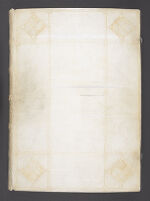
Binding: Post-1600. Whittawed leather, blind-ruled and -stamped (squares with foliate motifs in the corners of the upper and lower covers), featuring two metal clasps attached to rope cords, by W. H. Smith and Son; the spine inscribed in gold at the British Museum: ‘PSALTERIUM DAVIDIS’.
- Custodial History:
-
Origin: ?Canterbury, Southeastern England.
Provenance:
Ralph (fl. 4th quarter of the 12th century), uncle of Abbot Roger I (r. 1175-1213), owned in the late 12th century: donated this manuscript, together with 20 other manuscripts, to the Benedictine abbey of St Augustine, Canterbury (see Emden, Donors (1968), p. 15).
The Benedictine abbey of St Augustine, Canterbury; its pressmark ‘Psalterium Radulphi Glosatum / d·ij· gradij· j’, added in a 15th- or 16th-century script on f. 211v; no. 71 in its library catalogue, compiled between 1375 and 1420 and transcribed between 1474 and 1497 (see St Augustine's Abbey, Canterbury, ed. by Barker-Benfield (2008), pp. 396-97); perhaps added marginal annotations in a 12th- or 13th-century script (ff. 49r, 205v-206r).
Christopher Materas, owned in the 15th or 16th century: his ownership inscription ‘Liber Christophori Materas’, added in a 15th- or 16th-century script on f. 211v.
An unknown English owner, in the 15th or 16th century: added an English annotation in the margin of f. 199v (‘thes be the hartychell’) in a 15th- or 16th-century script.
An unknown owner, in the 17th or 18th century: added a Latin marginal annotation on f. 126r in a 17th- or 18th-century script.
? Ludwig Rosenthal (b. 1840, d. 1928), art and book collector at Munich; his name in a pencil note on the inside of the upper cover next to St John Hornby’s ownership note: ‘L. Rosenthal / Binding (?) Watson’.
Charles Harry St. John Hornby (b. 1867, d. 1946), from 1911 onwards: purchased the manuscript from Rosenthal in 1911 for £62.0.0. Rebound for Hornby, a director of W. H. Smith and Son, by that firm, for £5.10.3 (see his pencil note on the inside of the upper cover). His bookplate pasted on the inside of the upper cover: ‘FROM THE LIBRARY OF C. H. Sr JOHN HORNBY SHELLEY HOUSE, CHELSEA’; his note about the manuscript on f. ii recto.
Eric George Millar (b. 1887, d. 1966), librarian: purchased by him from Hornby's executors in 1946; his ownership note on a paper pasted on the inside of the front cover (‘FROM THE LIBRARY OF ERIC GEORGE MILLAR’); a note on paper (f. iii) by Sir Sydney Carlyle Cockerell (b. 1872, d. 1962), museum director and book collector, addressed to Millar, about Hornby’s sale of the manuscript (valued at £70.0.0), dated 18 augustus 1946; bequeathed by him to the British Museum in 1966 (see vol. 3 of the Millar Bequest).
- Information About Copies:
-
Full digital coverage available for this manuscript: see Digitised Manuscripts at http://www.bl.uk/manuscripts/.
- Publications:
-
Derek Howard Turner and others, 'The Eric Millar Bequest to the Department of Manuscripts', The British Museum Quarterly, 33:1/2 (1968), 16-52 (pp. 18-19, pl. 6).
Alfred Brotherston Emden, Donors of Books to S. Augustine's Abbey Canterbury (Oxford: Oxford Bibliographical Society, Bodleian Library, 1968), p. 15.
Walter Cahn, 'St. Albans and the Channel Style in England', in The Year 1200: A Symposium (New York: Metropolitan Museum of Art, 1975), pp. 187-230 (p. 207 n. 60).
Medieval Libraries of Great Britain: A List of Surviving Books, Supplement to the Second Edition, ed. by Neil Ripley Ker and Andrew G. Watson, Royal Historical Society Guides and Handbooks, 15 (London: Royal Historical Society, 1987), p. 12.
The British Library Catalogue of Additions to the Manuscripts, New Series 1966-1970, 2 vols (London: The British Library, 1998), I: Descriptions, p. 79.
Christopher de Hamel, Glossed Books of the Bible and the Origins of the Paris Booktrade (Woodbridge: Brewer, 1984), pp. 12-13.
Susanne Wittekind, ‘Verum etiam sub alia forma depingere: Illuminierte Psalmenkommentare und ihr Gebrauch’, in The Illuminated Psalter: Studies in the Content, Purpose and Placement of Its Images, ed. by Frank O. Büttner (Turnhout: Brepols, 2004), pp. 271-280 (p. 279 n. 59).
St Augustine's Abbey, Canterbury, ed. by Bruce C. Barker-Benfield, Corpus of British Medieval Library Catalogues, 13, 3 vols (London: The British Library, 2008), I: Introduction, The Catalogue, First Part, pp. 396-97.
Laura Cleaver, 'The Many Faces of Peter Lombard: Changing Perceptions of a Master in Images Made Between 1150 and 1215', in Spiritual Temporalities in Late-Medieval Europe, ed. by Michael Foster (Cambridge: Cambridge Scholars Publishing, 2010), pp. 33-56 (p. 41).
- Material Type:
- Archives and Manuscripts
- Legal Status:
- Not Public Record(s)
- Notes:
- This manuscript is part of The Polonsky Foundation England and France Project: Manuscripts from the British Library and the Bibliothèque nationale de France, 700-1200.