Hard-coded id of currently selected item: . JSON version of its record is available from Blacklight on e.g. ??
Metadata associated with selected item should appear here...
Kings MS 5
- Record Id:
- 040-002016921
- Hierarchy Root Ancestor Record Id:
- 032-002016915
- MDARK:
- ark:/81055/vdc_100000001207.0x0002cf
- LARK:
- ark:/81055/vdc_100165170777.0x000001
- SLARK:
- Format:
- ISAD(G)
- Reference (shelfmark):
- Kings MS 5
- Title:
- Biblia Pauperum
- Scope & Content:
-
Biblia Pauperum, a picture Bible including a series of images of the life of Christ with Old Testament prefigurations, with three miniatures on every recto. Each miniature of the Christological cycle is accompanied by bust-length portraits of apostles and prophets holding scrolls and corresponds to typological miniatures.
The subjects depicted in the three miniatures are explained in short leonine hexameters beneath the central image from the Christological cycle, incipit: 'Unde versus vipera vim'. The prose text on each side of the typological miniatures is a paraphrase of relevant biblical excerpts, incipit: ‘Legitur in Gen. 2o capitulo'. Each verso includes a rubric relating to the central miniature.
Originally, the leaves of this manuscript were folded into three, with the sewing between the first and the second miniature, and rubrics announcing the subjects on verso of the first miniature, but the manuscript was rebound in its present oblong format with the leaves unfolded. This is the only known surviving manuscript in this format, and is also unique in its painted rather than pen and wash illustrations of the text.
Decoration:
93 miniatures in colours and gold. Text in red, blue or gold. Instructions to illuminators in Dutch on some versos. Underdrawings partly visible. The illustrations are attributed to the Master of the Hours of Margaret of Cleves.
The subjects of miniatures are:
f. 1r: Eve and the serpent; the Annunciation; Gideon's fleece soaked by dew.
f. 2r: Moses and the Burning Bush; the Nativity of Christ; the budding of Aaron's rod.
f. 3r: Abner visiting King David; the Adoration of the Magi; the Queen of Sheba presenting gifts to Solomon.
f. 4r: Rebekah sending Jacob away; the Flight into Egypt; David's wife, Michal, letting David down from a window.
f. 5r: Moses destroying the consecrated image of the calf; the infant Christ causing the idols to fall; the Ark of the Covenant causing Dagon to fall.
f. 6r: The repentance of David before the prophet Nathan; Mary Magdalene anointing Christ's feet; the healing of Miriam, the sister of Moses and Aaron, of her leprosy.
f. 7r: King Darius purifying the temple; the Expulsion of the traders from the Temple; Judas Maccabeus ordering the cleansing of the Temple.
f. 8r: Elisha reviving the Shunammite's son; the raising of Lazarus; the raising of the son of the widow by Elijah.
f. 9r: Judith with the head of Holofernes; the Entry into Jerusalem; the return of Elisha to the city.
f. 10r: The bringing of bread and wine by the high priest Melchizedek to Abraham; the Last Supper; the bestowing of manna from heaven.
f. 11r: The selling of Joseph; the selling of Christ by Judas; the selling of Joseph to Potiphar.
f. 12r: The murder of Abner by Joab; the Betrayal of Christ; Trypho's betrayal of the Jews.
f. 13r: The killing of the prophets; Christ before Pilate; Daniel's imprisonment.
f. 14r: The disrobing of Joseph by his brothers; the conspiracy to kill Christ; Absalom speaking to the people at the city gate (usurping David's kingdom).
f. 15r: The Drunkenness of Noah; the Mocking of Christ; children mocking the prophet Elisha.
f. 16r: Abraham and Isaac climbing Mount Moriah; Christ bearing the Cross with Veronica receiving the veil imprinted with the face of Christ; Elijah's and the widow holding two sticks in the form of a cross.
f. 17r: The Binding of Isaac; the Crucifixion; Moses lifting up the bronze Serpent.
f. 18r: The Creation of Eve; Longinus piercing the side of Christ; Moses striking the rock.
f. 19r: Joseph's brothers deceiving Jacob about what happened to Joseph; the Deposition of Christ in the tomb; Jonah thrown into the sea.
f. 20r: Samson carrying the gates of Gaza; the Resurrection; Jonah emerging from the whale.
f. 21r: David beheading Goliath with a sword; Christ's descent into Limbo (the Anastasis); Samson killing the lion.
f. 22r: Reuben grieving after failing to find Joseph in the well; the Holy Women at the Tomb; the Spouse (of the Song of Songs) seeking her Beloved.
f. 23r: Darius finding Daniel unhurt in the lion's den; Christ's appearance to Mary Magdalene ('Noli me tangere'); the Spouse with her Beloved.
f. 24r: Joseph revealing himself to his brothers; Christ appearing to his disciples; the killing of the fatted calf for the Prodigal Son.
f. 25r: Gideon's sacrifice; the Incredulity of Thomas; Jacob wresting with the angel.
f. 26r: The Ascension of Enoch; the Ascension of Christ; Elijah ascending to heaven in a chariot.
f. 27r: Moses receiving the Tables of the Law; the Pentecost; Elijah's sacrifice.
f. 28r: The crowning of Bathsheba; the Coronation of the Virgin; the Coronation of Esther.
f. 29r: The Judgement of Solomon; the Last Judgement; David's order to kill the Amalekite.
f. 30r: Job feasting with his children; the Joys of the Blessed in Paradise; Jacob's dream of a ladder to heaven.
f. 31r: The earth swallowing Dathan and Abiram; the damned in hell; the destruction of Sodom and Gomorrah.
- Collection Area:
- Western Manuscripts
- Project / Collection:
- King's Manuscripts
- Hierarchy Record Ids:
- 032-002016915
040-002016921 - Is part of:
- Kings MS 1-446 : King's Manuscripts
Kings MS 5 : Biblia Pauperum - Hierarchy:
- 032-002016915[0004]/040-002016921
- Container:
- View / search within Archive / Collection: Kings MS 1-446
- Record Type (Level):
- File
- Extent:
-
1 volume
- Digitised Content:
- https://iiif.bl.uk/uv/#?manifest=https://bl.digirati.io/iiif/ark:/81055/vdc_100165170777.0x000001 (opens in a new tab)
- Thumbnail:
-
- Languages:
- Latin
- Scripts:
- Latin
- Start Date:
- 1390
- End Date:
- 1400
- Date Range:
- c 1395-1400
- Era:
- CE
- Access:
- Restrictions to access apply please consult British Library staff
- User Conditions:
- Letter of introduction required to view this manuscript
Please request the physical items you need using the online collection item request form.
Digitised items can be viewed online by clicking the thumbnail image or digitised content link.
Readers who have registered or renewed their pass since 21 March 2024 can request physical items prior to visiting the Library by completing
this request form.
Please enter the Reference (shelfmark) above on the request form.If your Reader Pass was issued before this date, you will need to visit the Library in London or Yorkshire to renew it before you can request items online. All manuscripts and archives must be consulted at the Library in London.
This catalogue record may describe a collection of items which cannot all be requested together. Please use the hierarchy viewer to navigate to individual items. Some items may be in use or restricted for other reasons. If you would like to check the availability, contact our Reference Services team, quoting the Reference (shelfmark) above.
- Physical Characteristics:
-
Materials: Parchment.
Dimensions: 175 x 385 mm.
Foliation: ff. 31 (+ 4 unfoliated modern paper flyleaves: 2 at the beginning, and 2 at the end).
Script: Gothic.
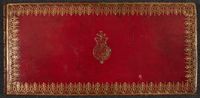
Binding: Post-1600. Gold-tooled red leather, stamped with the arms of George I or George II at the centre of both covers, probably middle of the 18th century; gilt edges.
- Custodial History:
-
Origin: Northern Netherlands (possibly The Hague).
Provenance:
?Margaret of Cleves (b. c. 1375, d. 1411), wife of Albrecht I, Duke of Bavaria and Count of Holland.
Alexander Radclyff, 16th century: inscribed 'alexander Radclyff boke' (f. 1v).
Inscription, 16th-century: 'EH' (f. 17v).
King George III (b. 1738, d. 1820): his royal coat of arms stamped on the covers.
Given to the British Museum by King George IV in 1823 as part of the library of King George III (known as the 'King's Library').
- Information About Copies:
-
Full digital coverage available for this manuscript, see Digitised Manuscripts http://www.bl.uk/manuscripts/.
Select digital coverage available for this manuscript, see Catalogue of Illuminated Manuscripts http://www.bl.uk/catalogues/illuminatedmanuscripts/welcome.htm.
Facsimile with commentary: Biblia Pauperum: King’s MS 5, British Library, London, 2 vols (Lucerne: Faksimile Verlag Luzern, 1993-94), vol. 1, Facsimile; vol. 2, Commentary in English, French and German, by Janet Backhouse, James H. Marrow and Gerhard Schmidt.
- Publications:
-
Walter de Gray Birch and Henry Jenner, Early Drawings and Illuminations: An Introduction to the Study of Illustrated Manuscripts (London: Bagster and Sons, 1879), p. 9.
Edward Maunde Thompson, 'On a Manuscript of the "Biblia Pauperum"', Bibliographica, 3 (1897), 385-406.
J.A. Herbert, Illuminated Manuscripts (London: Methuen, 1911), p. 308.
George F. Warner and Julius P. Gilson, Catalogue of Western Manuscripts in the Old Royal and King’s Collections, 4 vols (London: British Museum, 1921), III: Description of the King’s Manuscripts and Indexes to both Collections, pp. 2-3.
John Henrik Cornell, Biblia Pauperum: A Description and Discussion of the Various MSS. with Facsimiles (Stockholm: [n. pub.], 1925), pp. III, 168-70, pl. 70, and passim.
Charles L. Kuhn, 'Herman Scheerre and English Illumination of the Early Fifteenth Century', Art Bulletin, 22 (1940), 138-56 (p. 144, fig. 34).
L.M.J. Delaissé, A Century of Dutch Manuscript Illumination (Berkeley: University of California Press, 1968), p. 18, figs 113-14.
Janet Backhouse, The Illuminated Manuscript (Oxford: Phaidon, 1979), p. 60, fig. 50.
Adrian Wilson and Joyce Lancaster Wilson, A Medieval Mirror: Speculum humanae salvationis, 1324-1500 (Berkeley: University of California Press, 1984), pl. IV-1 following p. 100.
Sandra L. Hindman, ‘Dutch Manuscript Illumination around 1400: Some Cuttings in Darmstadt (MS 2296),’ in Miscellanea Neerlandica: opstellen voor Dr Jan Deschamps ter gelegenheid van zijn zeventigste verjaardag, ed. by Elly Cockx-Indestege and Frans Hendrickx, 3 vols (Louvain: Peeters, 1987), I, 419-40 (p. 429, nn. 15, 16, p. 436 n. 25).
James H. Marrow, ‘Prolegomena to a New Descriptive Catalogue of Dutch Illuminated Manuscripts,’ in Miscellanea Neerlandica: opstellen voor Dr Jan Deschamps ter gelegenheid van zijn zeventigste verjaardag, Elly Cockx-Indestege and Frans Hendrickx, 3 vols (Louvain: Peeters, 1987), I, 295-309 (p. 296 n. 3, p. 298 n. 10).
The Golden Age of Dutch Manuscript Painting (New York: Braziller, 1990), no. 2, pl. I. 2 [exhibition catalogue].
J.P. Gumbert, The Dutch and their Books in the Manuscript Age, The Panizzi Lectures, 1989 (London: British Library, 1990), p. 85 n. 49.
Marta O. Renger, ‘Some Distinctive Utrecht Workshop Procedures around 1400’, in Masters and Miniatures: Proceedings of the Congress on Medieval Manuscript Illumination in the Northern Netherlands,Utrecht, 10-13 December 1989, ed. by Koert van der Horst and Johann-Christian Klamt (Doornspijk: Davaco, 1991), pp. 315-26 (pp. 316-18, pls 5, 14).
W.C.M. Wüstefeld, Middeleeuwse Boeken van het Catharijneconvent (Zwolle: Waanders, c. 1993), p. 220, n. 11.
Biblia Pauperum: King’s MS 5, British Library, London, 2 vols (Lucerne: Faksimile Verlag Luzern, 1993-94), vol. 1, Facsimile; vol. 2, Commentary in English, French and German, by Janet Backhouse, James H. Marrow and Gerhard Schmidt.
Dorine Proske-Van Heerdt, 'Realism at the Cradle of Illumination in the Northern Netherlands', in Flanders in a European Perspective: Manuscripts Illumination Around 1400 in Flanders and Abroad, Proceedings of the International Colloquium, Leuven, 7-10 September 1993, ed. by Maurits Smeyers and Bert Cardon, Corpus of Illuminated Manuscripts/Corpus van verluchte handschriften, 8 (Leuven: Peeters, 1995), pp. 111-26 (pp. 114,-15, 117, 122 fig. 2).
Janet Backhouse, The Illuminated Page: Ten Centuries of Manuscript Painting in the British Library (London: British Library, 1997), no. 120.
Pamela Porter, Medieval Warfare in Manuscripts (London: British Library, 2000), pp. 24, 26.
Michelle Brown, The Holkham Bible: A Facsimile (London, British Library, 2007), p. 14, pl. 8.
Deirdre Jackson, Marvellous to Behold: Miracles in Medieval Manuscripts (London: British Library, 2007), pl. 27.
Scot McKendrick and Kathleen Doyle, Bible Manuscripts: 1400 Years of Scribes and Scripture (London: British Library, 2007), pp. 140-41, fig. 127.
Margaret Scott, Medieval Dress & Fashion (London: British Library, 2007), p. 120, pl. 72.
- Exhibitions:
- Johan Maelwael, Rijksmuseum, Amsterdam, October 6 2017 - January 7 2018
- Material Type:
- Archives and Manuscripts
- Legal Status:
- Not Public Record(s)