Hard-coded id of currently selected item: . JSON version of its record is available from Blacklight on e.g. ??
Metadata associated with selected item should appear here...
Add MS 33241
- Record Id:
- 040-002027405
- Hierarchy Root Ancestor Record Id:
- 032-002027404
- MDARK:
- ark:/81055/vdc_100000001484.0x000378
- LARK:
- ark:/81055/vdc_100055997590.0x000001
- SLARK:
- Format:
- ISAD(G)
- Reference (shelfmark):
- Add MS 33241
- Title:
- Encomium Emmae reginae
- Scope & Content:
-
This manuscript contains an account praising Emma (d. 1052), the second consort of both Æthelred II (d. 1016), king of England, and Cnut (d. 1035), king of England, Denmark and Norway. The work was composed by a Flemish monk at Emma's behest. This manuscript also contains an image of the author presenting his work to Emma while her sons Harthacnut (d. 1042) and Edward the Confessor (d. 1066) look on.
This manuscript was previously thought to be the only surviving copy of the Encomium Emmae Reginae (Praise of Queen Emma) until another copy, containing the unique Edwardian recension of the text, was identified in Copenhagen, Royal Library, Acc. 2011/5 in 2008. The two copies are largely the same, except for their endings (see Bolton, 'A Newly Emergent Mediaeval Manuscript' (2009)).
Contents:
ff. 2r-67r: Encomium Emmae Reginae.
[f. 67v is blank].
Decoration:
1 full-page miniature showing the Encomiast presenting his work to Emma (f. 1v). Coloured initials throughout.
- Collection Area:
- Western Manuscripts
- Project / Collection:
- Additional Manuscripts
England and France 700-1200 Project - Hierarchy Record Ids:
- 032-002027404
040-002027405 - Is part of:
- Add MS 33241-33269 : Hamilton Manuscripts
Add MS 33241 : Encomium Emmae reginae - Hierarchy:
- 032-002027404[0001]/040-002027405
- Container:
- View / search within Archive / Collection: Add MS 33241-33269
- Record Type (Level):
- File
- Extent:
-
A parchment codex
- Digitised Content:
- https://iiif.bl.uk/uv/#?manifest=https://bl.digirati.io/iiif/ark:/81055/vdc_100055997590.0x000001 (opens in a new tab)
- Thumbnail:
-
- Languages:
- Latin
- Scripts:
- Latin
- Start Date:
- 1000
- End Date:
- 1099
- Date Range:
- 11th century
- Era:
- CE
- Access:
- User Conditions:
- Letter of introduction required to view this manuscript
Please request the physical items you need using the online collection item request form.
Digitised items can be viewed online by clicking the thumbnail image or digitised content link.
Readers who have registered or renewed their pass since 21 March 2024 can request physical items prior to visiting the Library by completing
this request form.
Please enter the Reference (shelfmark) above on the request form.If your Reader Pass was issued before this date, you will need to visit the Library in London or Yorkshire to renew it before you can request items online. All manuscripts and archives must be consulted at the Library in London.
This catalogue record may describe a collection of items which cannot all be requested together. Please use the hierarchy viewer to navigate to individual items. Some items may be in use or restricted for other reasons. If you would like to check the availability, contact our Reference Services team, quoting the Reference (shelfmark) above.
- Physical Characteristics:
-
Materials: Parchment.
Dimensions: 175 x 110 mm (text space: 135 x 75 mm).
Foliation: ff. 67 (+ 5 unfoliated modern paper fly leaves at the beginning + 7 at the end).
Script: Caroline minuscule.
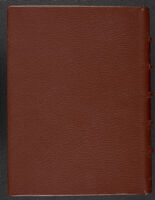
Binding: British Museum/British Library in-house: rebound in 1978. Brown leather binding, the spine inscribed in gold at the British Museum: 'GESTA CNUTONIS'.
- Custodial History:
-
Origin: ? Saint-Omer, ? Northern France or ? England.
Provenance:
? Saint-Omer, Northern France or England: The manuscript may have been copied shortly after the text was composed in the mid-11th century. There were two scribes: the first scribe was responsible for the drawing, ff. 2r-5r, and ff. 8r-41r; the second scribe copied ff. 5r-7v, 41r-67r (Keynes, 'Introduction' (1998), p. xli). It is unclear whether this manuscript was created on the Continent or in England (Keynes, 'Introduction' (1998), p. xliv).
? Emma [Ælfgifu] (d. 1052), queen of England: the image at the beginning of the text might suggest this manuscript was a presentation copy made for her, but this is not certain (see Keynes, 'Introduction' (1998), p. xlv).
The Benedictine abbey of St Augustine (St Augustine's Abbey), Canterbury, founded in 598: inscribed with its pressmark and ownership inscription on f. 1r: 'Gesta Cnutonis [...] Lib[er] S[an]c[t]i Aug[ustini] Cant' (see Ker, Medieval Libraries (1964), p. 40).
Unknown 15th- and 16th century owners: their marginal notes inscribed in 15th- and 16th-century scripts.
Thomas Talbot (b. c. 1535, d. c. 1595), antiquary: copied the text (now Aberystwyth, National Library of Wales, Hengwrt 158 [Peniarth 281]).
Alexander Douglas Hamilton (b. 1767, d. 1852), 10th duke of Hamilton and 7th duke of Brandon: owned by 1819 (see Clarke, Repertorium Bibliographicum (1819), pp. 259-60).
Berlin, Königliche Bibliothek (now Staatsbibliothek zu Berlin): bought in 1882 (see Campbell, Encomium (1998), p. xii): purchased by the British Museum in 1887 via Dr. Lippmann (according to a note on the flyleaf), together with other manuscripts from Hamilton's collection held at the Königliche Bibliothek, for £1,000.
- Information About Copies:
- Full digital coverage available for this manuscript: see Digitised Manuscripts at http://www.bl.uk.manuscripts/.
- Publications:
-
William Clarke, Repertorium Bibliographicum (London: Clarke, 1819), pp. 259-60.
N. R. Ker, Medieval Libraries of Great Britain: A List of Surviving Books, 2nd edn (Oxford: Clarendon Press, 1964), p. 40.
Pauline Stafford, Queen Emma and Queen Edith: Queenship and Women’s Power in Eleventh-Century England (Oxford: Blackwell, 1997), pp. 28-40.
Encomium Emmae Reginae, ed. and trans. by A. Campbell, with introduction by Simon Keynes (Cambridge: Cambridge University Press, 1998).
Andy Orchard, ‘Literary background to the Encomium Emmae Reginae’, Journal of Medieval Latin, 11 (2001), 156-83.
Elizabeth M. Tyler, ‘Talking about History in Eleventh-Century England: The Encomium Emmae Reginae and the Court of Harthacnut’, Early Medieval Europe, 13 (2005), 359-83.
Timothy Bolton, ‘A Newly Emergent Mediaeval Manuscript Containing Encomium Emmae Reginae with the Only Known Complete Text of the Recension Prepared for King Edward the Confessor’, Mediaeval Studies, 19 (2009), 205-21.
Kathleen Doyle and Charlotte Denoël, Medieval Illumination: Manuscript Art in England and France 700-1200 (London: British Library, 2018), also published as Enluminures Médiévales: Chefs-d'oeuvre de la Bibliothèque nationale de France et de la British Library, 700-1200 (Paris : BnF Éditions, 2018), p. 164.
Anglo-Saxon Kingdoms: Art, Word, War, ed. by Claire Breay and Joanna Story (London: The British Library, 2018), no. 149 [exhibition catalogue].
- Exhibitions:
- Anglo-Saxon Kingdoms: Art, Word, War, British Library, London, 19 October 2018 - 19 February 2019
- Material Type:
- Archives and Manuscripts
- Legal Status:
- Not Public Record(s)
- Notes:
-
This manuscript is part of The Polonsky Foundation England and France Project: Manuscripts from the British Library and the Bibliothèque nationale de France, 700-1200.