Hard-coded id of currently selected item: . JSON version of its record is available from Blacklight on e.g. ??
Metadata associated with selected item should appear here...
Arundel MS 157
- Record Id:
- 040-002039440
- Hierarchy Root Ancestor Record Id:
- 032-002039280
- MDARK:
- ark:/81055/vdc_100000000395.0x0002ad
- LARK:
- ark:/81055/vdc_100056004752.0x000001
- SLARK:
- Format:
- ISAD(G)
- Reference (shelfmark):
- Arundel MS 157
- Title:
- The Book of Psalms, Psalter of the Virgin Mary, and Little Office of the Virgin Mary
- Scope & Content:
-
This English manuscript is an early example of a Psalter with the Hours of the Virgin Mary attached (see Donovan, The de Brailes Hours (1991), p. 201 (no. 2). p. 201). The manuscript’s origin is unknown, but probably has a connection with Oxford since its Calendar contains three feasts of St Frideswide (d. 727): the latter was abbess at Oxford and venerated there as local saint by the 10th century; her relics were discovered and elevated in 1180 and preserved at the Augustinian Priory of St Frideswide at Oxford. The manuscript also contains the ‘Psalter of the Virgin Mary’ that has been attributed to St Anselm (b. c. 1033, d. 1109), abbot of Bec and archbishop of Canterbury. This relatively rare attribution can also be found in the 13th century Oscott Psalter (Add MS 50000) which has also been associated with Oxford because of its inclusion of St Frideswide in its Litany of Saints.
Contents:
ff. 1v-2r: A prayer to the Veil of Veronica (Sudarium), with indulgences, beginning: ‘Hec oracia composita est in honore effigiei vultus de Dominici que Rome habita Veronica nuncupatur’.
ff. 3r-12v: Two-panel pages with scenes from the life of Christ.
ff. 13r-18v: A Calendar of Saints, including feasts for the English saints Edward the Confessor, Cuthbert, Ælfheah of Canterbury, Dunstan, Augustine of Canterbury, Botwulf of Thorney, Alban, Etheldreda, Mildrith, Kenelm, Edward the Martyr, Neot, Oswald, Thomas of Canterbury, Ethelburga, Frideswide, and Thomas of Canterbury [features Anglo-Norman captions for the roundels with the Labours of the Months].
ff. 19r-116r: The Book of Psalms.
ff. 116r-124r: Canticles: Confitebor tibi (Isaiah), Ego dixi (Ezekiel), Exultavit cor meum (Anne), Cantemus domino gloriose (Moses), Domine audivi (Habakkuk), Audite celi (Moses), Te deum (St Ambrose), Benedicite (Three Holy Children), Benedictus (Zechariah), Magnificat (Virgin Mary), Nunc dimittis (Simeon).
ff. 124r-126v: Gloria in excelsis Deo (Angelic Hymn), Pater noster (Lord’s Prayer), Symbolum Apostolorum (Apostles’ Creed), Quicumque Vult (Athanasian Creed).
ff. 126v-128v: A Litany of Saints, including the English saints Edmund the Martyr, Thomas of Canterbury, Alban, Augustine of Canterbury, Cuthbert, Cedd, and Swithun.
ff. 126v-131r: Prayers for sinners, the congregation, benefactors, peace, against temptations, for Christian souls, family members, the Father, Son and Holy Spirit.
ff. 132r-145v: The Office of the Dead.
ff. 146r-159r: Pseudo-Anselm of Canterbury, Psalterium Beate Marie (The Psalter of the Virgin Mary): a poem, also known as Ave porta paradysi, in which a verse from each of the 150 Psalms alternates with a Marian verse salutation of four lines, beginning: ‘Incipit psalterium beate marie virginis editum a sancto anselmo archipiscopo cantuariensi’.
ff. 159v-185r: The Little Office of the Virgin Mary, containing collects for the Virgin Mary, the Trinity, the Holy Cross, and saints Michael the Archangel, John the Baptist, Peter, Andrew, James the Greater, Bartholomew, Thomas the Apostle, Stephen, Thomas of Canterbury, Lawrence, Edmund the Martyr, Vincent, Leodegar, George, Blaise, Eustace, Nicholas, Augustine of Hippo, Dunstan, Giles, Leonard, Anne, Mary Magdalene, Katherine of Alexandria, Margaret of Antioch, Agnes, Radegund, and Frideswide.
[ff. 1r, [1a] recto, [1a] verso, 2v, [2a] recto, [2a] verso, [3a] recto, [3a] verso, [4a] recto, [4a] verso, [5a] recto, [5a] verso, [6a] recto, [6a] verso, [7a] recto, [7a] verso, [8a] recto, [8a] verso, [9a] recto, [9a] verso, [10a] recto, [10a] verso, [11a] recto, [11a] verso, [12a] recto, [12a] verso, 19v, 20r, [34a] recto, [34a] verso, [43a] recto, [43a] verso, [51a] recto, [51] verso, [60a] recto, [60a] verso, [71a] recto, [71a] verso, [81a] recto, [81a] verso, [82a] recto, [82a] verso, [92a] recto, [92a] verso, [115a] recto, [115] verso, 131v, and 185v are blank].
Decoration:
20 full-page two-panel miniatures in colours and gold with frames in colours (see also Morgan, Early Gothic Manuscripts, I (1982), pp. 72-73 (no. 24)):
f. 3r: The Annunciation; and Visitation.
f. 3v: The Nativity; and the Annunciation to the Shepherds.
f. 4r: The Magi before Herod; and Adoration of the Magi.
f. 4v: The Dream of the Magi; and Presentation in the Temple.
f. 5r: The Flight into Egypt; and Massacre of the Innocents.
f. 5v: The Baptism; and First Temptation.
f. 6r: The Second Temptation; and Third Temptation.
f. 6v: The Marriage at Cana; and Expulsion from the Temple.
f. 7r: The Feast of Herod, Beheading of John the Baptist; and Feeding of the Five Thousand.
f. 7v: Christ walking on water; and the Transfiguration.
f. 8r: The Raising of Lazarus; The meal at the house of Lazarus.
f. 8v: The Entry into Jerusalem; The Last Supper.
f. 9r: The Washing of the Feet; Christ waking the Apostles in the Garden of Gethsemane.
f. 9v: The Betrayal of Judas; Peter’s Denial and Trial of Christ.
f. 10r: Judas leaves the High Priest and hangs himself; and the Flagellation.
f. 10v: The Crucifixion; and Deposition.
f. 11r: The Harrowing of Hell; and lamenting women at the Tomb.
f. 11v: Christ appears to Mary Magdalene (‘Noli me tangere’); and the Supper at Emmaus.
f. 12r: Doubting Thomas; and the Ascension.
f. 12v: Pentecost; Christ in Majesty.
1 half-page miniature of the Veil of Veronica in colours and gold (f. 2r); perhaps the earliest extant image of the Veronica (Morgan, Early Gothic Manuscripts, I (1982), p. 73). Some scholars have argued that the miniature was executed by Matthew Paris (b. c. 1200, d. 1259), historian, and Benedictine monk at St Albans Abbey (e.g. see Lewis, The Art of Matthew Paris (1987), pp. 29, 127-9, 381, 419, 420, 426, 441, 471, 489 n. 199, pl. 5); Morgan, however, noted that its style and iconography differ significantly from Paris’s work (see Morgan, ‘“Veronica” Images’ (2018), pp. 84-101). The manuscript perhaps was produced by a workshop that was active at the beginning of the 13th century and whose work survives in a number of luxury Psalters: the manuscript’s scenes of the life of Christ, for example, were executed by the same artist as the so-called ‘Munich Psalter’ (Munich, Bayerische Staatsbibliothek, Clm. 835).
24 roundels with the Labours of the Months and the Signs of the Zodiac in colours and frames in gold (ff. 13r-18v).
1 large full-page initial ‘B’ for Psalm 1 (Beatus Vir) in colours and gold, with interlace inhabited by white lions, a frame in colours with four medallions at the corners: David rescuing the lamb from the lion; the Anointing of David; David casting a stone from his sling at Goliath; David beheading Goliath. 10 large historiated initials in colours in frames with colours and gold (some featuring hybrid figures): 9 at the other major divisions of the Psalter; and 1 at the first of the Canticles:
f. 34v: The Anointing of David (Psalm 26).
f. 43v: The Judgement of Solomon (Psalm 38).
f. 51v: Doeg beheading the priests (Psalm 51).
f. 52r: The Temptation of Christ (Psalm 52).
f. 60v: Christ between Peter and Paul; a man in the water between two devils (Psalm 68).
f. 71v: Five musicians (Psalm 80).
f. 82r: The Nativity (Psalm 97).
f. 83r: Woman with a halo holding a chalice and a host, and Christ blessing (Psalm 101).
f. 93r: The Trinity (Psalm 109).
f. 116r: The Martyrdom of Isaiah (Confitebor).
13 medium historiated initials in colours in frames with colours and gold for the Canticles, Pater noster and Apostles’ Creed:
f. 116v: Isaiah with the sick Hezekiah (Ego dixi).
f. 117r: Hannah standing (Exultavit cor meum).
f. 117r: Moses holding the tables of the Law (Cantemus domino)
f. 118v: Habakkuk standing (Domine audivi).
f. 119v: Moses seated with a scroll (Audite celi).
f. 122r: St Ambrose (Te deum).
f. 122v: The Three Hebrews in the Fiery Furnace (Benedicite).
f. 123v: Zacharias standing (Benedictus).
f. 124r: The Virgin seated (Magnificat).
f. 124r: Simeon standing (Nunc dimittis).
f. 124v: The Annunciation to the Shepherds (Gloria in excelsis Deo).
f. 124v: Christ blessing (Pater Noster).
f. 124v: The Virgin and the Apostles (Symbolum Apostolorum).
Numerous medium initials in colours or gold, with or without frames in gold or colours; some have been decorated with ornamental motifs: foliate interlace inhabited by anthropomorphic, hybrid and zoomorphic figures; others have been decorated only with anthropomorphic, hybrid figures or zoomorphic figures and heads. The latter sometimes contain biblical figures and scenes: e.g. the Virgin Mary (f. 130v); 12 medium ‘KL’ initials in gold in blue and purple frames ('champ' initials) in the Calendar (ff. 13r-18v); 1 medium gold initial with red pen-flourishing (f. 163v); numerous small initials alternating between blue and red for Calendar entries and verses; or between blue and gold; the latter with red or green penwork decoration and pen-flourishing (only on ff. 146r-158v).
Display script in gold capitals against a purple or blue background at the major Psalm divisions. Rubrics in red. Line-fillers alternating between red and blue, featuring anthropomorphic, hybrid and zoomorphic figures (ff. 20v-131r). Paraph markers alternating between red and blue. Roman numerals in red and blue in the Calendar.
- Collection Area:
- Western Manuscripts
- Project / Collection:
- Arundel Manuscripts
England and France 700-1200 Project - Hierarchy Record Ids:
- 032-002039280
040-002039440 - Is part of:
- Arundel MS 1-550 : Arundel Manuscripts
Arundel MS 157 : The Book of Psalms, Psalter of the Virgin Mary, and Little Office of the Virgin Mary - Hierarchy:
- 032-002039280[0158]/040-002039440
- Container:
- View / search within Archive / Collection: Arundel MS 1-550
- Record Type (Level):
- File
- Extent:
-
A parchment codex
- Digitised Content:
- https://iiif.bl.uk/uv/#?manifest=https://bl.digirati.io/iiif/ark:/81055/vdc_100056004752.0x000001
- Thumbnail:
-
- Languages:
- Anglo-Norman
Latin - Scripts:
- Latin
- Start Date:
- 1200
- End Date:
- 1224
- Date Range:
- 1st quarter of the 13th century
- Era:
- CE
- Access:
-
Please request the physical items you need using the online collection item request form.
Digitised items can be viewed online by clicking the thumbnail image or digitised content link.
Readers who have registered or renewed their pass since 21 March 2024 can request physical items prior to visiting the Library by completing
this request form.
Please enter the Reference (shelfmark) above on the request form.If your Reader Pass was issued before this date, you will need to visit the Library in London or Yorkshire to renew it before you can request items online. All manuscripts and archives must be consulted at the Library in London.
This catalogue record may describe a collection of items which cannot all be requested together. Please use the hierarchy viewer to navigate to individual items. Some items may be in use or restricted for other reasons. If you would like to check the availability, contact our Reference Services team, quoting the Reference (shelfmark) above.
- User Conditions:
- Letter of introduction required to view this manuscript
- Physical Characteristics:
-
Materials: Parchment.
Foliation: ff. 185 ( + 3 modern paper flyleaves at the beginning + 3 at the end); 1 unfoliated modern paper leaf between f. 1 and f. 2 (f. [1a]); f. 2 and f. 3 (f. [2a]); f. 3 and f. 4 (f. [3a]); f. 4 and f. 5 (f. [4a]); f. 5 and f. 6 (f. [5a]); f. 7 and f. 8 (f. [7a]); f. 8 and f. 9 (f. [8a]); f. 9 and f. 10 (f. [9a]); f. 10 and f. 11 (f. [10a]); f. 11 and f. 12 (f. [11a]); f. 12 and f. 13 (f. [12a]); f. 34 and f. 35 (f. [34a]); f. 43 and f. 44 (f. [43a]); f. 51 and f. 52 (f. [51a]); f. 60 and f. 61 (f. [60a]); f. 71 and f. 72 (f. [71a]); f. 81 and f. 82 (f. [81a]); f. 82 and f. 83 (f. [82a]); f. 92 and f. 93 (f. [92a]); f. 115 and f. 116 (f. [115a]); 1 parchment stub between f. 131 and f. 132; 1 paper stub between f. 47 and f. 48; and 1 between f. 77 and f. 78; f. [i] recto has a paper pastedown (with bibliographical notes).
Dimensions: 295 x 200 mm (text space: 185 x 115 mm).
Script: Protogothic.
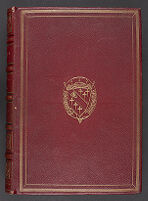
Binding: Post-1600. Gold-tooled red leather, Howard’s bookplate (‘BIBLIOTHECA ARUNDELIANA’) gold-stamped on the upper and lower covers, the spine inscribed in gold: ‘PSALTERIUM’; red speckled foredge.
- Custodial History:
-
Origin: ?Oxford, Southeastern England.
Provenance:
? The Augustinian Priory of St Frideswide at Oxford: the Calendar contains three feasts of St Frideswide (12 February, 15 May, 19 October); the Little Office of the Virgin Mary contains a collect for St Frideswide (f. 173r). St Frideswide’s relics were kept at the priory of St Frideswide, and she is the patron saint of Oxford. St Augustine is the first of the Confessors in the Litany. The feast of the Translation of St Frideswide’s relics (f. 13v) provides a terminus post quem of 1180; the absence of the feast for the Translation of St Thomas Becket a terminus ante quem of 1220. The Calendar also contains the feast for the Translation of St Edward the Confessor, commanded in 1222, but has been added by a different hand (see Scott-Fleming, The Analysis of Pen Flourishing (1989), p. 86).
A ?16th-century owner: removed the word ‘pape’ in the Calendar (e.g. f. 13r).
‘Captain B[...]ee’, owned in 1658: according to a 17th-century inscription on f. 1r, signed by a certain ‘S. Heveningham’.
Henry Howard (b. 1628, d. 1684), 6th duke of Norfolk: bought for him in 1658, inscribed 'This book was bought of Capt[ain] B[...]ee by Mr. Simon Fox for the R[igh]t. Hon[oura]ble. Henry Howard. 23rd of March 1658' (f. 1r); presented to the Royal Society in 1667.
The Royal Society, London (its ink stamp: 'Soc. Reg. Lond / ex dono HENR. HOWARD / Norfolciensis.', f. 2r). Purchased by the British Museum from the Royal Society of London together with 549 other Arundel manuscripts in 1831.
- Information About Copies:
-
Full digital coverage available for this manuscript: see Digitised Manuscripts, https://bl.uk/manuscripts/.
Select digital coverage available for this manuscript; see the Catalogue of Illuminated Manuscripts, https://bl.uk/catalogues/illuminatedmanuscripts/.
- Publications:
-
Catalogue of Manuscripts in The British Museum, New Series, 1, 1 vol. in 2 parts (London: British Museum, 1834-1840), Part I (1834): The Arundel Manuscripts, p. 43.
Walter de Gray Birch and Henry Jenner, Early Drawings and Illuminations: An Introduction to the Study of Illustrated Manuscripts (London: Bagster, 1879), p. 6.
John Romilly Allen, Norman Sculpture and the Mediaeval Bestiaries: From the Rhind Lectures in Archaeology for 1885, Early Christian symbolism in Great Britain and Ireland before the Thirteenth Century, 3 (London: Whiting, 1887), pp. 294 n. 1, 304.
Schools of Illumination: Reproductions from Manuscripts in the British Museum, 6 vols (London: British Museum, 1914-1930), II (1915): English 12th and 13th Centuries, pl. 8.
John Bradley, Illuminated Manuscripts, 2nd edn (London: Bracken Books, 1920), p. 253 (no. 17).
[John Alexander Herbert], British Museum: Reproductions from Illuminated Manuscripts, Series 3, 3rd edn (London: British Museum, 1925), pl. 16.
Eric George Millar, English Illuminated Manuscripts from the Xth to the XIIIth Century (Paris: Van Oest, 1926), p. 45, pl. 66.
British Museum Guide to an Exhibition of English Art Gathered from Various Departments and Held in the Prints and Drawings Gallery1934 (London: Clowes, 1934), p. 36 (no. 107).
Günther Haseloff, Die Psalterillustration im 13. Jahrhundert: Studien zur Geschichte der Buchmalerei in England, Frankreich und den Niederlanden ([n. p.]: [n. pub.], 1938), pp. 14, 100-01 (Table 2, no. I).
David Talbot Rice, English Art 871-1100 (Oxford: Clarendon Press, 1952), p. 110.
Thomas Sherrer Ross Boase, English Art 1100-1216, Oxford History of English Art, 2 (Oxford: Clarendon Press, 1957), pp. 280-82, 290-91, pl. 91a.
Margaret Rickert, Painting in Britain: the Middle Ages, 2nd edn (London: Penguin Books, 1965), pp. 98-102, 234 n. 27, 32, 33, pl. 98a.
Florens Deuchler, Der Ingeborgpsalter (Berlin: De Gruyter, 1967), pp. 8 n. 22, 43, 78, 92 n. 66, 164 n. 284.
The Year 1200: A Centennial Exhibition at The Metropolitan Museum of Art, February 12 through May 10, 1970, 2 vols, The Cloisters Studies in Medieval Art, 1-2 (New York: Metropolitan Museum of Art, 1970), I: The Exhibition, ed. by Konrad Hoffmann, pp. 261-62 (no. 260).
Henry B. Graham, ‘The Munich Psalter’, in The Year 1200: A Symposium (New York: Metropolitan Museum of Art, 1975), pp. 301-12 (p. 302).
Andrew G. Watson, Catalogue of Dated and Datable Manuscripts c. 700-1600 in The Department of Manuscripts: The British Library, 2 vols (London: British Library, 1979), I, p. 90 (no. 448), II, pl. 126.
Brunsdon Yapp, Birds in Medieval Manuscripts (London: British Library, 1981), p. 22.
Flora Lewis, 'The Veronica: Image, Legend and Viewer', in England in the Thirteenth Century: Proceedings of the 1984 Harlaxton Symposium, ed. by W. M. Ormrod (Woodbridge: Boydell, 1985), pp. 100-06 (p. 012, fig. 3).
Nigel Morgan, Early Gothic Manuscripts, 2 vols, A Survey of Manuscripts Illuminated in the British Isles, 4 (London: Miller, 1982-1988), I (1982): 1190-1250, pp. 72-73 (no. 24), pp. 49, 69, 77, 81, 89, 126, 178, 186, pls 88-92.
Helmut Engelhart, Die Würzburger Buchmalerei im Hohen Mittelalter: Untersuchungen zu einer Gruppe Illuminierter Handschriften aus der Werkstatt der Würzburger Dominikanerbibel von 1246, 2 vols, Quellen und Forschungen zur Geschichte des Bistums und Hochstifts Würzburg, 34 (Würzburg: Schöningh, 1987), I: Textband, pp. 32 n. 147, 92 n. 313, 231 n. 435, 304 n. 107, II: Abbildungen, pl. 286.
Suzanne Lewis, The Art of Matthew Paris in the Chronica Majora (Aldershot: Scolar Press, 1987), pp. 29, 127-29, 381, 419, 420, 426, 441, 471, 489 n. 199, pl. 5.
Judith H. Oliver, Gothic Manuscript Illumination in the Diocese of Liège (c. 1250 - c. 1330), Corpus of Illuminated Manuscripts from the Low Countries, 2-3, 2 vols (Leuven: Peeters, 1988), I, 40 n. 42.
Medieval Libraries of Great Britain: A List of Surviving Books, Supplement to the Second Edition, ed. by Neil Ripley Ker and Andrew G. Watson, Royal Historical Society Guides and Handbooks, 15 (London: Royal Historical Society, 1987), p. 52.
Sonia Scott-Fleming, The Analysis of Pen Flourishing in Thirteenth-Century Manuscripts (Leiden: Brill, 1989), p. 86.
Claire Donovan, The de Brailes Hours: Shaping the Book of Hours in Thirteenth-Century Oxford (London: British Library, 1991), p. 201 (no. 2).
Suzanne Lewis, Reading Images: Narrative Discourse and Reception in the Thirteenth-century Illuminated Apocalypse (Cambridge: Cambridge University Press, 1995), p. 293.
Walter Cahn, Romanesque Manuscripts: The Twelfth Century, 2 vols (London: Miller, 1996), II: Catalogue, p. 166.
Janet Backhouse, The Illuminated Page: Ten Centuries of Manuscript Painting in the British Library (Toronto: University of Toronto Press, 1997), p. 72 (no. 54).
Nigel Morgan, ‘The Decorative Ornament of the Text and Page in Thirteenth-century England: Initials, Border Extensions and Line Fillers’, in Decoration and Illustration in Medieval English Manuscripts, ed. by Anthony S. G. Edwards, English Manuscript Studies 1100-1700, 10 (London: British Library, 2002), pp. 1-33 (p. 13).
Claus Michael Kauffmann, Biblical Imagery in Medieval England 700-1500 (London: Miller, 2003), pp. 167, 173.
Frank O. Büttner, ‘Der illuminierte Psalter im Westen’, in The Illuminated Psalter: Studies in the Content, Purpose and Placement of its Images, ed. by Frank O. Büttner (Turnhout: Brepols, 2004), pp. 1-106 (p. 27 n. 125).
Nigel Morgan, ‘Patrons and their Devotions in the Historiated Initials and Full-Page Miniatures of 13th-Century English Psalters’, in The Illuminated Psalter: Studies in the Content, Purpose and Placement of its Images, ed. by Frank O. Büttner (Turnhout: Brepols, 2004), pp. 309-22 (p. 309 ns 1, 2, 3).
Richard W. Pfaff, The Liturgy in Medieval England: A History (Cambridge: Cambridge University Press, 2009), p. 276, n. 15.
Lucy Freeman Sandler, ‘The Lumere as lais and its Readers: Pictorial Evidence from British Library MS Royal 15 D ii’, in Thresholds of Medieval Visual Culture: Liminal Spaces, ed. by Elina Gertsman and Jill Stevenson (Woodbridge: Boydell, 2012), pp. 73-94 (p. 86).
Kathryn M. Rudy, Postcards on Parchment: The Social Lives of Medieval Books (New Haven: Yale University Press, 2015), pp. 45-46 (fig. 30).
Nigel Morgan, ‘“Veronica” Images and the Office of the Holy Face in Thirteenth-Century England’, in The European Fortune of the Roman Veronica in the Middle Ages, ed. by Amanda Murphy and others, Convivium Supplementum, 2 (Turnhout: Brepols, 2018), pp. 84–101.
Kathleen Doyle and Charlotte Denoël, Medieval Illumination: Manuscript Art in England and France 700-1200 (London: British Library, 2018), also published as Enluminures Médiévales: Chefs-d'oeuvre de la Bibliothèque nationale de France et de la British Library, 700-1200 (Paris : BnF Éditions, 2018), pp. 18. 26, 163.
- Material Type:
- Archives and Manuscripts
- Legal Status:
- Not Public Record(s)
- Notes:
- This manuscript is part of The Polonsky Foundation England and France Project: Manuscripts from the British Library and the Bibliothèque nationale de France, 700-1200.