Hard-coded id of currently selected item: . JSON version of its record is available from Blacklight on e.g. ??
Metadata associated with selected item should appear here...
Add MS 11983
- Record Id:
- 040-002041690
- Hierarchy Root Ancestor Record Id:
- 032-002041530
- MDARK:
- ark:/81055/vdc_100000000451.0x000246
- LARK:
- ark:/81055/vdc_100064356864.0x000001
- SLARK:
- Format:
- ISAD(G)
- Reference (shelfmark):
- Add MS 11983
- Title:
-
Seneca the Younger, De Clementia, Apocolocyntosis or Ludus de Morte Claudii, Proverbia, De Beneficiis; Publilius Syrus, Proverbia Senecae Secundum Ordinem Alphabeti; Ausonius, Versus de Duodecim Caesarum, Tetrasticha; Epitaphium Senecae; anonymous verses in praise of England; Marbod of Rennes, De Ornamentis Verborum; Hermes Trismegistus, Asclepius
- Scope & Content:
-
This manuscript from c. 1100 contains a collection of works by and related to Seneca the Younger (b. 4 BC, d. 65AD), together with those by Ausonius (b. c. 310, d. 395) and Marbod of Rennes (b. c. 1035, d. 1123).
Contents:
ff. 4r-21v: Seneca, De Clementia (On Mercy), beginning: ‘Scribere de clementia nero cesar constitui’.
ff. 21v-28v: Seneca, Apocolocyntosis (The Gourdification), also known as Ludus de Morte Claudii Caesaris (Play on the Death of Emperor Claudius), beginning: ‘Quid actum sit in celo’.
ff. 28v-36v: Publilius Syrus (fl. 1st century), Proverbia Senecae Secundum Ordinem Alphabeti (Proverbs of Seneca according to the Order of the Alphabet), beginning: ‘Alienum est omne quicquid optando evenit’.
ff. 36v-37r: Ausonius, Versus de Duodecim Caesarum (Poem on the Twelve Emperors), beginning: ‘Cesareos proceres in quorum regna secundis’.
ff. 37r-39r: Ausonius, Tetrasticha (Four Verses), beginning: ‘Nunc et predictos, et regni sorte sequentes’.
ff. 39r-39v: Epitaphium Senecae (Epitaph of Seneca), beginning: ‘Cura labor meritum’.
ff. 40r-43r: Seneca, Proverbia (Proverbs), beginning: ‘Non quid sed quem ad modum feras inter’.
ff. 43r-46v: Marbod of Rennes, De Ornamentis Verborum (On the Adornment of Words), beginning: ‘Versificaturo quedam tibi tradere curo’.
ff. 48r-70r: Seneca, De Beneficiis (On Benefits), beginning: ‘Cum sit in multis crimen’.
ff. 70v-84v: Hermes Trismegistus, Asclepius translated by Pseudo-Apuleius, with the rubric, 'Incipit ermii trismegiston de helena ad asclepium allocuta feliciter', beginning, ‘Asclepius iste pro sole mihi. Deus, deus te nobis, o Asclepi, ut diuino sermoni interesses adduxit..' (edition: De philosophia libri, III, ed. Thomas, Corpus Hermeticum, ed. A. D. Nock and A.-J. Festugiére, II (Paris, 1945), pp. 296-355).
The manuscript contains a number of later additions:
ff. 46v-47r: Verses in praise of England, beginning: ‘Venimus ad naves ascendere me prohibebat’. These include the lines ‘Anglia terra ferax’, etc., attributed by Trithemius (De scriptoribus ecclesiasticis liber unus, 1546) to Richard of Cluny (Scott, ‘Some Poems Attributed to Richard of Cluny’ (1976), pp. 185-93), added in the (?) 14th century.
f. 47r: A 14th-century inscription: ‘Grisarius est nomen illius divitis qui vocatur in evangelio lazarum’.
f. 85r: Latin notes from the 14th and 15th centuries, including a request for prayer: 'Orent andreas atque petrus iesum michi parcas'.
f. 1v: A table of contents, and mnemonic verses added in the 15th or 16th century.
f. 2v: Excerpts, also found in the work of the French scholar Étienne Baluze (b. 1630, d. 1718), known as Stephanus Baluzius, beginning 'Νec enim delicata ingenia multis verbis tenenda sunt', added in the (?) 15th or 16th century.
f. 3v: A table of contents, added in the 15th or 16th century ('Contenta'), followed by a verse, beginning: 'Cum sit veste niger animo niger iustus'.
[ff. 2r, 3r, 47v are blank].
Decoration:
7 large initials in red ink on ff. 4r, 18r, 21v, 28v, 40r, 43r, 48r. 3 large foliate initials in brown ink with red infill on ff. 53v, 61r, 63r. 1 large foliate initial in brown ink with red and green infill on f. 70v. Numerous small initials in red, and three small initials in black with foliate design (ff. 50r, 57r, 66v). Rubrics in red. Late medieval quire signatures.
- Collection Area:
- Western Manuscripts
- Project / Collection:
- Additional Manuscripts
England and France 700-1200 Project - Hierarchy Record Ids:
- 032-002041530
040-002041690 - Is part of:
- Add MS 11828-12117 : Collection belonging to the late Right Rev. Samuel Butler, D.D., Lord Bishop of Lichfield.
Add MS 11983 : Seneca the Younger, De Clementia, Apocolocyntosis or Ludus de Morte Claudii, Proverbia, De Beneficiis; Publilius Syrus,… - Hierarchy:
- 032-002041530[0154]/040-002041690
- Container:
- View / search within Archive / Collection: Add MS 11828-12117
- Record Type (Level):
- File
- Extent:
- A parchment codex
- Digitised Content:
- https://iiif.bl.uk/uv/#?manifest=https://bl.digirati.io/iiif/ark:/81055/vdc_100064356864.0x000001
- Thumbnail:
-
- Languages:
- Latin
- Scripts:
- Latin
- Start Date:
- 1070
- End Date:
- 1130
- Date Range:
- c 1075-c 1125
- Era:
- CE
- Access:
-
Please request the physical items you need using the online collection item request form.
Digitised items can be viewed online by clicking the thumbnail image or digitised content link.
Readers who have registered or renewed their pass since 21 March 2024 can request physical items prior to visiting the Library by completing
this request form.
Please enter the Reference (shelfmark) above on the request form.If your Reader Pass was issued before this date, you will need to visit the Library in London or Yorkshire to renew it before you can request items online. All manuscripts and archives must be consulted at the Library in London.
This catalogue record may describe a collection of items which cannot all be requested together. Please use the hierarchy viewer to navigate to individual items. Some items may be in use or restricted for other reasons. If you would like to check the availability, contact our Reference Services team, quoting the Reference (shelfmark) above.
- User Conditions:
- Letter of introduction required to view this manuscript
- Physical Characteristics:
-
Materials: Parchment.
Dimensions: 175 x 105mm (text space: 140 x 75mm).
Foliation: ff. 85 (+ 1 unfoliated parchment flyleaf at the beginning); f. 1 and f. 85 are parchment leaves pasted onto the insides of the upper and lower covers; ff. 1, 1*, 2, and 3 are early modern parchment leaves; 1 unfoliated parchment stub between f. 58 and f. 59; f. 61 and f. 62; f. 80 and f. 81; f. 81 and f. 82; and f. 82 and f. 83; 2 unfoliated parchment stubs between f. 3 and f. 4; and f. 84 and f. 85; 1 unfoliated modern paper with bibliographical notes between f. 84 and f. 85.
Script: Protogothic.
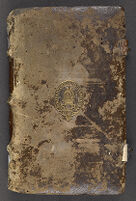
Binding: Pre-1600. Brown leather, with Samuel Butler's bookplate gold-stamped on the upper and lower covers; title plates on the spine, inscribed in gold at the British Museum: ‘Seneca et aliorum tractatus’. Metalwork clasps.
- Custodial History:
-
Origin: England or France.
‘Robertus Aiscogh’, owned in the 15th or 16th century: his name inscribed on f. 1v; perhaps also added the tables of contents and notes on ff. 1v, 3v, and 85r.
Samuel Butler (b. 1774, d. 1839), headmaster and bishop of Coventry and Lichfield, owned from 1816 onwards: his bookplate gold-stamped on the upper and lower binding (‘E·BIBLIOTHECA·BUTLERIANA’); his sale catalogue, 2 June, 1840, lot (?) 468 ['468' inscribed in pencil on f. 2r]; the sale did not take place because Butler’s son, Reverend Thomas Butler (b. 1806, d. 1886), clergyman and naturalist, sold Butler’s collection to Payne & Foss.
John Payne and Henry Foss (fl. 1825-1850), London booksellers: their sale, London, 5 July 1841, lot 335 (see the pencil note on f. 2r and Bibliotheca Butleriana: A Catalogue of the Library of the Late Right Rev. Samuel Butler, Etc (London: Payne & Foss, 1841), p. 23); purchased by the British Museum.
- Information About Copies:
- Full digital coverage available for this manuscript: see Digitised Manuscripts at http://www.bl.uk.manuscripts/.
- Publications:
-
Catalogue of Additions to the Manuscripts in the British Museum in the Years 1841-1845 (London: Woodfall, 1850), p. 23.
A. B. Scott, ‘Some Poems Attributed to Richard of Cluny’, in Medieval Learning and Literature: Essays Presented to Richard William Hunt, ed. by J. J. G. Alexander and Margaret T. Gibson (Oxford: Clarendon Press, 1976), pp. 181-99.
P. T. Eden, ‘The Manuscript Tradition of Seneca’s Apocolocyntosis’, Classical Quarterly, 29:1 (1979), 149-61.
Leighton Durham Reynolds, ‘The Younger Seneca’, in Texts and Transmission: A Survey of the Latin Classics, ed. by Leighton Durham Reynolds (Oxford: Clarendon Press, 1983), pp. 357-81 (pp. 359 n. 9, 361-62, 364-65, 367-68).
M. D. Reeve, ‘Publilius’, in Texts and Transmission: A Survey of the Latin Classics, ed. by Leighton Durham Reynolds (Oxford: Clarendon Press, 1983), pp. 327-39 (p. 327 n. 5).
Michael Lapidge, ‘The Stoic Inheritance’, in A History of Twelfth-Century Western Philosophy, ed. by Peter Dronke (Cambridge: Cambridge University Press, 1988), p. 94.
L. Annaei Senecae Aποκολοκύντωσις, ed. by Renata Roncali (Leipzig: Teubner, 1990), p. IX (as ‘L’).
Carlo Santini, ‘L’Apocolocyntosis: Introduzione’, in Seneca: Una Vicenda Testuale, ed. by Teresa De Robertis and Gianvito Resta (Florence: Mandragora, 2004), pp. 329-41 (pp. 331, 340).
L. A. Sèneca, Apocolocintosi de Divì Claudi, Epigrames, edited by Joan Mariné Isidro (Barcelona: Fundació Bernat Metge, 2004), p. 59.
Paul Anthony Hayward, ‘The Earls of Leicester, Sygerius Lucanus, and the Death of Seneca: Some Neglected Evidence for the Cultural Agency of the Norman Aristocracy’, Speculum, 91:2 (2016), 328-55 (pp. 341 n. 56, 343, 345 n. 79).
- Material Type:
- Archives and Manuscripts
- Legal Status:
- Not Public Record(s)
- Notes:
- This manuscript is part of The Polonsky Foundation England and France Project: Manuscripts from the British Library and the Bibliothèque nationale de France, 700-1200.