Hard-coded id of currently selected item: . JSON version of its record is available from Blacklight on e.g. ??
Metadata associated with selected item should appear here...
Harley MS 2
- Record Id:
- 040-002045830
- Hierarchy Root Ancestor Record Id:
- 040-002045830
- MDARK:
- ark:/81055/vdc_100000000596.0x00009b
- LARK:
- ark:/81055/vdc_100063647159.0x000001
- SLARK:
- Format:
- ISAD(G)
- Reference (shelfmark):
- Harley MS 2
- Title:
-
Collection of historical and theological texts, including Elias of Evesham, ‘Quadrilogus’ of materials relating to Thomas Becket; Eustace of Faversham, Vita sancti Edmundi Cantuariensis;and William of Malmesbury, De Gesta Pontificum
- Scope & Content:
-
This manuscript contains ten parts written in England during the 2nd half of the 12th century or the 1st half of the 13th century. Most likely they were once part of different manuscripts (as suggested by a quire mark (‘III’) on f. 257v).
A (? late) 13th-century table of contents that lists all their contents indicates that the different parts were joined together soon after their production. These parts may have been written and bound together at the Augustinian abbey of Thornton-on-Humber in Lincolnshire, which certainly owned the manuscript by the 14th or 15th century.
In the early 16th century, the manuscript was selected by Henry VIII for acquisition for the Royal Library and was possibly annotated by him.
The manuscript contains saints’ Lives, sermons and an incomplete copy of the Gesta Pontificum Anglorum (Deeds of the Bishops of the English) by the Benedictine monk William of Malmesbury (b. c. 1080, d. 1143). The Life of St Edmund by Eustace of Faversham is linguistically interesting since it cites the saint’s last words (f. 94v) in Early Middle English.
Contents:
ff. 1r-69r: Elias of Evesham (fl. c. 1200), 'Quadrilogus' compilation of materials related to the life of St Thomas Becket, here entitled Vita Beati Thome Archiepiscopi et Martiris (Life of Thomas, Archbishop and Martyr).
ff. 69r-71v: Herbert of Bosham (d. after 1189), Catalogus Eruditorum Beati Thomae (Catalogue of Teachers of St Thomas), beginning 'Et quoniam in historia hac de eruditis Thomae nunc domini et gloriosi'.
ff. 71v-73vr: Causa Exilii et Martirii (Cause of Exile and Martyrdom), listing the Constitutions of Clarendon of 1164 that caused the conflict between Thomas Becket and Henry II (b. 1133, d. 1189).
ff. 73v-75r: Letters sent by Thomas Becket (d. 1170), Archbishop of Canterbury, to a friend (ed. by Duggan, The Correspondence (2000), II, p. 238), and by Pope Alexander III (Rolando Bandinelli) (b. c. 1100, d. 1181) to Thomas Becket and other English clergymen.
ff. 76r-87v: Anonymous, Vita Sancti Wilhelmi [Guillelmi] Eboracensis Archiepiscopi (Life of William, Archbishop of York), including a section of miracles (ff. 80v-87v).
ff. 88r-97r: Eustace of Faversham (fl. 1242-1244), Vita Sancti Edmundi Cantuariensis (Life of St Edmund of Canterbury), composed c. 1242-44, begining 'Beatus Eadmundus Cantuariensis archiepiscopus ex piis parentibus Abendione genitus' [Quotes Edmund's last words in Middle English on f. 94v: 'Men seith gamen gamen goth in wombe, ac ich saie gamen gamen goth in hert'].
ff. 98r-171r: William of Malmesbury, De Gesta Pontificum, Book I, Prologue of Book II, ends abruptly.
ff. 172r-196r: Anonymous, Vita et Miracula Sancti Johannis Patriarche sive Eleemosynarii (The Life and Miracles of St John the Merciful, Patriarch [of Alexandria]).
f. 197v: A quotation from Matthew 12:30 (‘qui non est mecum contra me est’), added in a (?) 13th-century script.
ff. 198r-208v: Pseudo-Gregory of Tours [here not attributed], Liber de Miraculis Beati Andreas Apostoli (Book of Miracles of St Andrew the Apostle), beginning 'Igitur post illum dominicae ascensionis nobile gloriosumque triumphum', imperfect.
ff. 209r-212r: Anonymous or unidentified author, Vita Sancte Mariae Magdalenae cum Translatione Eiusdem (Life of St Mary Magdalene and her Translation), beginning 'Fuit igitur secundum saeculi fastum clarissimis beata Maria natalibus orta'.
ff. 212r-213r: Anonymous or unidentified author, Vita de Sancta Martha (Life of St Martha), beginning ‘Martha ierosolimitana opido bethanico regali pro sapia patre syro eucharia matre oriunda’.
ff. 213r-215r: St Augustine (b. 354, d. 430), Bishop of Hippo, Sermo de Igne Purgatorii (Sermon on the Fire of Purgatory), beginning 'In lectione apostolica que nobis paulo ante recitata est'.
ff. 216r-233r: Innocent III (Lotharius de Segnis) (b. 1160/61, d. 1216), De Missarum Mysteriis (On the Mysteries of the Mass), here entitled ‘De Missarum Solempniis’, beginning 'Tria sunt quibus praecipue lex divina consistit'.
ff. 234r-261v: St Bernard of Clairvaux, Sermones super Cantica Canticorum, Sermons: 44-58.
ff. 262r-263r: Pseudo-Robert Grosseteste, De Effectibus Virtutum (On the Effects of the Virtues), beginning ‘Nichil fit in terra sine causa dicit Job .v. et ita omne quod sit propter aliquid fit’, ends imperfect on f. 263r.
ff. 264r-266r: Pseudo-Robert Grosseteste, De Effectibus Virtutum, beginning ‘Nichil fit in terra sine causa dicit Job .v. et ita omne quod sit propter aliquid fit’ (complete text).
ff. 266r-269r: Pseudo-Robert Grosseteste, diagrams showing the effects of the preceding virtues and vices.
ff. 269v-287r: Pseudo-Robert Grosseteste, De Aversione a Summo Bono (On Turning Away from the Highest Good), beginning 'Primum in via mali est aversio actualis a summo bono quod patet'.
ff. 287v-288r: Pen trials and Latin quotations, added in 13th- to 15th-century scripts.
[ff. 75v, 97v, 171v, 215v, 233v, [260a]recto, [260a]verso, 263v, 287v, 288r, 288v are blank].
Decoration:
Large and medium initials in blue with penwork decoration in red, or in red with penwork decoration in blue. Small initials in red or blue. Rubrics in red. 1 medium puzzle initial in blue and red with blue penwork decoration (f. 76r); medium initials in red or blue, some with arabesque motifs. Rubrics in red; 1 medium puzzle initial in blue and red with blue and red filigree penwork decoration (f. 88r); 1 medium initial in blue (f. 93r). 1 rubrics in red or green and red (f. 88r); Large and medium initials in red, two with added decoration in black ink and penwork decoration in red (ff. 99v, 100r). Rubrics in red. Spaces have been left empty for coloured initials but have not been filled. Manicules in brown ink added to the margins. Medium initials in blue or red, one with penwork decoration in the other colour (f. 172r) and one with penwork decoration in the same colour (f. 193r). Human faces in brown ink have been added to ascenders and descenders of minuscule letters (ff. 174r, 189r, 191v, 194v) and paraph marks (ff. 178r, 182r); A rubric in red on f. 198r. Empty spaces have been left empty for coloured initials but have not been filled. Small initials in blue or red. Rubrics in red. Rubrics in red. Small (one-line) initials in red. Empty spaces have been left for coloured initials but have not been filled. Manicules added in drypoint in the margins. Medium initials in blue or red. Small (one-line) initials highlighted in yellow or red. Rubrics in red.
- Collection Area:
- Western Manuscripts
- Project / Collection:
- England and France 700-1200 Project
Harley Collection - Hierarchy Tree:
- [{ "id" : "040-002045830", "parent" : "#", "text" : "Harley MS 2: Collection of historical and theological texts, including Elias of Evesham, ‘Quadrilogus’ of materials relating to Thomas Becket;…" , "li_attr" : {"class": "orderable"} }]
- Hierarchy Record Ids:
- 032-002045828
040-002045830 - Is part of:
- Harley MS 1-7661 : Harley Manuscripts
Harley MS 2 : Collection of historical and theological texts, including Elias of Evesham, ‘Quadrilogus’ of materials relating to Thomas… - Hierarchy:
- 032-002045828[0002]/040-002045830
- Container:
- View / search within Archive / Collection: Harley MS 1-7661
- Record Type (Level):
- File
- Extent:
-
1 volume
- Digitised Content:
- https://iiif.bl.uk/uv/#?manifest=https://bl.digirati.io/iiif/ark:/81055/vdc_100063647159.0x000001 (opens in a new tab)
- Thumbnail:
-
- Languages:
- English, Middle
Latin - Scripts:
- Latin
- Start Date:
- 1175
- End Date:
- 1299
- Date Range:
- 4th quarter of the 12th century-2nd half of the 13th century
- Era:
- CE
- Access:
-
Please request the physical items you need using the online collection item request form.
Digitised items can be viewed online by clicking the thumbnail image or digitised content link.
Readers who have registered or renewed their pass since 21 March 2024 can request physical items prior to visiting the Library by completing
this request form.
Please enter the Reference (shelfmark) above on the request form.If your Reader Pass was issued before this date, you will need to visit the Library in London or Yorkshire to renew it before you can request items online. All manuscripts and archives must be consulted at the Library in London.
This catalogue record may describe a collection of items which cannot all be requested together. Please use the hierarchy viewer to navigate to individual items. Some items may be in use or restricted for other reasons. If you would like to check the availability, contact our Reference Services team, quoting the Reference (shelfmark) above.
- Physical Characteristics:
-
Materials: Parchment.
Dimensions: 295 x 205 mm (text space: 205 x 140 mm, in 2 columns [ff. 1r-75v; 76r-87v; 89r-97r]; 205 x 140 mm, in 1 column [ff. 88r-88v]; 220 x 150 mm, in 2 columns [ff. 98r-171v]; 235 x 150 mm, in 2 columns; [ff. 172r-196r]; 200 x 140 mm, in 2 columns [ff. 198r-208v]; 210 x 135 mm, in 2 columns [ff. 209r-215r]; 190 x 125 mm, in 2 columns [ff. 216r-233v]; 210 x 135 mm, in 2 columns [ff. 234r-261v]; 225 x 175/165 mm, in 2 columns [ff. 262r-287r]).
Foliation: ff. 1* + 288 + 1 (+ 2 unfoliated paper flyleaves at the beginning + 3 at the end); f. 1* is a smaller parchment leaf on a paper stub; 1 unfoliated parchment leaf between f. 261 and f. 262 (f. [261a]); f. [261a] has been foliated as ‘262’ in the 17th-century foliation that runs throughout the manuscript, but is ignored in the modern foliation that immediately follows f. [261a], and runs from ff. 262-288 only; 2 unfoliated parchment stubs between f. 75 and f. 76, and f. 97 and f. 98; a parchment pastedown on f. 1* recto (medieval ownership inscription); a paper pastedown on f. [289]verso (modern note of repairs); the lower margin of f. 262 has been cut out; the paper leaves of f. [289] and f. [290] contain unidentified paper watermarks.
Script: Protogothic/Gothic, written above (ff. 1r-75v; ff. 88r-97r; 198r-208v; 209r-215v; 216r-233v; 234r-261v) and below (ff. 76r-87v; 98r-171v; 172r-196r; 262r-288v) the top line.
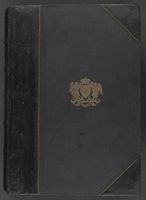
Binding: Post-1600. British Museum in-house, re-bound in 1966: Gold-tooled black half leather binding; the Harleian bookplate gold-stamped on the upper and lower covers, the spine inscribed in gold: ‘VITAE SANCTORUM THOMAE WILLELMI ET EDMUNDI - WILLELMI MALMESBURIENSIS – SERMONES BERNARDI, ETC.’; marbled endpapers.
- Custodial History:
-
Origin:
?Thornton Abbey, Midlands, England.
Provenance:
The Augustinian abbey of St Mary, Thornton-on-Humber, founded in 1139 as a priory (an abbey since 1148): its ownership inscription, added in the 15th century on a parchment rectangle pasted on to f. 1* recto: ‘Historia de gestis pontificum Anglorum. constat monasterio beate marie de thornton super humbream’ (see Ker, Medieval Libraries (1964), p. 189); perhaps its table of contents on f. 1*verso, added in the 13th century; perhaps its pressmark ’33. A. 2’ on f. 1* recto; the manuscript is listed in an early 16th-century inventory of Thornton Abbey’s books (see below).
? ‘William Fawne’, owned in 1525: his name inscribed on f. 1* recto (‘Wylliam Fawne anno domini Mccccc xxv’): a 'William Fawne' is named as executor in the will of Nicholas Fawne, Vicar of Skendleby (Lincolnshire), drawn up in 1547 (see Maddison, Lincolnshire Wills (1888), p. 64).
The Royal Library, acquired between (?) 1525 and 1530: the manuscript can be identified with the 'Libellus de gestis pontificum anglorum' that is listed in a 16th-century inventory of Thornton Abbey’s books, probably created by the antiquary John Leland (b. c. 1503, d. 1552) before 1536. Henry VIII (b. 1491, d. 1547) read the inventory and marked those manuscripts which he desired for the Royal Library with a cross: the selected manuscripts include Thornton Abbey’s copy of the Gestis Pontificum Anglorum (see Liddell, ''Leland's' Lists’ (1939), p. 91). At the Royal Library, the manuscript’s passages on councils, the authority of bishops and the Pope, and consanguinity in marriage were examined by scholars for the Collectanea satis copiosa (The Sufficiently Abundant Collections): a collection of learned texts compiled in 1530-1531 that justified Henry VIII's independence from Rome. Carley suggests that Harley MS 2’s copy of the Constitutions of Clarendon of 1164, listed to explain the cause of Thomas of Canterbury’s exile and martyrdom, may have been the immediate source for the articles that are quoted from the Constitutions in the Collectanea (see Carley, ‘William of Malmesbury’ (2009), p. 140 (no. 132)). The marginal notes that highlight passages throughout the manuscript were added in the Royal Library, possibly by Henry VIII himself: e.g. the passage on consanguinity in marriage on f. 130r (see Carley, ‘Marks in Books’ (1997), p. 591 n. 25). The manuscript left the Royal Library at an unknown point in time.
The Harley Collection, formed by Robert Harley (b. 1661, d. 1724), 1st earl of Oxford and Mortimer, politician, and Edward Harley (b. 1689, d. 1741), 2nd earl of Oxford and Mortimer, book collector and patron of the arts.
Edward Harley bequeathed the library to his widow, Henrietta Cavendish, née Holles (b. 1694, d. 1755) during her lifetime and thereafter to their daughter, Margaret Cavendish Bentinck (b. 1715, d.1785), duchess of Portland; the manuscripts were sold by the Countess and the Duchess in 1753 to the nation for £10,000 (a fraction of their contemporary value) under the Act of Parliament that also established the British Museum; the Harley manuscripts form one of the foundation collections of the British Library.
- Information About Copies:
-
Full digital coverage available for this manuscript: see Digitised Manuscripts at http://www.bl.uk.manuscripts/.
- Publications:
-
A Catalogue of the Harleian Manuscripts in the British Museum, 4 vols (London: Eyre and Strahan, 1808-12), I, pp. 1-2 (no. 2).
Vita S. Thomae Cantuariensis archiepiscopi et martyris, ab auctoribus contemporaneis, ed. by I. A. Giles, 2 vols, Patres ecclesiae Anglicanae, 36-37 (Oxford: Parker, 1845) II [for editions of certain materials concerning Thomas Becket].
James Craigie Robertson, Materials for the History of Thomas Becket, 7 vols (London, Longman, 1875-1885) I (1875): Rolls Series, 67, p. xxxi n. 2.
Willelmi Malmesbiriensis monachi De gestis pontificum Anglorum libri quinque, ed. by N. E. S. A. Hamilton, Rolls Series, 52 (London: Rolls Commission, 1870), pp. xxi-xxii.
James Raine, The Historians of the Church of York and Its Archbishops, 3 vols, Rolls Series, 71 (London: Longman, 1879-1894), II (1886), pp. 270-91 [edition of the Vita Sancti Wilhelmi Eboracensis Archiepiscopi].
A. R. Maddison, Lincolnshire Wills: First Series A.D. 1500 - 1600 (Lincoln: Williamson, 1888), p. 64.
J. R. Liddell, ''Leland's' Lists of Manuscripts in Lincolnshire Monasteries', The English Historical Review, 54: 213 (1939), 88-95 (p. 91).
S. Harrison Thomson, The Writings of Robert Grosseteste, Bishop of Lincoln 1235-1253 (Cambridge: Cambridge University Press, 1940), pp. 235-36.
Clifford Hugh Lawrence, St. Edmund of Abingdon: A Study in Hagiography and History (Oxford: Clarendon Press, 1960), p. 31.
Medieval Libraries of Great Britain: A List of Surviving Books, ed. by Neil Ripley Ker, 2nd edn, Royal Historical Society Guides and Handbooks, 3 (London: Royal Historical Society, 1964), p. 189.
Morton W. Bloomfield, Incipits of Latin Works on the Virtues and Vices 1100-1500 AD (Cambridge, MA: Mediaeval Academy of America, 1979), pp. 278 (no. 3213), 354 (no. 4190).
John Guy, 'Thomas Cromwell and the Intellectual Origins of the Henrician Revolution', in Reassessing the Henrician Age: Humanism, Politics and Reform 1500-1550 (Oxford: Basil Blackwell, 1986), pp. 151-78.
Margaret Laing, Catalogue of Sources for a Linguistic Atlas of Early Medieval English (Woodbridge: Brewer, 1993), p. 86.
James P. Carley, ‘Marks in Books and the Libraries of Henry VIII’, Papers-Bibliographical Society of America, 91 (1997), 583-606 (p. 591 n. 25, 594).
Anne Duggan, ed. and trans., The Correspondence of Thomas Becket, Archbishop of Canterbury, 1162-1170, 2 vols, Oxford Medieval Texts (Oxford: Clarendon Press, 2000), p. 238 [edition of Thomas of Canterbury’s letter to a friend].
Suzanne Paul, An Edition and Study of Selected Sermons of Robert Grosseteste (unpublished doctoral dissertation, University of Leeds, 2002), p. 158.
James P. Carley, The Books of King Henry VIII and His Wives, with a preface by David Starkey (London: British Library, 2004), pl. 85.
William of Malmesbury: Gesta Pontificorum Anglorum, The History of the English Bishops, ed. by Michael Winterbottom and Rodney Malcolm Thomson (Oxford: Clarendon Press, 2007), I: Text and Translation, p. xiii.
James P. Carley, ‘William of Malmesbury, De gestis pontificum, 12th century’, in Henry VIII: Man and Monarch, ed. by Susan Doran (London: British Library, 2009), p. 140 (no. 132) [exhibition catalogue].
- Material Type:
- Archives and Manuscripts
- Legal Status:
- Not Public Record(s)
- Notes:
- This manuscript is part of The Polonsky Foundation England and France Project: Manuscripts from the British Library and the Bibliothèque nationale de France, 700-1200.