Hard-coded id of currently selected item: . JSON version of its record is available from Blacklight on e.g. ??
Metadata associated with selected item should appear here...
Harley MS 4751
- Record Id:
- 040-002050594
- Hierarchy Root Ancestor Record Id:
- 040-002050594
- MDARK:
- ark:/81055/vdc_100000000859.0x00010d
- LARK:
- ark:/81055/vdc_100056056799.0x000001
- SLARK:
- Format:
- ISAD(G)
- Reference (shelfmark):
- Harley MS 4751
- Title:
-
A bestiary with additions from Gerald of Wales's Topographia Hibernica
- Scope & Content:
-
This manuscript contains a bestiary from the 'second family' of bestiaries (see James, The Bestiary (1928), pp. 15-16) with additions from Gerald of Wales's (b. c. 1146, d. 1223) Topographia Hibernica (Topography of Ireland) on Irish birds.
Contents:
ff. 1r-74v: Bestiary, beginning: 'Bestiarum vocabulum proprie convenit leonibus' and ending, 'ex eius calce multitudo nascatur'. It ends imperfectly with Isidore of Seville's (b. c. 560, d. 636) Etymology section devoted to plants. The text is closely related to Bodleian Library, Bodley MS 764 (see Willene B. Clark, A Medieval Book of Beasts (2006), pp. 75-76).
Decoration:
106 miniatures in colours of animals. Large initial on a rectangular ground in colours (f. 1r). Large initials in blue with red pen-flourishing, or in red with blue pen-flourishing. Rubrics in red. Notes in margin for the illuminator.
- Collection Area:
- Western Manuscripts
- Project / Collection:
- England and France 700-1200 Project
Harley Collection - Hierarchy Tree:
- [{ "id" : "040-002050594", "parent" : "#", "text" : "Harley MS 4751: A bestiary with additions from Gerald of Wales's Topographia Hibernica" , "li_attr" : {"class": "orderable"} }]
- Hierarchy Record Ids:
- 032-002045828
040-002050594 - Is part of:
- Harley MS 1-7661 : Harley Manuscripts
Harley MS 4751 : A bestiary with additions from Gerald of Wales's Topographia Hibernica - Hierarchy:
- 032-002045828[4750]/040-002050594
- Container:
- View / search within Archive / Collection: Harley MS 1-7661
- Record Type (Level):
- File
- Extent:
- A parchment codex
- Digitised Content:
- https://iiif.bl.uk/uv/#?manifest=https://bl.digirati.io/iiif/ark:/81055/vdc_100056056799.0x000001 (opens in a new tab)
- Thumbnail:
-
- Languages:
- Latin
- Scripts:
- Latin
- Start Date:
- 1160
- End Date:
- 1240
- Date Range:
- Late 12th century-Early 13th century
- Era:
- CE
- Access:
- User Conditions:
- Letter of introduction required to view this manuscript
Please request the physical items you need using the online collection item request form.
Digitised items can be viewed online by clicking the thumbnail image or digitised content link.
Readers who have registered or renewed their pass since 21 March 2024 can request physical items prior to visiting the Library by completing
this request form.
Please enter the Reference (shelfmark) above on the request form.If your Reader Pass was issued before this date, you will need to visit the Library in London or Yorkshire to renew it before you can request items online. All manuscripts and archives must be consulted at the Library in London.
This catalogue record may describe a collection of items which cannot all be requested together. Please use the hierarchy viewer to navigate to individual items. Some items may be in use or restricted for other reasons. If you would like to check the availability, contact our Reference Services team, quoting the Reference (shelfmark) above.
- Physical Characteristics:
-
Materials: Parchment.
Dimensions: 310 x 230 mm (text space: 205 x 140 mm).
Foliation: ff. 74 (where ff. 1* and 2* are short notes on the text in English + 1 unfoliated parchment leaf at the beginning and at the end).
Script: Gothic, above top line.
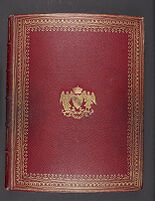
Binding: Post-1600. Harleian binding of red leather with extensive gold tooling; gilt edges.
- Custodial History:
-
Origin: ?Salisbury, Southwestern England.
Provenance:
Late 14th-century notes in Middle English (ff. 24v-25r).
16th-century recipes in English (ff. 24v, 26v).
Various 16th-17th-century inscriptions: ' John Bollocke of Marden' (f. 34v); 'Abraham Millard' (lined out) (f. 43v); John Burd' (f. 53); 'James Solbrery' (f. 58); 'Edward Lord Herbert' (f. 65v); 'Richard Bowen' and 'Thomas Newcombe' (both upside down) (f. 69v); 'Edward Griffith' (f. 70v); 'Edmund Maddock' (f. 72v). The year 1668 is written in the margin (f. 35v).
The Harley Collection, formed by Robert Harley (b. 1661, d. 1724), 1st earl of Oxford and Mortimer, politician, and Edward Harley (b. 1689, d. 1741), 2nd earl of Oxford and Mortimer, book collector and patron of the arts. Edward Harley bequeathed the library to his widow, Henrietta Cavendish, née Holles (b. 1694, d. 1755) during her lifetime and thereafter to their daughter, Margaret Cavendish Bentinck (b. 1715, d.1785), duchess of Portland; the manuscripts were sold by the Countess and the Duchess in 1753 to the nation for £10,000 (a fraction of their contemporary value) under the Act of Parliament that also established the British Museum; the Harley manuscripts form one of the foundation collections of the British Library.
- Information About Copies:
-
Full digital coverage available for this manuscript: see Digitised Manuscripts at http://www.bl.uk.manuscripts/.
Select digital coverage available for this manuscript: see Catalogue of Illuminated Manuscripts at http://www.bl.uk/catalogues/illuminatedmanuscripts/welcome.htm.
- Publications:
-
A Catalogue of the Harleian Manuscripts in the British Museum, 4 vols (London: Eyre and Strahan, 1808-12), III (1808), no. 4751.
Walter de Gray Birch and Henry Jenner, Early Drawings and Illuminations: An Introduction to the Study of Illustrated Manuscripts (London: Bagster and Sons, 1879), p. 6.
J. A. Herbert, Illuminated Manuscripts (London: Methuen, 1911), p. 187.
Reproductions from Illuminated Manuscripts, Series 3, 3rd edn (London: British Museum, 1925), pl. 13.
Eric. G. Millar, English Illuminated Manuscripts from the Xth to the XIIIth Century (Paris: Van Oest, 1926), pl. 56.
M. R. James, The Bestiary: Being a Reproduction in full of the Manuscript Ii.4.26 in the University Library, Cambridge (Oxford: Roxburghe Club, 1928), pp. 15-16, no. 18.
Guide to an Exhibition of English Art gathered from Various Departments and held in the Prints and Drawings Gallery (London: British Museum, 1934), no. 102.
T. S. R. Boase, English Art 1100-1216, Oxford History of English Art, 2 (Oxford: Clarendon Press, 1957), pp. 294-95.
Florence McCulloch, Medieval Latin and French Bestiaries, University of North Carolina Studies in the romance Languages and Literatures, 33 (Chapel Hill: The University of North Carolina Press, 1962), p. 36.
Francis Klingender, Animals in Art and Thought to the end of the Middle Ages, ed. by Evelyn Antal and John Harthan (London: Routledge & Kegan Paul, 1971), pp. 388-89, 394-95, pls 213, 220a, 225, 226, 227.
Nigel Morgan, Early Gothic Manuscripts, 2 vols, A Survey of Manuscripts Illuminated in the British Isles, 4 (London Harvey Miller, 1982-1988), I: 1190-1250, no. 76.
John E. Murdoch, Album of Science: Antiquity and the Middle Ages, ed. by I. B. Cohen (New York: Scribner's Sons, 1984), no. 263.
Two East Anglian Picture Books: A Facsimile of the Helmingham Herbal and Bestiary and Bodleian Ms. Ashmole 1504, ed. by Nicholas Barker (London: The Roxburghe Club, 1988), p. 5.
Ann Payne, Medieval Beasts (London: British Library, 1990), p. 14.
Dora Faraci, Il bestiario medio inglese (Ms Arundel 292 della British Library) (Rome: Japadre, 1990), p. 258.
Ann Payne, 'The Northumberland Bestiary and its group' Sotheby's Art at Auction 1990-1991, ed. by Sally Prideaux (London: Sotheby's, 1991), pp. 159-65 (p. 162).
Richard Barber, Bestiary: being an English Version of the Bodleian Library, Oxford MS Bodley 764 (Woodbridge: Boydell and Brewer, 1993), pp. 12-13.
Debra Hassig, Medieval Bestiaries: Text, Image, Ideology (Cambridge: Cambridge University Press, 1995), pp. 4-5, 137-40, 173, 176.
The Mythical Quest: In Search of Adventure, Romance and Enlightenment, intro. by Penelope Lively (London: British Library, 1996), pl. on p. 74, p. 98.
Ron Baxter, Bestiaries and Their Users in the Middle Ages (Stroud, Gloucestershire: Sutton Publishing, 1998), pp. 147, 177.
Debra Hassig, 'Sex in the Bestiaries', in The mark of the beast: the Medieval Bestiary in Art, Life and Literature, ed. by Debra Hassig (New York: Routledge, 1999), pp. 71-93.
Pamela Gravestock, 'Did imaginary animals exist?' in The mark of the beast: the Medieval Bestiary in Art, Life and Literature, ed. by Debra Hassig (New York: Routledge, 1999), pp. 119-39.
Xenia Muratova ‘Le bestiaire medieval et la culture normande’, in Manuscrits et enluminures dans le monde normand (Xe-XVe siècles), ed. by Pierre Bouet and Monique Dosdat (Caen: Presses universitaires de Caen, 1999), pp. 51-68 (p. 154 n. 8).
Pamela Porter, Medieval Warfare in Manuscripts (London: British Library, 2000), p. 23.
Alixe Bovey, Monsters and Grotesques in Medieval Manuscripts (London: British Library, 2002), pp. 22-25, pl. 17, 20.
Michelle P. Brown, 'Marvels of the West: Giraldus Cambrensis and the Role of the Author in the Development of Marginal Illustration', in Decoration and Illustration in Medieval English Manuscripts, English Manuscript Studies 1100-1700, ed. by A.S.G Edwards, 10 (London: British Library, 2002), pp. 34-59 (p. 51).
Debra Higgs Strickland, Saracens, Demons, & Jews: Making Monsters in Medieval Art (Princeton: Princeton University Press, 2003), fig. 73.
Jacqueline Leclercq-Marx, ‘La sirène et l'(ono)centaure dans le Physiologus grec et latin et dans quelques bestiaries: Le texte et l’image’, in Bestiarires médiévaux: Nouvelles perspectives sur les manuscrits de les traditions textuelles, ed. by Baudouin Van den Abelle, Publications de l’Institut d’études médiévales, Collection Textes, études, congrés, 21 (Louvain: Brepols, 2005), pp. 169-82 (p. 180 , pl. 54).
Treasures of the British Library, ed. by Nicolas Barker and others (London: British Library, 2005), pp. 40-41.
Willene B. Clark, A Medieval Book of Beasts. The second-family bestiary: commentary, art, text and translation (Woodbridge: The Boydell Press, 2006), pp. 75-76.
Elizabeth Morrison, Beasts: Factual & Fantastic (Los Angeles: J. Paul Getty Museum, 2007), p. 83.
The Medieval Bestiary: Animals in the Middle Ages, ed. by David Badke, [http://bestiary.ca/manuscripts/manulocshelf.htm] [accessed 14 August 2009].
Joe Flatman, Ships and Shipping in Medieval Manuscripts (London: British Library, 2009), pls 10, 12.
René Cintré, Bestiaire médiéval des animaux familiers (Rennes: Editions Ouest France, 2013), p. 96.
Christian Heck and Rémy Cordonnier, Le bestiaire medieval: L'animal dans les manuscrits enluminés (Paris: Editions Citadelle-Mazenod, 2011), pp. 150, 163.
Sarah Kay, 'Post-human philology and the ends of time in medieval bestiaries', Postmedieval: a journal of medieval cultural studies, 5/4 (2014), 473-85 (481).
Doyle, Kathleen and Charlotte Denoël, Medieval Illumination: Manuscript Art in England and France 700-1200 (London: British Library, 2018), also published as Enluminures Médiévales: Chefs-d'oeuvre de la Bibliothèque nationale de France et de la British Library, 700-1200 (Paris : BnF Éditions, 2018), pp. 25, 162. - Exhibitions:
- The Middle Ages, (online), 26 March 2015-
- Material Type:
- Archives and Manuscripts
- Legal Status:
- Not Public Record(s)
- Notes:
- This manuscript is part of The Polonsky Foundation England and France Project: Manuscripts from the British Library and the Bibliothèque nationale de France, 700-1200.