Hard-coded id of currently selected item: . JSON version of its record is available from Blacklight on e.g. ??
Metadata associated with selected item should appear here...
Add MS 22820
- Record Id:
- 040-002096755
- Hierarchy Root Ancestor Record Id:
- 032-002096686
- MDARK:
- ark:/81055/vdc_100000000122.0x0000cb
- LARK:
- ark:/81055/vdc_100055988155.0x000001
- SLARK:
- Format:
- ISAD(G)
- Reference (shelfmark):
- Add MS 22820
- Title:
- Hrabanus Maurus, Commentary on Jeremiah
- Scope & Content:
-
A colophon at the end of this manuscript states that this book was written by Herimann, a monk from the Benedictine abbey of Cluny, for its then abbot St Majolus (b. c. 906, d. 994). This leaves no doubt that the manuscript was written during his abbacy from 956 to 992, and makes it one of the earliest manuscripts that survives from the abbey, founded in 910. The manuscript contains the commentary of the Benedictine monk Hrabanus Maurus (b. c. 780, d. 856) on the Book of Jeremiah. Its single historiated initial, containing a miniature of the Prophet Jeremiah, may be the earliest surviving artistic production from Cluny (Evans, Cluniac Art (1950), p. 10).
Contents:
ff. 1r-327: Hrabanus Maurus, Commentary on Jeremiah, beginning ‘RABANUS Eccellentissimo Imperatori Hluthario Virtus Vita et Salus perpetua [etc.]’.
Decoration:
1 large historiated initial with knot-work and foliate decoration in black and green (f. 9r): it contains a miniature of the Prophet Jeremiah, enthroned, holding a book and gesturing (two figures stand next to him).
Large display capitals in red and brown ink on f. 1r and f. 327v (containing interlace). 2 medium capitals with foliate decoration in red and purple on f. 45v and f. 60v. Large initials in brown ink. Small capitals in purple or green with a red dot inside the letterforms. Text and small capitals highlighted with green ink.
- Collection Area:
- Western Manuscripts
- Project / Collection:
- Additional Manuscripts
England and France 700-1200 Project - Hierarchy Record Ids:
- 032-002096686
040-002096755 - Is part of:
- Add MS 22752-22834 : Count Guglielmo Libri’s collection
Add MS 22820 : Hrabanus Maurus, Commentary on Jeremiah - Hierarchy:
- 032-002096686[0068]/040-002096755
- Container:
- View / search within Archive / Collection: Add MS 22752-22834
- Record Type (Level):
- File
- Extent:
-
A parchment codex
- Digitised Content:
- https://iiif.bl.uk/uv/#?manifest=https://bl.digirati.io/iiif/ark:/81055/vdc_100055988155.0x000001 (opens in a new tab)
- Thumbnail:
-
- Languages:
- Latin
- Scripts:
- Greek
Latin - Start Date:
- 0950
- End Date:
- 0999
- Date Range:
- 2nd half of the 10th century
- Era:
- CE
- Access:
- User Conditions:
- Letter of introduction required to view this manuscript
Please request the physical items you need using the online collection item request form.
Digitised items can be viewed online by clicking the thumbnail image or digitised content link.
Readers who have registered or renewed their pass since 21 March 2024 can request physical items prior to visiting the Library by completing
this request form.
Please enter the Reference (shelfmark) above on the request form.If your Reader Pass was issued before this date, you will need to visit the Library in London or Yorkshire to renew it before you can request items online. All manuscripts and archives must be consulted at the Library in London.
This catalogue record may describe a collection of items which cannot all be requested together. Please use the hierarchy viewer to navigate to individual items. Some items may be in use or restricted for other reasons. If you would like to check the availability, contact our Reference Services team, quoting the Reference (shelfmark) above.
- Physical Characteristics:
-
Materials: Parchment.
Dimensions: 285 x 205 mm (text space: 210 x 15 mm).
Foliation: ff. 327 ( + 5 unfoliated paper flyleaves at the beginning + 4 at the end).
Script: Caroline minuscule.
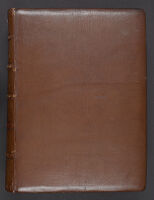
Binding: Post-1600. Brown leather binding, the spine inscribed at the British Musuem: ‘RABANUS SUPER JEREMIA.’.
- Custodial History:
-
Origin: Cluny, Central France.
Provenance:
The Benedictine abbey of Cluny, from the 10th-century onward, possibly until the abbey’s dissolution by French Revolutionary troops in 1793: on f. 327v the scribe identifies himself in a colophon as Herimann, a monk of Cluny, who claims to have written the manuscript for St Majolus, referred to as abbot of Cluny (956-992): ‘Hic liber descriptus est iussu domni MAIOLI · ABBATIS. Ab Herimanno sacerdote licet indigno et monachorum omnium ultimo et prælibati patris voto oblatus sancto petro cluniensi coenobio . Orat scriptor quatinus quicumque. eum manibus ; susceperit legendum . veniam illi a domino implorat peccaminum’. But the manuscript does not seem to appear in the catalogue of Cluny’s manuscripts, written under the abbacy of Hugh III (1157-1163) (see Delisle, Le cabinet, II (1874), pp. 458-85).
Guglielmo Libri (b. 1803, d. 1869), Italian count, mathematician, and book collector: perhaps acquired in 1830 (a note on f. 327v: ‘Paris 1830’); his sale 2 April 1859, Lot 851(see Catalogue of the Extraordinary Collection (1859), pp. 191-92 (no. 851)); purchased by the British Museum (see the note on f. [v] recto: ‘Purchased at M. Libri’s sale 2 April 1859 (Lot 851)’) for £22.
- Information About Copies:
-
Full digital coverage available for this manuscript; see Digitised Manuscripts, https://bl.uk/manuscripts/.
- Publications:
-
Catalogue of the Extraordinary Collection of Splendid Manuscripts, Chiefly upon Vellum, in Various Languages of Europe and the East formed by M. Guglielmo Libri (London: Sotheby & Wilkinson, 1859), pp. 191-92 (no. 851).
Léopold Victor Delisle, Le cabinet des manuscrits de la Bibliothèque nationale, 4 vols (Paris: Imprimerie impériale, 1868-1881), II (1874), pp. 458-85.
Catalogue of Additions to the Manuscripts in the British Museum in the Years 1854-1860 (London: Clowes, 1875), p. 739.
The Palaeographic Society: Facsimiles of Manuscripts and Inscriptions, Second series, ed. by Edward Augustus Bond, Edward Maunde Thompson, and George Frederic Warner, (London: Clowes, 1884-1894), II (1894), pls 109-10.
Henri Omont, ‘Manuscrit de Raban Maur offert par saint Maïeul à l'abbaye de Cluny’, Millénaire de Cluny: congrès d'histoire et d'archéologie tenu à Cluny les 10, 11, 12 septembre 1910, 2 vols (Paris: Macon, Protat frères, 1910), I: pp. 127-129 (passim).
Joan Evans, Cluniac Art of the Romanesque Period (Cambridge: Cambridge University Press, 1950), pp. xi, 2, 10, 125.
Andrew G. Watson, Catalogue of Dated and Datable Manuscripts c.700-1600 in the Department of Manuscripts, The British Library, 2 vols (London: British Museum, 1979), I, no. 278.
Raymund Kottje, 'Die handschriftliche Überlieferung der Bibelkommentare des Hrabanus Maurus', in Raban Maur et son temps, ed. by Philippe Depreux and others, Collection Haut Moyen Âge, 9 (Turnhout: Brepols, 2010), p. 259-74 (p. 267, n. 69).
Henrik Aubert, ‘Nova cluniacensia: les feuillets de garde du manuscrit Paris BnF nal 1236 et la création de la liturgie clunisienne’, Bulletin du centre d'études médiévales, 16 (2012), 1-42 (pp. 9-10).
- Material Type:
- Archives and Manuscripts
- Legal Status:
- Not Public Record(s)
- Notes:
- This manuscript is part of The Polonsky Foundation England and France Project: Manuscripts from the British Library and the Bibliothèque nationale de France, 700-1200.