Hard-coded id of currently selected item: . JSON version of its record is available from Blacklight on e.g. ??
Metadata associated with selected item should appear here...
Add MS 47678
- Record Id:
- 040-002104026
- Hierarchy Root Ancestor Record Id:
- 032-002104019
- MDARK:
- ark:/81055/vdc_100000000173.0x000193
- LARK:
- ark:/81055/vdc_100056002648.0x000001
- SLARK:
- Format:
- ISAD(G)
- Reference (shelfmark):
- Add MS 47678
- Title:
- Marcus Tullius Cicero, In Catilinam, Pro Ligario, Pro rege Deiotaro, In Verrem
- Scope & Content:
-
This manuscript contains In Catilinam (The Speech against Catiline), Pro Ligario (The Speech in Defense of Ligarius), Pro rege Deiotaro (The Speech in Defense of King Deiotarius) and the second In Verrem II (The Second Speech Against Verres) by the Roman orator Marcus Tullius Cicero (b. 106 BC, d. 43 BC). This manuscript, written at Tours in the early 9th century, is one of the earliest and best witnesses to Cicero’s four speeches.
Contents:
ff. 1r-18v: Cicero, In Catilinam, imperfect, beginning: ‘Quousque tandem abutere Catilina patientia nostra’.
ff. 19r-21r: Cicero, Pro Ligario, imperfect, beginning: hoc victore esse non possumus sed non loquor‘.
ff. 21r-27v: Cicero, Pro rege Deiotaro, imperfect, beginning: ‘Cum in omnibus causis gravioribus’.
ff. 28r-39v: Cicero, In Verres, imperfect, beginning: ‘Multa mihi necessario praetermittenda sunt’.
Decoration:
One small initial in brown ink with some penwork decoration (f. 1r). Several small initials in black ink. Capitals in black and brown.
- Collection Area:
- Western Manuscripts
- Project / Collection:
- Additional Manuscripts
England and France 700-1200 Project - Hierarchy Record Ids:
- 032-002104019
040-002104026 - Is part of:
- Add MS 47672-47683 : HOLKHAM HALL MANUSCRIPTS.MSS. 47672-47683 formed part of the Library of the Earls of Leicester at Holkham Hall, Norfolk.…
Add MS 47678 : Marcus Tullius Cicero, In Catilinam, Pro Ligario, Pro rege Deiotaro, In Verrem - Hierarchy:
- 032-002104019[0007]/040-002104026
- Container:
- View / search within Archive / Collection: Add MS 47672-47683
- Record Type (Level):
- File
- Extent:
-
A parchment codex
- Digitised Content:
- https://iiif.bl.uk/uv/#?manifest=https://bl.digirati.io/iiif/ark:/81055/vdc_100056002648.0x000001
- Thumbnail:
-
- Languages:
- Latin
- Scripts:
- Latin
- Start Date:
- 0800
- End Date:
- 0824
- Date Range:
- 1st quarter of the 9th century
- Era:
- CE
- Access:
-
Please request the physical items you need using the online collection item request form.
Digitised items can be viewed online by clicking the thumbnail image or digitised content link.
Readers who have registered or renewed their pass since 21 March 2024 can request physical items prior to visiting the Library by completing
this request form.
Please enter the Reference (shelfmark) above on the request form.If your Reader Pass was issued before this date, you will need to visit the Library in London or Yorkshire to renew it before you can request items online. All manuscripts and archives must be consulted at the Library in London.
This catalogue record may describe a collection of items which cannot all be requested together. Please use the hierarchy viewer to navigate to individual items. Some items may be in use or restricted for other reasons. If you would like to check the availability, contact our Reference Services team, quoting the Reference (shelfmark) above.
- User Conditions:
- Letter of introduction required to view this manuscript
- Physical Characteristics:
-
Materials: Parchment.
Dimensions: 320 x 240 mm (text space: 250 x 180 mm, in two columns).
Foliation: ff. 39 ( + 4 unfoliated paper flyleaves at the beginning + 2 at the end).
Script: Caroline minuscule.
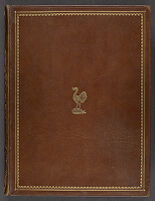
Binding: Post-1600. Brown leather with gold tooling; the spine inscribed in gold ‘M.T.CICERO ORAT CONTRA’
- Custodial History:
-
Origin: Tours, Central France.
Provenance:
The Benedictine Abbey of Marmoutier, Tours, founded in 372: identified as a Tours manuscript based on the script (see Rand, A Survey of the Manuscripts (1929), pp. 104-05).
The Benedictine Abbey of Cluny, founded in 910: the manuscript was listed as no. 498 in the catalogue of books prepared under Abbot Hugh III (d. 1163): 'Volumen in quo continetur Cicero in Catilina, et idem pro Quinto Ligario et pro rege Dejotaro, et de publicis litteris et de actione, idemque in Verinis' (see Delisle, Cabinet (1874), II, p. 478); its ownership inscription: 'de conventu clun[iacensi]', in a 14th-century hand, now erased (see Peterson, Collations (1901), pp. 16, 28). The manuscript was at Cluny until at least the 14th century (see Catalogue of Additions (1982), p. 49), but it is not in the catalogue made by Dom Anselme le Michel in c. 1645.
Thomas Coke (b. 1697, d. 1759), Earl of Leicester, politician, architect, and art collector: probably acquired the manuscript between 1712-1718 on the Continent.
Thomas William Coke (b. 1754, d. 1842), 1st Earl of Leicester of Holkham, politician and agriculturalist: his bookplate on the first inner cover.
The Library of the Earls of Leicester at Holkham Hall, Norfolk: its shelf-mark '387' (f. iv); notes by the Rev. Charles Warburton James, librarian at Holkam (c. 1919-1921) (ff. ii-iii).
Purchased by the British Museum with the assistance of the National Art-Collections Fund in 1952.
- Publications:
-
Léopold Delisle, Le Cabinet des manuscrits de la Bibliothèque imperial, 2 vols (Paris: Imprimerie Impériale, 1868-1874), II (1874), p. 478.
Emile Louis Marie Chatelain, Paléographie des classiques latins. Collection de facsimilés des principaux manuscrits (Paris: Hachette, 1884-1900), pl. xxviia, p. 28.
William Peterson, Collations from the Codex Cluniacensis s. Holkhamicus, Anecdota Oxoniensia, Classical Series, 9 (Oxford, Clarendon Press: 1901), pp. 16, 28.
Albert C. Clark, ‘Peterson’s Cluniacensis MS. of Cicero’, Classical Review, 16 (1902), 322-26.
M. Tulii Ciceronis Orationes, ed. by William Peterson, Scriptorum Classicorum Bibliotheca Oxoniensis, 3 vols (Oxford, Clarendon Press: 1905-17), 3: Divinatio in Q. Caecilium, In C. Verrem (1917), pp. iv-ix.
M. Tulli Ciceronis scripta quae manserunt omnia., ed. by Alfred Klotz, Bibliotheca Scriptorum Graecorum et Romanorum Teubneriana (Leipzig: Teubner, 1916-81), VIII: Orationes pro T. Annio Milone, pro M. Marcello, pro Q. Ligario, pro rege Deiotaro (1918), pp. xi-xvi.
Edward K. Rand, A Survey of the Manuscript of Tours, 2 vols (Cambridge, Mass.: The Mediaeval Academy of America, 1929), I, p. 104 (no. 25).
M. Tulli Ciceronis scripta quae manserunt omnia, ed. by Paul Reis, Bibliotheca Scriptorum Graecorum et Romanorum Teubneriana, 2 vols (Leipzig: Teubner, 1916-81), VI: Orationes in L. Catilinam (1933).
Cicéron. Discours, ed. by Henri de la Ville de Mirmont, Henri Bornecque, Marcel Lob, 20 vols (Paris: Les Belles Lettres, 1926-69), III: Seconde action contre Verrès, Livre II : La Préture de Sicile (1936), pp. v-viii.
Cicéron. Discours, ed. by Henri de la Ville de Mirmont, Henri Bornecque, Marcel Lob, 20 vols (Paris: Les Belles Lettres, 1926-69), IV: Seconde action contre Verrès, Livre III : Le Froment (1925), pp. v, xv.
Cicéron. Discours, ed. by Henri de la Ville de Mirmont, Henri Bornecque, Marcel Lob, 20 vols (Paris: Les Belles Lettres, 1926-69), X: Catilinaires (1926), pp. ix, xi.
Cicéron. Discours, ed. by Henri de la Ville de Mirmont, Henri Bornecque, Marcel Lob, 20 vols (Paris: Les Belles Lettres, 1926-69), XVIII: Pour Marcellus. Pour Ligarius. Pour le Roi Déjotarus (1952), pp. 15-16.
Thomas S. Pattie, 'The Ruling as a Clue to the Make-up of a Medieval Manuscript', British Library Journal, 1 (1975), 15-21 (pp. 15-21).
Donald A. Bullough, ‘Roman Books and Carolingian Renovatio’, in Studies in Church History 14 (1977), 23-50 (p. 47 n. 45).
Catalogue of Additions to the Manuscripts 1951-1955, 2 vols (London: The British Library, 1982), I, pp. 47-50.
Leigh D. Reynolds and Richard H. Rouse, 'Cicero' in Texts and Transmission: A Survey of the Latin Classics, ed. by Leigh D. Reynolds (Oxford: Clarendon Press, 1983), pp. 61-62, 64-65, 68-69, 71-72, 78-79, 90, 96.
Rosamond McKitterick, The Carolingians and the Written Word (Cambridge: Cambridge University Press, 1989), p. 154.
Bernhard Bischoff, Manuscripts and Libraries in the Age of Charlemagne, trans. and ed. by Michael Gorman, Cambridge Studies in Palaeography and Codicology, 1 (Cambridge: Cambridge University Press, 1994), p. 31.
Mildred Budny, 'Assembly marks in the Vivian Bible and scribal, editorial, and organizational marks in medieval books' in Making the Medieval Book: Techniques of Production, Proceedings of the Fourth Conference of The Seminar in the History of the Book to 1500, Oxford, July 1992, ed. by Linda L. Brownrigg (Los Altos Hills, California: Anderson-Lovelace, 1995), pp. 199-239 (p. 207).
John O. Ward, ‘Ciceronian Rhetoric and Oratory from St. Augustine to Guarino da Verona’ in Cicero Refused to Die: Ciceronian Influence through the Centuries, ed. by Nancy van Deusen (Leiden: Brill, 2013), pp. 163-96, 176 (n. 63).
- Material Type:
- Archives and Manuscripts
- Legal Status:
- Not Public Record(s)
- Notes:
- This manuscript is part of The Polonsky Foundation England and France Project: Manuscripts from the British Library and the Bibliothèque nationale de France, 700-1200.