Hard-coded id of currently selected item: . JSON version of its record is available from Blacklight on e.g. ??
Metadata associated with selected item should appear here...
Royal MS 10 D VIII
- Record Id:
- 040-002106538
- Hierarchy Root Ancestor Record Id:
- 032-002105724
- MDARK:
- ark:/81055/vdc_100000000277.0x00012b
- LARK:
- ark:/81055/vdc_100161520597.0x000001
- SLARK:
- Format:
- ISAD(G)
- Reference (shelfmark):
- Royal MS 10 D VIII
- Title:
- Gratian's Decretum, with the Glossa ordinaria of Bartholomew of Brescia
- Scope & Content:
-
This manuscript contains a thirteenth-century copy of Gratian's Decretum, a comprehensive compilation of canon law that includes decisions of Church councils, papal bulls, and excerpts from the Fathers of the Church, which was first composed in Bologna between 1139 and 1158. In addition to the Decretum, the volume also includes the Glossa ordinaria, a systematic textual commentary in the form of marginal glosses that was composed by the Italian canonist Bartholomew of Brescia (d. 1258), and the Historiae super libro Decretorum (Stories concerning the book of decrees), written by the same author. The latter work is a compilation of biblical stories collected by Bartholomew, which illustrate points of canon law, arranged under the appropriate distinctiones or causae.
The manuscript was not originally made for an English patron, but a number of added glosses throughout the volume suggest that it had arrived in England by the fourteenth century. It later came into the posssession of Howel Kyffin, Dean of St Asaph in northern Wales (between 1381 and 1384).
A letter from the Prior of Belvoir to the Prior of St. Albans, concerning a quittance for a parson of Great Rissington, which dates to the late 15th century, was once inserted into the manuscript as a detached leaf (now Royal MS 14 B LI).
Contents:
ff. 1r-343v: Gratian's Decretum, with the Glossa ordinaria of Bartholomew of Brescia.
ff. 345r-348v: Bartholomew of Brescia, Historiae super libro Decretorum.
The manuscript features a later addition:
f. ii verso: an added verse couplet, written in Latin.
Decoration:
The manuscript was most likely illuminated in Paris by the artist of at least two other surviving manuscripts: Paris, Bibliothèque nationale, lat. 830 (a Missal for Paris use) and Giessen, Universitatsbibliothek 945 (a copy of Justinian's Codex in French), which have been attributed to a thirteenth-century Parisian workshop known as the 'Bari Atelier' (see Branner, Manuscript Painting in Paris (1977), p. 229).
38 miniatures in colours and gold, at the beginning of each causa, and parts 1 and 3 (ff. 1r, 82v, 102v, 119v, 127r, 128v, 130v, 133v, 139v, 142v, 145r, 148r, 159v, 169v, 173v, 176r, 180v, 193v, 197r, 199v, 201r, 203r, 205v, 212v, 234v, 245r, 249r, 255v, 262v, 266r, 267r, 270r, 272r, 280r, 308r, 309r, 315v, 316v). Foliate initials in colours and gold with dragons and marginal extensions, at the beginning of major text and gloss divisions. Initials in red with blue pen-flourishing, or in blue with red pen-flourishing. Paraphs in blue. Running titles and chapter numbers in red and blue. Display script with cadels and first letters of sentences highlighted in yellow. Distinction numbers in the margins in red and blue (ff. 345r-348v).
The subjects of the miniatures are as follows:
f. 1r: an enthroned king dictating the law to a scribe (Distinctio 1);
f. 82v: a boy being received into a monastery (Causa 1);
f. 102v: a bishop being degraded before four clerics (Causa 2);
f. 119v: a bishop being restored to his former position (Causa 3);
f. 127r: bishop and a boy accusing another bishop before a pope, who sits as a judge (Causa 4);
f. 128v: a pope as judge, with three bishops before him (Causa 5);
f. 130v: a bishop acting as a judge in the case of an accused monk, with two lay accusers (Causa 6);
f. 133v: a pope acting as a judge with two litigant bishops and their advisers (Causa 7);
f. 139v: a bishop on his deathbed indicating his successor (Causa 8);
f. 142v: a bishop with two priests, one before an altar, illustrating a case of a bishop removing a priest from a church and substituting another (Causa 9);
f. 145r: a pope or an ecclesiastical judge and a bishop and a lay plaintiff before him (Causa 10);
f. 148r: a clerk disputing with laymen (Causa 11);
f. 159v: a dying clerk with two clerks at his bed, illustrating the making of a will (Causa 12);
f. 169v: two laymen discussing with a cleric, and two churches with altars, illustrating a case of people moving from one diocese to another (Causa 13);
f. 173v: a judge with canons and two laymen before him (Causa 14);
f. 176r: a clerk and a woman, and the clerk committing a homicide (Causa 15);
f. 180v: an abbot and three monks in a church (Causa 16);
f. 193v: an ill clerk with an abbot and two monks at his bedside, illustrating a case of a clerk proposing to become a monk (Causa 17);
f. 197r: an abbot and litigant bishops with their advisers before him (Causa 18);
f. 199v: clerics before a bishop and an altar, illustrating the clerics asking permission to leave their church or canon community and move to a monastery (Causa 19);
f. 201r: a monk and two laymen with a monastic habit, illustrating the case of two novices, one of whom becomes a monk, while the other returns to the secular world (Causa 20);
f. 203r: a clerk before a secular judge, and a clerk before a bishop (Causa 21);
f. 205v: a clerk swearing before a secular judge and a bishop (Causa 22);
f. 212v: a bishop and four plaintiffs (Causa 23);
f. 234v: a bishop distributing communion and a priest behind him, illustrating a case of a priest being deprived of his office (Causa 24);
f. 245r: a bishop judging between a clerk and a monk, with two sheaves behind them illustrating the subject of the litigation (Causa 25);
f. 249r: a bishop as a judge and three litigants (Causa 26);
f. 255v: a marriage ceremony (Causa 27);
f. 262v: a marriage ceremony (Causa 28);
f. 266r: a marriage ceremony (Causa 29);
f. 267r: the baptism of an infant (Causa 30);
f. 270r: a dying man with a woman at his bedside; the same woman marrying another man, illustrating a case of a widow who married a man with whom she had committed an adultery (Causa 31);
f. 272r: a marriage ceremony (Causa 32);
f. 280r: a judge with a husband and wife before him (Causa 33);
f. 308r: two pilgrims, a woman and a man before a judge, illustrating a case of a pilgrim reclaiming his wife (Causa 34);
f. 309r: a woman on her deathbed and a marriage ceremony (Causa 35);
f. 315v: a young man receiving a chalice and a money bag from a young woman, illustrating a case of an abused girl (Causa 36);
f. 316v: the consecration of a church (Pars 3).
- Collection Area:
- Western Manuscripts
- Project / Collection:
- Royal Collection
- Hierarchy Record Ids:
- 032-002105724
040-002106538 - Is part of:
- Royal MS 1 A I-20 E X : Royal Manuscripts
Royal MS 10 D VIII : Gratian's Decretum, with the Glossa ordinaria of Bartholomew of Brescia - Hierarchy:
- 032-002105724[0771]/040-002106538
- Container:
- View / search within Archive / Collection: Royal MS 1 A I-20 E X
- Record Type (Level):
- File
- Extent:
-
1 volume
- Digitised Content:
- https://iiif.bl.uk/uv/#?manifest=https://bl.digirati.io/iiif/ark:/81055/vdc_100161520597.0x000001 (opens in a new tab)
- Thumbnail:
-
- Languages:
- Latin
- Scripts:
- Latin
- Start Date:
- 1250
- End Date:
- 1299
- Date Range:
- 2nd half of the 13th century
- Era:
- CE
- Access:
- User Conditions:
- Letter of introduction required to view this manuscript
Please request the physical items you need using the online collection item request form.
Digitised items can be viewed online by clicking the thumbnail image or digitised content link.
Readers who have registered or renewed their pass since 21 March 2024 can request physical items prior to visiting the Library by completing
this request form.
Please enter the Reference (shelfmark) above on the request form.If your Reader Pass was issued before this date, you will need to visit the Library in London or Yorkshire to renew it before you can request items online. All manuscripts and archives must be consulted at the Library in London.
This catalogue record may describe a collection of items which cannot all be requested together. Please use the hierarchy viewer to navigate to individual items. Some items may be in use or restricted for other reasons. If you would like to check the availability, contact our Reference Services team, quoting the Reference (shelfmark) above.
- Physical Characteristics:
-
Material: Parchment.
Dimensions: 440 x 260 mm (text space: 365 x 200 mm).
Foliation: ff. ii + 349 (+ 1 unfoliated medieval parchment flyleaf attached to a modern paper flyleaf at the beginning); ff. i, ii and 349 are medieval parchment flyleaves.
Script: Gothic, written below the top line.
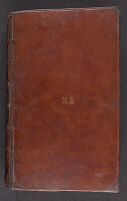
Binding: Post-1600. Royal library binding of brown leather.
- Custodial History:
-
Origin: Southern and Central France (probably Paris).
Provenance:
The Bari Atelier, a workshop active in Paris in the 3rd quarter of the 13th century: responsible for the manuscript's decoration (see Royal Manuscripts (2011), no. 106).
An unidentified English owner, 14th century: added marginal glosses in a minute English hand throughout the manuscript.
Howel Kyffin, probably to be identified with the dean of St Aspah (1381-1384): inscribed 'nota r[e]ductiones ystoria[rum] decreto[rum] s[ecun]d[u]m Barth[olomeum] Brix[iensem]. Howel Kyffin' (f. 345r).
'Cowley', 15th century: inscribed, 'Cowley: / Qui timet deu[m] faciet bonum' (ff. ii recto, 349r). A similar ownership inscription appears in a copy of Gregory the Great's Moralia in Job, now Royal MS 6 D VII (f. 299r).
A letter of a prior of Belvoir, a cell of St Albans to the prior of St Albans, now Royal MS 14 B LI, found in the manuscript, dating to the late 15th century.
The Old Royal Library (the English Royal Library): Westminster inventory number 'no. 984' (f. 1), acquired by the Upper Library at Westminster after the inventory of 1542; in the catalogue of 1666, Royal Appendix 71, ff. 9, 9v, or 10; and in the catalogue of the library of St James’s Palace (see Bernard, Catalogi librorum manuscriptorum Angliae et Hiberniae (1697), no. 8373 or 8386).
Presented to the British Museum by George II in 1757 as part of the Old Royal Library.
- Information About Copies:
-
Select digital coverage available for this manuscript, see Catalogue of Illuminated Manuscripts http://www.bl.uk/catalogues/illuminatedmanuscripts/welcome.htm.
- Publications:
-
George F. Warner and Julius P. Gilson, Catalogue of Western Manuscripts in the Old Royal and King’s Collections, 4 vols (London: British Museum, 1921), I, p. 332.
Stephan Kuttner, Repertorium der Kanonistik, 1140-1234: Prodromus corporis glossarum (Vatican City: Biblioteca Apostolica Vaticana, 1937), p. 106.
Robert Branner, Manuscript Painting in Paris during the Reign of Saint-Louis (University of California Press, 1972), p. 229.
The Libraries of King Henry VIII, ed. by J. P. Carley, Corpus of British Medieval Library Catalogues, 7 (London: The British Library, 2000), H2.984.
Royal Manuscripts: The Genius of Illumination (London: British Library, 2011), no. 106 [exhibition catalogue].
Martin Heale, The Abbots and Priors of Late Medieval and Reformation England (Oxford: Oxford University Press, 2016), pp. 74, 246.
- Material Type:
- Archives and Manuscripts
- Legal Status:
- Not Public Record(s)