Hard-coded id of currently selected item: . JSON version of its record is available from Blacklight on e.g. ??
Metadata associated with selected item should appear here...
Royal MS 15 A XVI
- Record Id:
- 040-002107025
- Hierarchy Root Ancestor Record Id:
- 032-002105724
- MDARK:
- ark:/81055/vdc_100000000338.0x0000ae
- LARK:
- ark:/81055/vdc_100059911348.0x000001
- SLARK:
- Format:
- ISAD(G)
- Reference (shelfmark):
- Royal MS 15 A XVI
- Title:
- Juvencus, Evangelia; Aldhelm, Enigmata (imperfect); Bede, De arte metrica (extract, chapter 25); Martin the Irishman, Scholica graecarum glossarum (imperfect)
- Scope & Content:
-
Contents:
ff. 2r-57r: Juvencus (fl. c. 330), Evangelia (Gospels).
ff. 59v-73v: Aldhelm (d. 709), bishop of Sherborne, Enigmata (Riddles), imperfect.
f. 73v: An extract from Bede the Venerable (b. c. 673, d. 735), De arte metrica (On the Metrical Art), chapter 25.
ff. 74v-83v: Martin the Irishman (b. 819, d. 875), Scholica graecarum glossarum, imperfect.
Numerous Latin glosses and two Old English glosses (ff. 73, 76v).
- Collection Area:
- Western Manuscripts
- Project / Collection:
- England and France 700-1200 Project
Royal Collection - Hierarchy Record Ids:
- 032-002105724
040-002107025 - Is part of:
- Royal MS 1 A I-20 E X : Royal Manuscripts
Royal MS 15 A XVI : Juvencus, Evangelia; Aldhelm, Enigmata (imperfect); Bede, De arte metrica (extract, chapter 25); Martin the Irishman,… - Contains:
- Royal MS 15 A XVI, ff 1r-73v : Juvencus, Evangelia, Aldhelm of Sherborne, Enigmata (imperfect); Bede the Venerable, De arte metrica (extract,…
Royal MS 15 A XVI, ff 74-84 : Martin the Irishman, Scholica graecarum glossarum
Click here to View / search full list of parts of Royal MS 15 A XVI - Hierarchy:
- 032-002105724[1222]/040-002107025
- Container:
- View / search within Archive / Collection: Royal MS 1 A I-20 E X
- Record Type (Level):
- File
- Extent:
-
A parchment codex
- Digitised Content:
- https://iiif.bl.uk/uv/#?manifest=https://bl.digirati.io/iiif/ark:/81055/vdc_100059911348.0x000001 (opens in a new tab)
- Thumbnail:
-
- Languages:
- English, Old
Latin - Scripts:
- Latin
- Start Date:
- 0800
- End Date:
- 0999
- Date Range:
- 9th century-10th century
- Era:
- CE
- Access:
- User Conditions:
- Letter of introduction required to view this manuscript
Please request the physical items you need using the online collection item request form.
Digitised items can be viewed online by clicking the thumbnail image or digitised content link.
Readers who have registered or renewed their pass since 21 March 2024 can request physical items prior to visiting the Library by completing
this request form.
Please enter the Reference (shelfmark) above on the request form.If your Reader Pass was issued before this date, you will need to visit the Library in London or Yorkshire to renew it before you can request items online. All manuscripts and archives must be consulted at the Library in London.
This catalogue record may describe a collection of items which cannot all be requested together. Please use the hierarchy viewer to navigate to individual items. Some items may be in use or restricted for other reasons. If you would like to check the availability, contact our Reference Services team, quoting the Reference (shelfmark) above.
- Physical Characteristics:
-
Materials: Parchment.
Dimensions: 225 x 165 mm (text space varies).
Foliation: ff. 84 (+ 3 unfoliated paper flyleaves at the beginning + 3 at the end).
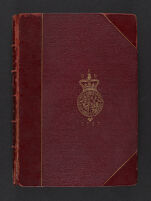
Binding: Post-1600. Red leather with gold tooling; arms of George II; gilt fore-edges; marbled endpapers.
- Custodial History:
-
Provenance:
This manuscript was probably compiled at the end of the 10th century: two leaves and several lines of part 1 (ff. 7, 59, 67) were lost and replaced by a 10th-century English hand and on the same parchment as the second part (ff. 2r-73v) (see Warner and Gilson, Catalogue of Western Manuscripts in the Old Royal and King’s Collections (1921), p. 146).
The Benedictine abbey of St Augustine, Canterbury, founded in 598: possibly in its library during the Anglo-Saxon period (see Dumville, 'English Libraries Before 1066' (1994), p. 207); in its library in the 13th century and perhaps used as a monastic schoolbook (see Rella, 'Continental manuscripts acquired for English centers' (1980), p. 112 ); inscribed in a 14th-century hand: 'Liber sancti Augustini Cantu[ariensis]' (f. 1r); a table of contents written by three different 14th- and 15th-centuries hands 'Juvencus cum A [...] et enigmata Aldelmi/ Scolica glosarum' (f. 1r); a 14th-century shelfmark D.xi.Gii (f. 1r); included in the late 15th-century library catalogue of the library of St Augustine's abbey, no. 1438 (see James, The Ancient Libraries of Canterbury and Dover (1903), no. 1438 and Barker-Benfield, St Augustine's Abbey, Canterbury (2008), no. BA I.1438).
Patrick Young (b. 1584, d. 1652), librarian and scholar: his notes in margin (ff. 59v-61v): one of his notes refers to another manuscript (Royal 12 C XXIII) collated with this one and owned by the earl of Arundel: ''Hunc librum / collatum esse ad ms / codicem co/mitis Arun/dell' (f. 59v).
? Thomas Howard, 14th earl of Arundel, 4th earl of Surrey, and 1st earl of Norfolk (b. 1585, d. 1646), art collector and politician: owned Royal 12 C XXIII collated with this manuscript (see Patrick Young's note above).
The Old Royal Library (the English Royal Library): seal of a ship (f. 1r) and Westminster inventory number 'no. 413' (f. 2); included in the inventory of books in the Upper Library at Westminster of 1542 (f. 30r) and in the 1698 catalogue of the library of St James’s Palace (see [Edward Bernard], Catalogi librorum manuscriptorum Angliae et Hiberniae (Oxford: Sheldonian, '1697', but 1698?), no. 8611.
Presented to the British Museum by George II in 1757 as part of the Old Royal Library.
- Information About Copies:
-
Full digital coverage available for this manuscript: see Digitised Manuscripts at http://www.bl.uk.manuscripts/.
Select digital coverage available for this manuscript: see Catalogue of Illuminated Manuscripts at http://www.bl.uk/catalogues/illuminatedmanuscripts/welcome.htm.
- Publications:
-
Walter De Gray Birch and Henry Jenner, Early Drawings and Illuminations: An Introduction to the Study of Ilustrated Manuscripts (London: Bagster, 1879), p. 3.
M. R. James, The Ancient Libraries of Canterbury and Dover (Cambridge: Cambridge University Press, 1903), p. 521, no.1438.
George F. Warner and Julius P. Gilson, Catalogue of Western Manuscripts in the Old Royal and King’s Collections, 4 vols (London: British Museum, 1921), II, p. 146.
R. Priebsch, The Heliand Manuscript: Cotton Caligula A VII in the British Museum (Oxford: Clarendon Press, 1925), p. 17.
Francis Wormald, English Drawings of the Tenth and Eleventh Centuries (London: Faber & Faber, 1952), pp. 44-45, 72, pl. 25a.
Neil R. Ker, Catalogue of Manuscripts containing Anglo-Saxon (Oxford: Clarendon Press, 1957), no. 267.
Medieval Libraries of Great Britain: A List of Surviving Books, ed. by Neil R. Ker, 2nd edn, Royal Historical Society Guides and Handbooks, 3 (London: Royal Historical Society, 1964), p. 45.
Mathias Thiel, 'Gurndlagen und Gestalt der Hebraischkenntnisse des fruhen Mittelalters', Studi Medievali, 10 (1969), 3-212 (p. 153).
J. H. Pitman, The Riddles of Aldhelm, Yale Studies in English, 67 (Hamden, Connecticut: Archon Books, 1970). [on the text of the Aenigmata].
Elzbieta Temple, Anglo-Saxon Manuscripts 900-1066, Survey of Manuscripts Illuminated in the British Isles, 2 (London: Miller, 1976), no. 85.
F. A. Rella, 'Continental manuscripts acquired for English centers in the tenth and early eleventh centuries, a preliminary checklist', Anglia, 98 (1980), 105-16 (p. 112).
David Dumville, 'English Libraries before 1066: Use and Abuse of the Manuscript Evidence', in Insular Latin Studies, ed. Michael W. Herren (Toronto: Pontifical Institute of Mediaeval Studies, 1981), pp. 153-78; reprinted in Anglo-Saxon Manuscripts: Basic Readings, ed. Mary P. Richards (New York: Garland, 1994), pp. 169-219 (p. 207).
Aldhelm, The Poetic Works, ed. by Michael Lapidge and James Rosier (Cambridge: Brewer, 1985), pp. 59-94 [notes and translation of the text of the Aenigmata].
Mary Catherine Bodden, 'Evidence for the knowledge of Greek in Anglo-Saxon England', Anglo-Saxon England, 17 (1988), 217-46 (pp. 219, 221n., 230n., 233).
Patrizia Lendinara, Anglo-Saxon Glosses and Glossaries (Ashgate: Variorum, 1999), pp. 149-53, 165n., 292.
The Libraries of King Henry VIII, ed. by J. P. Carley, Corpus of British Medieval Library Catalogues, 7 (London: The British Library, 2000), H2.731.
Helmut Gneuss, Handlist of Anglo-Saxon Manuscripts: A List of Manuscripts and Manuscript Fragments Written or Owned in England up to 1100, Medieval and Renaissance Texts and Studies, 241 (Tempe: Arizona Center for Medieval and Renaissance Studies, 2001), no. 489.
Richard Gameson, ‘L’Angleterre et la Flandre aux Xe et XIe siècles: le témoignage des manuscrits’, in Les Échanges culturels au Moyen Age, Série Histoire Ancienne et Médiévale, 70 (Paris: Sorbonne, 2002), pp. 165-206 (p. 183).
Andy Orchard, 'Enigma Variations: the Anglo-Saxon riddle-tradition', in Latin Learning and English Lore, I: Studies in Anglo-Saxon Literature for Michael Lapidge, ed. by. Katherine O'Brien O'Keeffe and Andy Orchard, Toronto Oldby English Series, 14 (Toronto: University of Toronto Press, 2005), 284-303.
Carin Ruff, 'The Place of Metrics in Anglo-Saxon Latin Education: Aldhelm and Bede', The Journal of English and Germanic Philology, 104.2 (2005), 149-70. [on the text].
St Augustine's Abbey, Canterbury, ed. by B. C. Barker-Benfield, Corpus of British Medieval Library Catalogues, 13, 3 vols (London: British Library, 2008), BA I.1438, pp. cii, n. 103, 406, 413, 938, 1378, 1710.
Mercedes Salvador-Bello, Isidorean Perceptions of Order: The Exeter Book Riddles and Medieval Latin Enigmata (Morgantown: West Virginia University Press, 2015), pp. 30, 32, 36, 55, 78, 173, 388, 420, 446, 449.
Richard Sharpe and James Willoughby, Medieval Libraries of Great Britain (Oxford: The Bodleian Libraries, 2015) «http://mlgb3.bodleian.ox.ac.uk/mlgb/book/1545/?search_term=Royal%2015%20A%20XVI&page_size=500» [accessed 4 August 2016]
- Exhibitions:
- Imagining the Divine: Art and the Rise of World Religions, Ashmolean Museum of Art and Archaeology, Oxford, 19 October 2017 - 18 February 2018
- Material Type:
- Archives and Manuscripts
- Legal Status:
- Not Public Record(s)
- Notes:
- This manuscript is part of The Polonsky Foundation England and France Project: Manuscripts from the British Library and the Bibliothèque nationale de France, 700-1200.