A fragment of a letter, incomplete, beginning missing. Extent and format of original material: Part of the fascicle comprised of 2 (1 + ¾) inscribed folios.
This collection is very valuable because it is composed of unique materials which do not exist in other archives or libraries and their preservation is of utmost importance for researchers in the field of humanities and social sciences. Most of publications are printed in the middle of the Great...
These publications are very valuable and rare. Most of them are printed in the middle of the war, on foreign territory, in hardly accessible machines, during the time when there was a shortage of printing paper, in low circulations (a part of the book circulation burnt in a fire in Thessaloniki)...
Considering the fact that in the pre-war Yugoslavia the legal system was not unitary (there were six different legal systems in one country), law books were printed in small numbers, only for a certain number of judges and lawyers. The founders of the Lazić Library were lawyers more than 600 yea...
Law on archives of the Ministry of Foreign Affairs and diplomatic and consular branch office of the Kingdom of Yugoslavia abroad as of April 5 1930 [1930]
Scope & Content:
Law on archives of the Ministry of Foreign Affairs and diplomatic and consular branch office of the Kingdom of Yugoslavia abroad as of April 5 1930. Book of regulations in the main archive of the Ministry of Foreign Affairs and unofficial publication in diplomatic and consular documents as of Ap...
Law on the organisation of the Ministry of Foreign Affairs and diplomatic and consular branch offices of the Kingdom of Yugoslavia abroad as of March 25 1930 [1930]
Scope & Content:
Law on the organisation of the Ministry of Foreign Affairs and diplomatic and consular branch offices of the Kingdom of Yugoslavia abroad as of March 25 1930. Author: Jugoslavija (1929-1941). Extent and format of original material: 32 p.
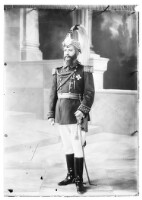
Dirgha Man Collection of photographs [Late 1800s-mid 1940s] Ganesh Man Chitrakar [mid 1940s- early 1950s]
Scope & Content:
These glass plate negatives were taken by Dirgha Man (1877-1951) and Ganesh Man Chitrakar (1916-1985). They are interesting in the context of Nepal’s history as they were Court Photographers. Furthermore, Nepal did not open up to outside visitors until the early-1950s. The photographs that Dirgh...
Life in the Courts: Portraits and Ceremonies: The Ranas ruled Nepal from 1846 when Jung Bahadur Rana captured power from the Shah Kings and started a 104 year rule as hereditary Prime Ministers. As Dirgha Man started working in the courts since the late 19th century, Rana Portraits and Ceremonie...