Hard-coded id of currently selected item: . JSON version of its record is available from Blacklight on e.g. ??
Metadata associated with selected item should appear here...
Arundel MS 230
- Record Id:
- 040-002039513
- Hierarchy Root Ancestor Record Id:
- 032-002039280
- MDARK:
- ark:/81055/vdc_100000000395.0x000316
- LARK:
- ark:/81055/vdc_100064371426.0x000001
- SLARK:
- Format:
- ISAD(G)
- Reference (shelfmark):
- Arundel MS 230
- Title:
-
Philippe de Thaon, Comput; De Singulis Mensibus; Psalter with gloss and prologue in Anglo-Norman; List of perilous days; Instructions for masses; List of plant names; Roman d'Alexandre (fragment)
- Scope & Content:
-
This composite manuscript contains four parts (ff. 1-6; ff. 7-161; ff. 162-180; ff. 181-194) that were produced in England during the 12th and 13th centuries. The manuscript contains the single surviving copy of an Anglo-Norman interlinear translation of the Gallican version of the Psalter. The Psalter (ff. 7-161) may have been produced at the Benedictine abbey of St Peter, St Paul and St Andrew in Peterborough, as is suggested by the saints in its Litany (ff. 157v-161r).
The Kalendar (ff. 2r-5v), however, appears to have been produced at the Benedictine abbey of St Mary the Virgin, St Bartholomew, and St Guthlac at Crowland, in Lincolnshire, and may have been added to the Psalter at a later point in time. The manuscript’s Anglo-Norman texts (ff. 1r, 6r, 6v, 181r-194v) may have come from Crowland as well. These include a copy of the Comput (Computus), the oldest extant scientific text in the vernacular, that Philippe de Thaon (fl. 1113-1150), the first Anglo-Norman poet, composed in 1113. However, it is unknown when and where exactly the four parts where joined together.
Contents:
f. 1r: Philippe de Thaon, Comput, imperfect.
f. 1v: Anonymous, De singulis Mensibus (On Each Month), also known as De Duodecim Mensibus (On the Twelve Months).
ff. 2r-6v: Calendar.
ff. 7r-146r: The Book of Psalms, with an interlinear translation in Anglo-Norman.
ff. 146r-157v: Canticles and hymns with interlinear translations in Anglo-Norman.
ff. 157v-161r: A Litany of Saints.
ff. 162r-180v: The Office of the Dead.
ff. 182r-194v: Philippe de Thaon, Comput.
The manuscript contains a number of additions:
f. 179r: A prayer for the soul of a deceased woman, 'Domine pro tua pietate miserere animae famulae tuae atque a contagiis mortalitatis exutam', added in the 13th century.
f. 6r: A list of perilous days (‘lunes’) followed by disasters (Anglo-Norman), added in the 2nd half of 13th century.
f. 6r: The Prologue to the Psalter in verse (Anglo-Norman), beginning ‘[C]es vers sunt de salu’, added in the 2nd half of the 13th century.
ff. 161r-161v, 157v, 174v: Latin prayers added in the 13th or 14th century.
f. 6v: An Anglo-Norman prose instruction for masses and pious acts for each day of the week, for when one is in prison, poverty or illness (‘Quy est en tristour prisone poverte out ciet en maladie face dire messes’), added in the mid 14th century.
f. 181r: A list of plants in Anglo-Norman, added in the mid 14th century.
f. 181v: A small fragment of the French romance, Voeux du Paon, added in the 14th century.
f. 180v: A request for prayers in Middle English for the souls of members from the Dygne family, added in the 15th century.
Decoration:
See the separate descriptions of Arundel MS 230, ff. 1-6, ff. 7-161, ff. 162-180, ff. 181-194.
- Collection Area:
- Western Manuscripts
- Project / Collection:
- Arundel Manuscripts
England and France 700-1200 Project - Hierarchy Record Ids:
- 032-002039280
040-002039513 - Is part of:
- Arundel MS 1-550 : Arundel Manuscripts
Arundel MS 230 : Philippe de Thaon, Comput; De Singulis Mensibus; Psalter with gloss and prologue in Anglo-Norman; List of perilous days;… - Contains:
- Arundel MS 230, ff 1-6 : Philippe de Thaon, Comput; De Singulis Mensibus; Calendar; Psalter in Anglo-Norman verse (Prologue); List of perilous days…
Arundel MS 230, ff 7-161 : The Book of Psalms, canticles and hymns with an interlinear translations in Anglo-Norman; Litany of Saints
Arundel MS 230, ff 162-180 : The Office of the Dead
Arundel MS 230, ff. 181-195 : Contents:ff. 182r-194v: Philippe de Thaon, Comput (Dean, Anglo-Norman Literature (1999), pp. 190-91 [no. 346]).…
Arundel MS 230, ff 181-194 : List of plant names (in Anglo-Norman); Romance de Alexandre (fragment); Philippe de Thaon, Comput
Click here to View / search full list of parts of Arundel MS 230 - Hierarchy:
- 032-002039280[0231]/040-002039513
- Container:
- View / search within Archive / Collection: Arundel MS 1-550
- Record Type (Level):
- File
- Extent:
-
1 volume
- Digitised Content:
- https://iiif.bl.uk/uv/#?manifest=https://bl.digirati.io/iiif/ark:/81055/vdc_100064371426.0x000001 (opens in a new tab)
- Thumbnail:
-
- Languages:
- Anglo-Norman
Latin - Scripts:
- Latin
- Start Date:
- 1150
- End Date:
- 1274
- Date Range:
- 2nd half 12th century-3rd quarter 13th century
- Era:
- CE
- Access:
- User Conditions:
- Letter of introduction required to view this manuscript.
Please request the physical items you need using the online collection item request form.
Digitised items can be viewed online by clicking the thumbnail image or digitised content link.
Readers who have registered or renewed their pass since 21 March 2024 can request physical items prior to visiting the Library by completing
this request form.
Please enter the Reference (shelfmark) above on the request form.If your Reader Pass was issued before this date, you will need to visit the Library in London or Yorkshire to renew it before you can request items online. All manuscripts and archives must be consulted at the Library in London.
This catalogue record may describe a collection of items which cannot all be requested together. Please use the hierarchy viewer to navigate to individual items. Some items may be in use or restricted for other reasons. If you would like to check the availability, contact our Reference Services team, quoting the Reference (shelfmark) above.
- Physical Characteristics:
-
Materials: Parchment.
Dimensions: 260 x 175 mm (text space: 200 x 150 mm [ff. 2r-5v]; 195 x 120 mm [ff. 7r-161r]; 185 x 115 mm [ff. 162r-180v]; 255 x 170 mm, in 2 columns [f. 181v]; 210 x 120 [ff. 1r, 6r, 6v, 182v-194v]).
Foliation: ff. 194 ( + 2 unfoliated modern paper flyleaves at the beginning + 2 at the end); 1 unfoliated parchment stub between f. 183 and f. 184; f. 184 and f. 185; f. 191 and f. 192; 2 between f. 149 and f. 150; and f. 185 and f. 186.
Script: Protogothic; Gothic, written below top line (ff. 162r-180v).
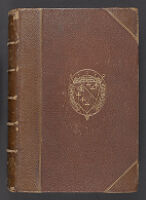
Binding: British Museum/British Library in-house, re-bound in 1972: Gold-tooled brown half leather binding, Howard’s bookplate gold-stamped on the upper and lower covers, the spine inscribed in gold at the British Museum: ‘PSALTERIUM CUM VERSIONE GALLICA.’; marbled endpapers.
- Custodial History:
-
Provenance:
?The Benedictine abbey of St Mary the Virgin, St Bartholomew, and St Guthlac at Crowland, Lincolnshire, founded in the 8th century: possibly added the Calendar, which includes feasts for Benedictine saints and the abbey's patron saints (see the description of Arundel MS 230, ff. 1-5), when it acquired the manuscript in the ?12th century (Ker, Medieval Libraries (1964), p. 54).
An unknown church in East England, owned in the ?14th century: an ?ownership inscription of a church (‘Ecclesie de [...]’) in the lower margin of f. 3r is mostly torn away; contemporary obits that are added to the Calendar, some in the hand of the ownership inscription, refer to various persons with surnames referring to places in East England: e.g. Wortham, Suffolk (f. 2r: ‘Wrtham’); Hanningfield Green, Suffolk (f. 4r: ‘Willelmi de Hanigffeld’; ‘Johannae de Hanigfeld’ with the year 1300); Ely, Cambridgeshire (f. 5v: ‘Nicolai de Ely’). The ‘Dominae Egidiae de Horkessleye’ whose obit is recorded on f. 3v may be identifiable with the 'Egidia de Horkesle' who is listed as a representative for the hundred of Wiston, Suffolk, in the year 1316 (see Inquisitions and Assessments Relating to Feudal Aids; With Other Analogous Documents Preserved in the Public Record Office A. D. 1284-1431 (London: Mackie, 1899-1921), V (1908): Stafford-Worcester, p. 43). The entry on February 3 has an obit for Hawise Quincy (b. 1194, d. 1263), wife of Hugh de Vere (b. 1210, d. 1263), 4th Earl of Oxford (f. 2v: ‘Hawiss[ae] comit[issae] de Oxenef[ord]’). The latter was buried at the Benedictine priory of Earls Colne, Essex.
An unknown member of the ‘Dygne’ family, owned in the 15th century: added a request for prayers for the souls of family members and perhaps that of her- or himself as well on f. 180v: ‘Of yowr charyte pray ffor the Sowlys of Wylliam, John, Rechard and Elizabeth Dygne with all there frendes Sowlys In specyall with all Chrysten Sowlys In generall that god wyll have prayd ffor’.
An unknown 15th- or 16th-century English owner: added an ownership inscription in the lower margin of f. 22r: ‘[…] owath this booke by these soynge that hee is a (?) cause […]’.
‘William Conwell’, owned in the 15th or 16th century: his ownership inscription on f. 124r (‘S[i]g[n]yt yt Wyll[ia]m Konwyll’) in a 15th-or 16th-century script.
?Thomas Howard (b. 1585, d. 1646), 2nd earl of Arundel, 4th earl of Surrey, and 1st earl of Norfolk, art collector and politician.
Henry Howard (b. 1628, d. 1684), 6th duke of Norfolk, presented to the Royal Society in 1667.
The Royal Society, London: its ink stamp: 'Soc. Reg. Lond / ex dono HENR. HOWARD / Norfolciensis.', f. 7r.
Purchased by the British Museum from the Royal Society of London together with 549 other Arundel manuscripts in 1831.
- Information About Copies:
-
Full digital coverage available for this manuscript: see Digitised Manuscripts, https://bl.uk/manuscripts/.
Select digital coverage available for this manuscript; see the Catalogue of Illuminated Manuscripts, https://bl.uk/catalogues/illuminatedmanuscripts/.
- Publications:
-
Catalogue of Manuscripts in The British Museum, New Series, 1, 1 vol. in 2 parts (London: British Museum, 1834-1840), Part I (1834): The Arundel Manuscripts, p. 69.
Thomas Wright, Popular Treatises on Science written during the Middle Ages, in Anglo-Saxon, Anglo-Norman, and English (London: The Historical Society of Science, 1841), p. xi.
Paul Meyer, 'Bribes de litterature anglo-normande', Jahrbuch für romanische und englische Literatur, 7 (1866), 37-57 (p. 39).
Li Cumpoz Philipe de Thaün: Der Computus des Philipp von Thaun mit einer Einleitung über die Sprache des Autors, ed. by Eduard Mall (Strasbourg: Trübner, 1873), p. 3.
Harry Leigh Douglas Ward and John Alexander Herbert, Catalogue of Romances in the Department of Manuscripts in the British Museum, 3 vols (London: British Museum, 1883-1910), I (1883), pp. 155-56.
Samuel Berger, La bible française au moyen âge (Paris: Champion, 1884), pp. 46-47, 404-05.
John Romilly Allen, Norman Sculpture and the Mediaeval Bestiaries: From the Rhind Lectures in Archaeology for 1885, Early Christian symbolism in Great Britain and Ireland before the Thirteenth Century, 3 (London: Whiting, 1887), p. 339.
A. Beyer, ‘Die Londoner Psalterhandschrift Arundel 230’, Zeitschrift für romanische Philologie, 11 (1887), 513-34; 12 (1888), 1-56.
English Benedictine Kalendars after A. D. 1100, ed. by Francis Wormald, 2 vols, Henry Bradshaw Society, 77, 81 (London: Harrison, 1934-1939), I, pp. 113-16.
Mary Dominica Legge, Anglo-Norman in the Cloisters: The Influence of the Orders upon Anglo-Norman Literature, Edinburgh University Publications Language and Literature, 2 (Edinburgh: University Press, 1950), p. 115.
Neil Ripley Ker, Medieval Libraries of Great Britain: A List of Surviving Books, Royal Historical Society Guides and Handbooks, 3 (London: Royal Historical Society, 1941), pp. 35 [Crowland].
The Monastic Breviary of Hyde Abbey, Winchester: MSS. Rawlinson Liturg. e. 1*, and Gough Liturg. 8, in the Bodleian Library, Oxford, ed. by J. B. L. Tolhurst, Henry Bradshaw Society, 65-80, 6 vols (London: Henry Bradshaw Society, 1932-1942), VI (1962), p. 239.
Anne-Marie Bouly de Lesdain, 'Les manuscrits didactiques antérieurs au XIVe siècle: Essai d'inventaire', Bulletin d'information de l'Institut de Recherche et d'Histoire des Textes, 14 (1966), 43-82 (pp. 58-59).
Medieval Libraries of Great Britain: A List of Surviving Books, ed. by Neil Ripley Ker, 2nd edn, Royal Historical Society Guides and Handbooks, 3 (London: The Royal Historical Society, 1964), p. 56 [Crowland].
The Cambridge History of the Bible, 3 vols (Cambridge: Cambridge University Press, 1963-1970), II (1969): The West from the Fathers to the Reformation, ed. by G. W. H. Lampe, p. 530.
Lucy Freeman Sandler, The Peterborough Psalter in Brussels and other Fenland Manuscripts (London: Miller, 1974), p. 154.
Dorothy A. Sneddon, 'The Anglo-Norman Psalters: 1. A Note on the Relationship between the Oxford and Arundel Psalters', Romania, 99 (1978), 395-99.
David H. Turner, The Benedictines in Britain, British Library Series, 3 (London: British Library, 1980), pp. 44, 105 (no. 23) [exhibition catalogue].
Philippe de Thaon: Comput (MS BL Cotton Nero A.V), ed. by Ian Short, Anglo-Norman Text Society: Plain Texts Series, 2 (London: Anglo-Norman Text Society, 1984), passim.
Geneviève Hasenohr, ‘Bibles et psautiers’, in Mise en page et mise en texte du livre manuscrit, ed. by Henri-Jean Martin and Jean Vezin (n. pl.: Cercle de la Librairie-Promodis, 1990), pp. 317-38 (p. 320).
Geneviève Hasenohr, 'Le rythme et la versification', in Mise en page et mise en texte du livre manuscrit, ed. by Henri-Jean Martin and Jean Vezin (n. pl.: Cercle de la Librairie-Promodis, 1990), pp. 235-38 (pp. 235-36).
Peter S. Baker, 'Textual Boundaries in Anglo-Saxon Works on Time (and in Some Old English Poems)', in 'Doubt Wisely': Papers in Honour of E. G. Stanley, ed. by M. J. Toswell and E. M. Tyler (New York: Routledge, 1996), pp. 445-56.
Ruth J. Dean and Maureen B. M. Boulton, Anglo-Norman Literature: A Guide to Texts and Manuscripts, Anglo-Norman Text Society: Occasional Publication Series, 3 (London: Anglo Norman Text Society, 1999), pp. 173, 191, 205, 242, 244, 248, 476 (nos 314, 346, 379, 446, 449, 457, 948).
Ian Short, 'The Texts: Introduction’, in The Trinity Apocalypse (Trinity College Cambridge, MS R.16.2), ed. by David McKitterick (London: British Library, 2005), pp. 123-36 (p. 125).
Richard Pfaff, The Liturgy in Medieval England: A History (Cambridge: Cambridge University Press, 2009), p. 360 n. 27.
Thomas O’Donnell, ‘The Gloss to Philippe de Thaon’s Comput and the French of England’s Beginnings’, in The French of Medieval England: Essays in Honour of Jocelyn Wogan-Browne, ed. by Thelma Fenster, and Carolyn Pl. Collette (Cambridge: Brewer, 2017), pp. 13-37 (p. 13 n. 3).
Cinzia Pignatelli and Alexei Lavrentiev, 'Le Psautier d'Arundel: une nouvelle édition’, in Actes du XXVIIe Congrès international de linguistique et de philologie romanes (Nancy, 15-20 juillet 2013), Section 13: Philologie textuelle et éditoriale, ed. by Richard Trachsler, Frédéric Duval, and Lino Leonardi (Nancy: ATILF/SLR, 2017), pp. 201-208.
Ian Short, 'Vernacular Manuscripts I: Britain and France', in The European Book in the Twelfth Century, ed. by Erik Kwakkel and Rodney Thomson (Cambridge: Cambridge University Press, 2018), pp. 311-326 (pp. 319-20).
Margarita Egan, Medieval French Lunaries: https://lunarybooks.com/ [Accessed 28/07/2023]
- Material Type:
- Archives and Manuscripts
- Legal Status:
- Not Public Record(s)
- Notes:
- This manuscript is part of The Polonsky Foundation England and France Project: Manuscripts from the British Library and the Bibliothèque nationale de France, 700-1200.