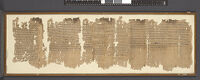
Seven fragments that do not belong together, housed in the same glass frame.
A: Top right corner of a medium-brown papyrus, another fragment of which is Papyrus 2384(A); written on both sides. On the front, there are the ends of 6 lines written along the fibres, with right and upper margin; on the back, there are the ends of 4 lines written across the fibres, the other way up in relation to the text on the front.
B: Medium-brown papyrus fragment, broken off on all sides; bearing writing on one side; the back is blank. On the front, there are portions of 10 lines written along the fibres, lacking beginnings and ends.
C: Medium-brown papyrus fragment, broken off on all sides and badly shredded on the right; with writing on both sides: on one side, there are traces of two lines written along the fibres; on the other side, the beginnings of 4 lines running across the fibres remain; folding lines are still visible.
D: Medium-brown papyrus fragment, complete on the left and broken off on all other sides; with writing on the front, the back is blank; there remain the beginnings of 8 lines written along the fibres. A sheet-join runs vertically at c. 22 mm from the left edge; the left margin is wide and measures 65 mm.
E: Medium-brown papyrus fragment, badly shredded, with writing on both sides; on the front, there are traces of 8 or 9 lines written along the fibres, with upper and lower margins; on the back, there is a word lacking the end, written across the fibres. Folding lines are still visible.
F: Medium-brown papyrus fragment, badly shredded, with writing on both sides. Each side bears portions of one column, running across and along the fibres.
G: Medium-brown papyrus fragment, badly shredded, possibly complete at the top and right; written on one side, the back being blank. On the front, there are portions of 3 lines running along the fibres.